Your analytics dashboard is lying to you – and you built it that way
We analyzed ~775,000 AI responses across 25 brands, 8 markets, and 8 AI models over 30 days. What we found should keep every CMO awake at night.

We analyzed ~775,000 AI responses across 25 brands, 8 markets, and 8 AI models over 30 days. What we found should keep every CMO awake at night.
The threat isn't that AI is new. It is that the gap between your analytics dashboard and your actual brand visibility in AI is vast, structural, and widening - and most marketing organizations are completely blind to it.
Historically, clicks were never a true measure of brand value. They measured friction; how often a user had to leave Google to find an answer. AI removes that friction. When a user asks an LLM which bank to choose, which software to buy, or which brand to trust, they receive a confident, specific answer.
Your brand is either in that answer, or it is not. And either way, your Google Analytics records absolutely nothing.
The dashboard isn't malfunctioning. It was simply built for a world that is quietly being replaced.
What ~775,000 AI responses told us:
Mentions vs. recommendations: The AI sentiment blindspot A brand mention and a positive recommendation are fundamentally different. Across our dataset, the gap between raw AI visibility and positive sentiment spans from 19% to 95%. This creates a massive blindspot: most brands have no idea whether AI is framing them as a leader or a cautionary tale.
No long tail: Challenger brands disappear in AI AI search is a winner-take-all arena. It heavily favors category leaders, effectively erasing the "long tail" keywords that challenger brands rely on to compete. Without this traditional SEO safety net, the reality is stark: if you are not the top authority, you do not exist in AI answers.
The legacy SEO trap: Winning search, losing AI Exceptional organic search performance no longer guarantees AI visibility. In fact, one in five high-performing brands completely lags in AI discovery. The companies most at risk are those operating on a false sense of security - having built the perfect dashboards for yesterday’s channel.
Methodology and data source
We used the 3RD platform to analyze structured metadata from ~775,000 AI responses across 25 brands during April and May 2026. The dataset spans 12 industries and 8 markets, with a deliberate skew toward Scandinavian countries and digitally sophisticated brands. The analysis covered eight leading AI models: ChatGPT, Gemini, Perplexity, Claude, Mistral, DeepSeek, Grok, and Llama.
For every AI response, the platform tracks three critical metrics:
Presence: Whether the brand was mentioned.
Sentiment: Whether the tone was positive, neutral, or negative.
Actionability: Whether the response included an outbound link.
A note on the sample: The 25 analyzed brands are not a random sample; they are organizations already actively monitoring their AI visibility. Because these companies are more digitally advanced than the market average, these findings are directionally robust rather than statistically generalizable. Given that these 25 brands represent the 'digital vanguard,' it is highly probable that the visibility gaps and sentiment risks identified here are even more pronounced for the broader, less prepared market.
Finding 1: The sentiment gap
Across our dataset, the gap between a brand being mentioned and being positively framed in an AI answer runs from 19% to 95%. While both metrics show up identically as "visibility" on a standard monitoring dashboard, they represent completely different commercial realities.
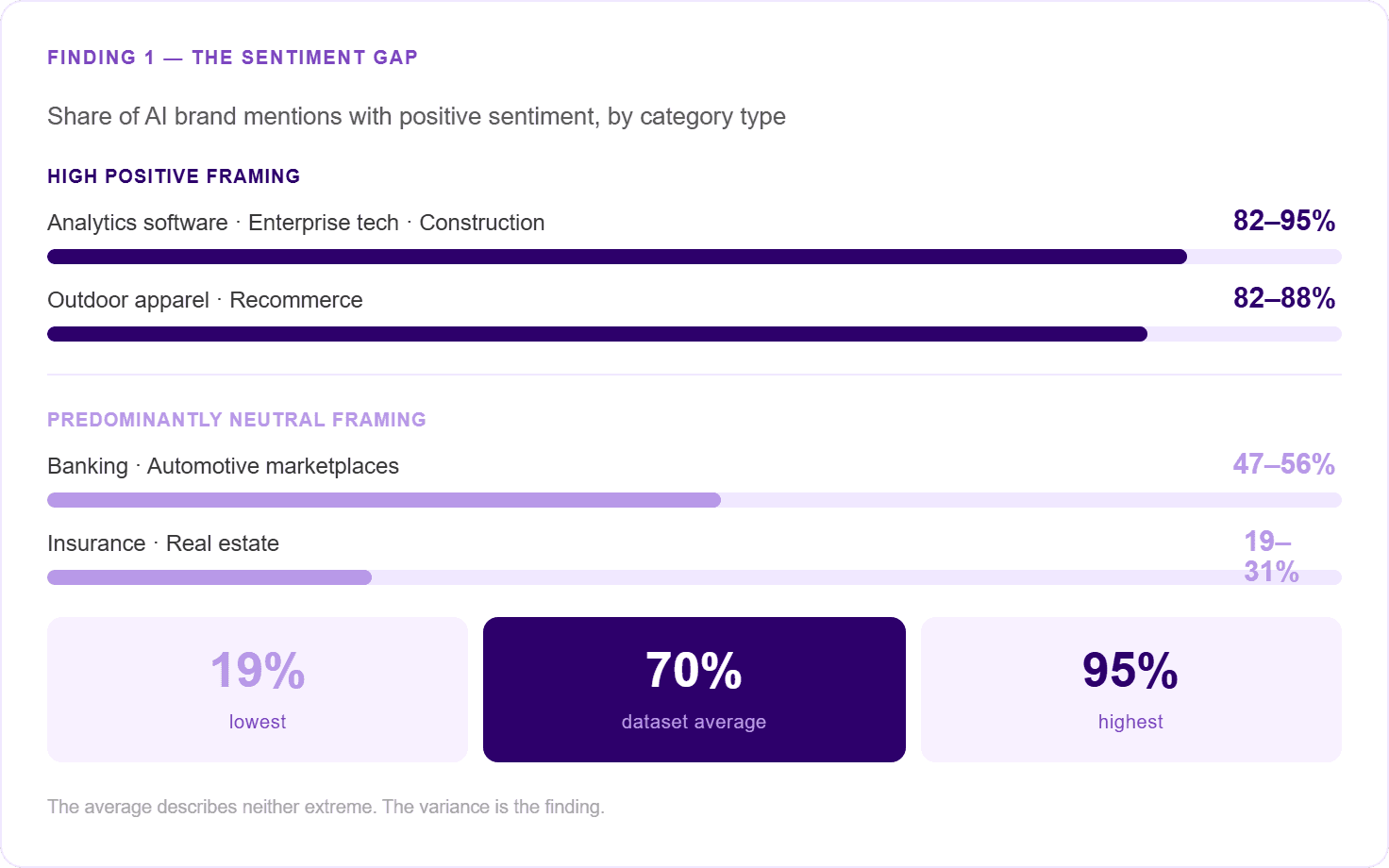
The average positive sentiment rate sits at approximately 70% - but this average conceals the real story. The variance is the finding:
The High End (82-95%): Brands in analytics software, enterprise tech, construction materials, outdoor apparel, and recommerce achieved near-total positive framing. When AI mentions these brands, it contextualizes them favorably, validating them as premium or preferred options.
The Low End (19-56%): Brands in banking, automotive marketplaces, insurance, and real estate appear regularly, but primarily within neutral mentions. AI acknowledges their existence without adding any positive brand equity. In these categories, a neutral mention is often a commercial dead end. When AI lists a brand without positive sentiment, it is merely acknowledging a market participant rather than endorsing a solution, effectively relegating the brand to commodity status.
The root cause: Categorical authority vs. commoditization
The brands dominating positive sentiment share one trait: they stand for a specific, clear proposition that AI models consistently associate with quality or leadership. When a brand occupies this space, nearly every mention is a positive endorsement.
Conversely, low-sentiment brands operate in commoditized categories where competitors are perceived as interchangeable. A bank is a bank; an insurance company is an insurance company. AI mentions them all, but treats them neutrally.
In these categories, a neutral mention is often a commercial dead end. When AI lists a brand without positive sentiment, it is merely acknowledging a market participant rather than endorsing a solution, effectively relegating the brand to a commodity status.
High visibility is a false metric
The starkest pattern in the data disproves volume as a success metric: a brand with low AI visibility (appearing in fewer than 25% of responses) can achieve a positive sentiment rate above 85%. Meanwhile, a brand with three times that visibility can net a positive sentiment rate below 50%.
We call this the Sentiment Gap - the distance between how visible a brand is and how often that visibility is framed positively. For some, the gap is negligible. For others, it represents a massive amount of AI presence generating brand awareness completely stripped of positive alignment.
Finding 2: The two-class AI system
AI-driven search concentrates its visibility on a select few brands, largely ignoring the rest. In every category analyzed, a structural divide has emerged, splitting markets into two distinct classes - and most brands have no idea which side they are on.
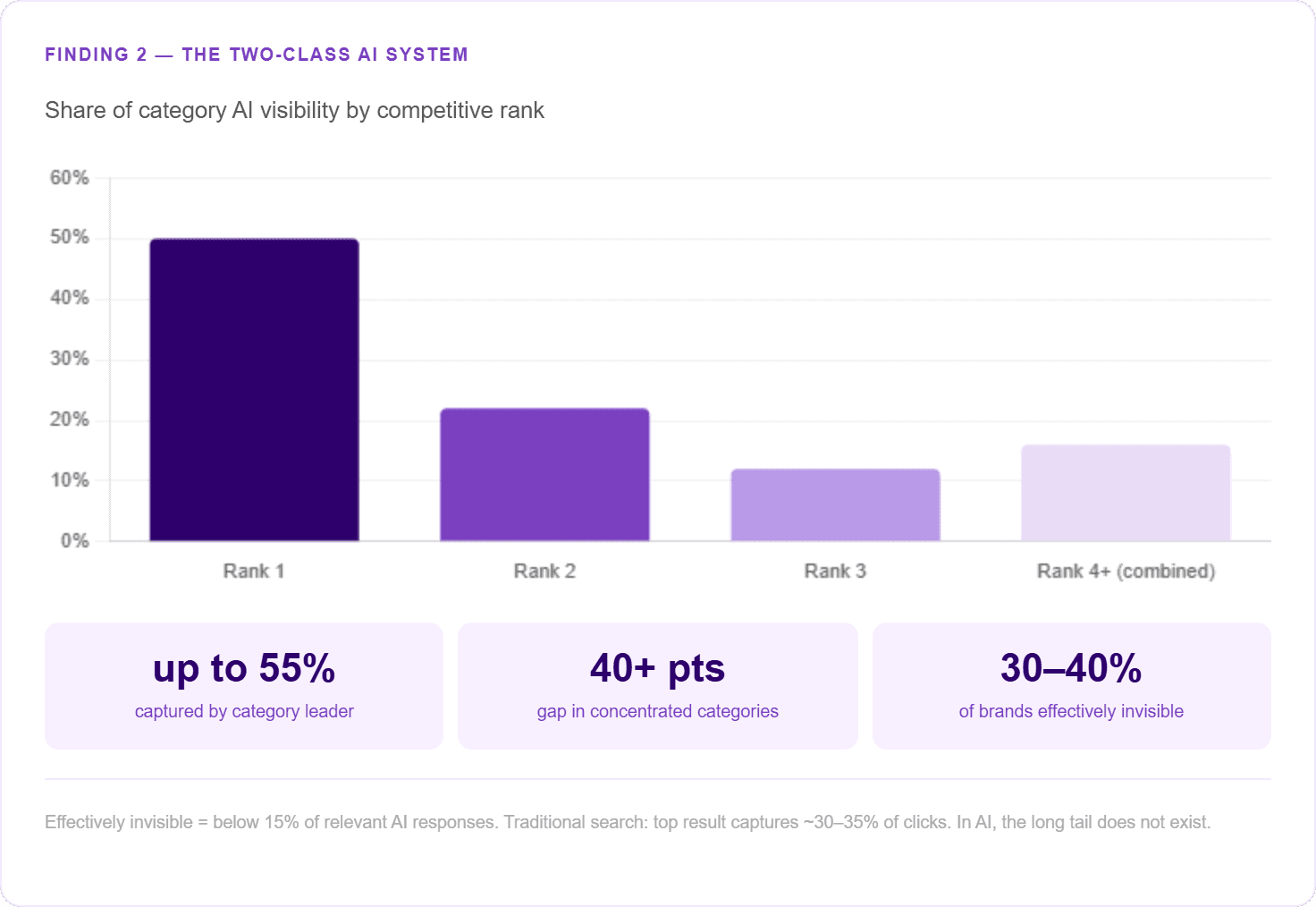
The visibility gap between market leaders and challengers varies heavily by category. In fragmented markets like insurance, the gap is just 1-2 percentage points. However, in highly concentrated categories, a single leader can capture up to 55% of all AI mentions, outpolling the nearest competitor by more than 40 points.
The trend is clear: leaders hold a permanent structural advantage, and that gap widens as a category matures.
The death of the long tail
In traditional search, the top result captures roughly 30% of clicks, but positions six through ten still harvest traffic. The long tail exists. In AI, the 'long tail' - the secondary visibility that sustains challenger brands - is effectively erased. While Google allows for niche discovery, AI search is a winner-take-all arena that concentrates presence at the absolute top.
Across our dataset, 30% to 40% of established competitor brands are effectively invisible - appearing in fewer than 15% of relevant AI responses. These are not weak brands; they are major market participants with substantial budgets and strong organic SEO presence. Yet, in AI-generated answers, they simply do not exist.
The threshold effect: Answers vs. footnotes
Our data reveals a distinct threshold effect based on visibility and tone:
Below 15-20% visibility: Brands are almost never framed positively. They are merely listed neutrally as basic market participants.
Above 60% visibility: Brands cross a threshold where AI consistently frames them with positive sentiment.
This creates a two-class system: brands that are the answer, and brands that are merely a footnote.
The model dilemma: Averages hide the strategy
Compounding this challenge is model divergence. ChatGPT, Gemini, Perplexity, and Claude often hold fundamentally different data-driven opinions on who wins a category.
A single, blended AI visibility score averages multiple conflicting competitive realities into a metric that accurately describes none of them. If you are reporting a single, aggregated AI visibility number to your leadership team, you are hiding your most critical strategic risks inside an average.
Finding 3: The legacy SEO trap
This was our most unexpected finding: approximately one in five brands in our dataset combines a strong organic search presence with an AI visibility score below 40. The threat to these high-performing brands isn't their SEO success, but the false sense of security it provides. Because their legacy dashboards continue to show growth in a declining channel, they remain blind to their lack of structural authority in the AI ecosystem.
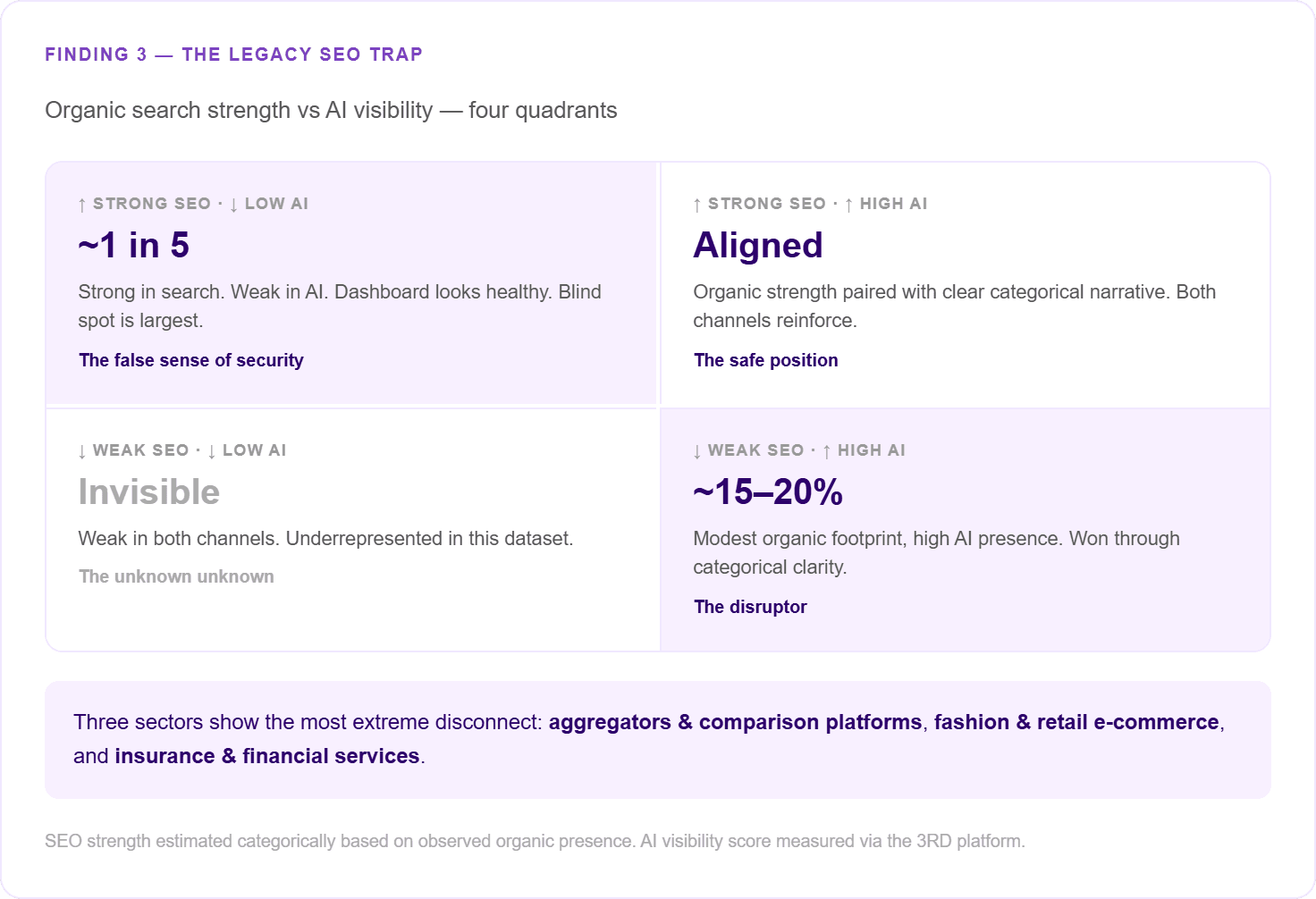
These companies built their digital presence on traditional SEO pillars: content volume, backlink authority, keyword coverage, and technical site health. In the age of AI, those foundations provide a floor - but not a ceiling.
Search rewards volume and technical execution. AI rewards narrative clarity, categorical dominance, and a concentration of positive sentiment across its training sources. The two channels are simply not as aligned as most marketing teams assume.
Extreme disconnects across three industries
The mismatch between search performance and AI presence is particularly severe in three sectors:
Aggregators and comparison platforms: Built to act as intermediaries between users and answers, these platforms are being bypassed. AI eliminates the intermediary by answering the query directly. These brands aren't failing due to poor execution; the channel simply no longer requires their core utility.
Fashion and retail e-commerce: While these brands drive massive organic traffic via product listing pages and editorial content, AI models largely look past this infrastructure when forming responses. High search rankings are no longer translating into categorical authority within AI ecosystems.
Insurance and financial services: Despite heavy traditional investments in educational content and comparison tools, all major brands in these sectors cluster at similarly low AI visibility scores. No single player has successfully converted its legacy organic investment into AI differentiation; models treat them as entirely interchangeable.
The strategic implication
The systems you use to measure marketing success are optimized for a channel facing structural decline, leaving you blind to the very channel that is replacing it.
The next frontier: Accuracy at scale
Every finding in this analysis points toward the same uncomfortable question: Your brand is in the AI answer, but is the answer right?
AI models frequently hallucinate or confidently present outdated facts: incorrect pricing, discontinued products framed as current, features attributed to the wrong model, or market claims that haven't been true for eighteen months. These inaccuracies are stated with absolute authority, at scale - often leaving users with few or no outbound links to verify the claims.
While visibility and sentiment can be tracked mathematically, measuring accuracy requires a completely different technical approach. It demands reading the full text of AI responses, identifying specific factual claims, and cross-referencing them against verified ground truth.
At the volume AI operates, manual auditing is impossible. It requires purpose-built infrastructure.
The volatility liability
The brands most exposed to this risk are not necessarily those with low visibility. The highest risk sits with companies in high-volatility categories where product specifications, compliance rules, and pricing change faster than AI training and browsing cycles:
Financial services
Consumer electronics
Travel and tourism
In these sectors, a confident, unlinked, and outdated AI response is no longer just a marketing failure - it is a compliance and legal liability.
The solution: Automated fact-checking
We are building the infrastructure to solve this. Automated fact-checking at AI scale - systematically auditing the literal claims AI models make about your brand and flagging inaccuracies before they compound - is launching on the 3RD platform soon.
Three metrics to modernize your measurement
Your legacy analytics infrastructure isn't broken; it is simply measuring the right things for a world that is fading.
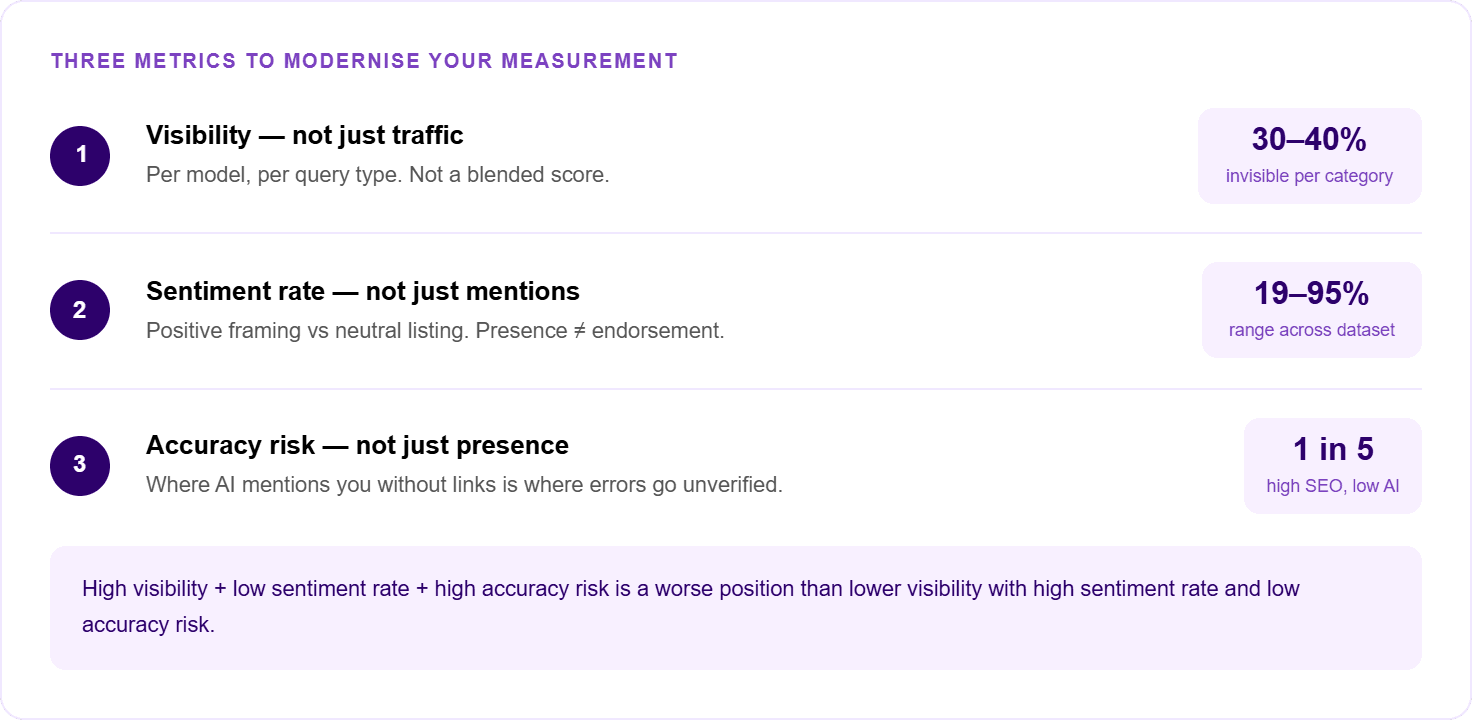
The following three metrics are not replacements, but necessary expansions to bring transparency to your current reporting.
Measure visibility - not just trafficAre you part of the AI conversation, and on which queries? Avoid blended visibility scores. Instead, demand a model-level breakdown across specific query types: recommendations, comparisons, and exploratory searches. For a single-market brand, the minimum viable dataset is 40 to 60 non-branded prompts run consistently over 30 days.
Measure sentiment rate - not just mentions"Brand X is one of several options" and "Brand X is the preferred solution" represent entirely different commercial outcomes. Track the ratio of positive to neutral sentiment across your AI mentions. A brand with high visibility but predominantly neutral sentiment is present in the conversation, but not winning it. The 19% to 95% variance in our dataset proves how much commercial reality is hidden inside a single visibility score.
Measure accuracy risk - not just presenceMonitor your mention and link rates by model and query type. Where your brand is mentioned with positive sentiment but without outbound links is where your accuracy exposure is highest. To mitigate this, optimize your schema markup: structured data gives AI models precise, unambiguous data, reducing the surface area for confident errors. Monitoring accuracy is not just about avoiding errors; it is about verifying that the AI’s 'ground truth' aligns with your official brand data. This is the only way to transform a potential liability into a verified recommendation.
The compound reality
These metrics must be evaluated together. High visibility paired with a low positive sentiment rate and high accuracy risk is a far worse strategic position than lower visibility with a high sentiment rate and low accuracy risk. The combination tells the story that no individual metric can.
The closing argument
The legacy analytics dashboard is not lying through malfunction. It is lying by design.
It was engineered to track the evidence of influence in a world where interaction left clear digital footprints: sessions, clicks, pageviews, and conversions. That world is not entirely gone, but influence increasingly flows through AI-generated environments that shape purchase intent, contextualize your brand, and redirect user journeys - all while leaving zero trace in your current analytics stack.
Paradoxically, the brands most exposed are not those with the lowest AI visibility. The highest risk belongs to the market leaders with the strongest organic search performance. These are the companies that built their entire measurement infrastructure around the exact channel AI is quietly displacing.
Because their legacy dashboards look healthier than ever, their blind spot is the largest.
The reality of modern marketing is now binary: Your brand is either in the AI answer, or it is not. And you cannot fix a blind spot you refuse to measure.
3RD is an AI visibility intelligence platform. We help brands understand how they are represented across AI models, identify where their AI presence diverges from their intended positioning, and measure the metrics that matter in an AI-first search landscape.