Votre tableau de bord analytique vous ment – et c'est vous qui l'avez conçu ainsi
Nous avons analysé environ 775 000 réponses d'IA pour 25 marques, 8 marchés et 8 modèles d'IA sur une période de 30 jours. Ce que nous avons découvert devrait empêcher d'autres directeurs marketing de dormir la nuit.

Nous avons analysé environ 775 000 réponses d'IA pour 25 marques, 8 marchés et 8 modèles d'IA sur une période de 30 jours. Les résultats que nous avons obtenus devraient empêcher tout directeur marketing de dormir.
La menace ne réside pas dans le fait que l'IA soit nouvelle. Elle tient au fait que l'écart entre votre tableau de bord analytique et votre visibilité réelle de marque dans l'IA est immense, structurel et ne cesse de s'accroître, et que la plupart des organisations marketing y sont totalement aveugles.
Historiquement, les clics n'ont jamais été une véritable mesure de la valeur de la marque. Ils mesuraient les frictions ; la fréquence à laquelle un utilisateur devait quitter Google pour trouver une réponse. L'IA élimine ces frictions. Lorsqu'un utilisateur demande à un LLM quelle banque choisir, quel logiciel acheter ou à quelle marque faire confiance, il reçoit une réponse confiante et précise.
Votre marque se trouve soit dans cette réponse, soit elle n'y est pas. Et dans les deux cas, votre outil Google Analytics n'enregistre absolument rien.
Le tableau de bord ne fonctionne pas mal. Il a simplement été conçu pour un monde qui est discrètement en train d'être remplacé.
Ce que nous ont appris environ 775 000 réponses d'IA :
Mentions vs recommandations : l'angle mort du sentiment d'IA Une mention de marque et une recommandation positive sont fondamentalement différentes. Sur l'ensemble de nos données, l'écart entre la visibilité brute de l'IA et le sentiment positif varie de 19 % à 95 %. Cela crée un angle mort massif : la plupart des marques n'ont aucune idée de savoir si l'IA les présente comme un leader ou comme un cas d'école à éviter.
Pas de longue traîne : les marques challengers disparaissent dans l'IA La recherche par IA est une arène où le vainqueur rafle tout. Elle favorise massivement les leaders de catégorie, effaçant de fait les mots-clés de la « longue traîne » sur lesquels s'appuient les marques challengers pour rivaliser. Sans ce filet de sécurité SEO traditionnel, la réalité est brutale : si vous n'êtes pas l'autorité suprême, vous n'existez pas dans les réponses de l'IA.
Le piège du SEO traditionnel : gagner sur la recherche, perdre sur l'IA Des performances exceptionnelles en recherche organique ne garantissent plus la visibilité sur l'IA. En fait, une marque performante sur cinq est totalement à la traîne en matière de découverte par l'IA. Les entreprises les plus menacées sont celles qui se reposent sur un faux sentiment de sécurité, après avoir construit les tableaux de bord parfaits pour les canaux d'hier.
Méthodologie et source des données
Nous avons utilisé la plateforme 3RD pour analyser les métadonnées structurées de quelque 775 000 réponses d'IA portant sur 25 marques au cours des mois d'avril et de mai 2026. L'ensemble de données couvre 12 secteurs d'activité et 8 marchés, avec un biais délibéré en faveur des pays scandinaves et des marques numériquement sophistiquées. L'analyse a porté sur huit modèles d'IA de premier plan : ChatGPT, Gemini, Perplexity, Claude, Mistral, DeepSeek, Grok et Llama.
Pour chaque réponse de l'IA, la plateforme suit trois indicateurs clés :
Présence : si la marque a été mentionnée.
Sentiment : si le ton était positif, neutre ou négatif.
Actionnabilité : si la réponse comprenait un lien sortant.
Remarque concernant l'échantillon : Les 25 marques analysées ne constituent pas un échantillon aléatoire ; il s'agit d'organisations qui surveillent déjà activement leur visibilité sur l'IA. Ces entreprises étant plus avancées sur le plan numérique que la moyenne du marché, ces résultats sont structurellement robustes plutôt que statistiquement généralisables. Étant donné que ces 25 marques représentent la « vanguard numérique », pour le reste du marché, moins préparé, il est hautement probable que les écarts de visibilité et les risques de réputation identifiés ici soient encore plus prononcés.
Résultat 1 : L'écart de sentiment
Sur l'ensemble de notre jeu de données, l'écart entre le fait qu'une marque soit mentionnée et le fait qu'elle soit présentée de manière positive dans une réponse d'IA va de 19 % à 95 %. Bien que ces deux indicateurs apparaissent de manière identique sous l'étiquette « visibilité » sur un tableau de bord de suivi standard, ils représentent des réalités commerciales totalement différentes.
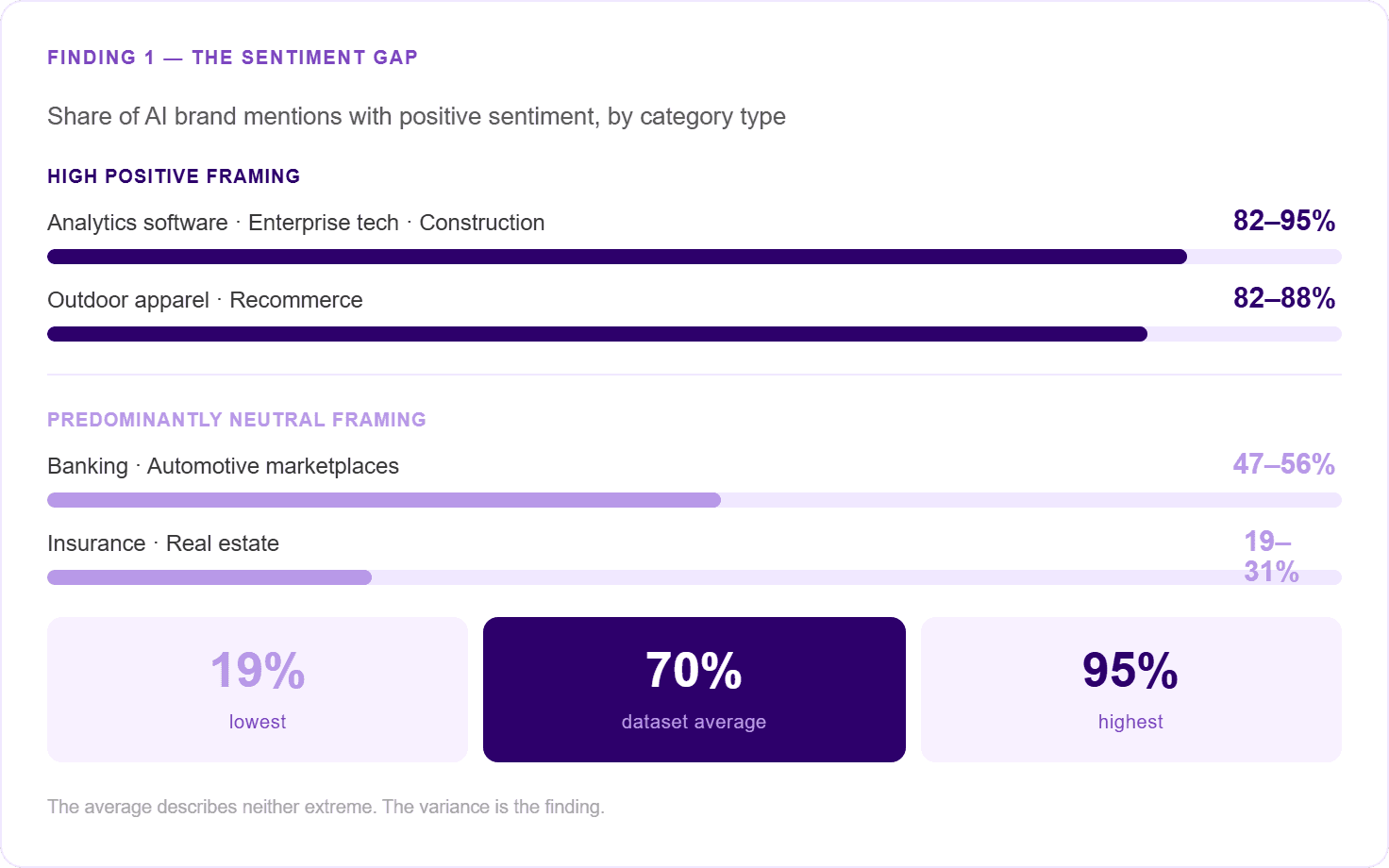
Le taux moyen de sentiment positif se situe à environ 70 %, mais cette moyenne masque la véritable réalité. La variance est la véritable découverte :
La tranche supérieure (82-95 %) : Les marques de logiciels d'analyse, de technologies d'entreprise, de matériaux de construction, de vêtements de plein air et de recommerce ont obtenu une présentation positive quasi totale. Lorsque l'IA mentionne ces marques, elle les contextualise favorablement, les validant comme des options de premier choix ou privilégiées.
La tranche inférieure (19-56 %) : Les marques du secteur bancaire, des plateformes automobiles, de l'assurance et de l'immobilier apparaissent régulièrement, mais principalement au sein de mentions neutres. L’IA reconnaît leur existence sans ajouter de valeur positive à la marque. Dans ces catégories, une mention neutre est souvent une impasse commerciale. Lorsque l'IA liste une marque sans sentiment positif, elle se contente de prendre acte d'un participant au marché plutôt que de recommander une solution, reléguant de fait la marque au rang de produit générique.
La cause profonde : Autorité catégorielle vs banalisation
La caractéristique commune des marques dominant le sentiment positif est qu'elles défendent une proposition claire et spécifique que les modèles d'IA associent systématiquement à la qualité ou au leadership. Lorsqu'une marque occupe cet espace, presque chaque mention constitue une recommandation positive.
À l'inverse, les marques à faible sentiment opèrent dans des catégories banalisées où les concurrents sont perçus comme interchangeables. Une banque est une banque ; une compagnie d'assurance est une compagnie d'assurance. L'IA les mentionne toutes, mais les traite de manière neutre.
Dans ces catégories, une mention neutre est souvent une impasse commerciale. Lorsque l'IA liste une marque sans sentiment positif, elle se contente de prendre acte d'un participant au marché plutôt que de recommander une solution, reléguant de fait la marque au rang de produit générique.
Une visibilité élevée est un indicateur trompeur
La tendance la plus flagrante dans les données invalide le volume en tant qu'indicateur de succès : une marque ayant une faible visibilité sur l'IA (apparaissant dans moins de 25 % des réponses) peut atteindre un taux de sentiment positif supérieur à 85 %. À l'inverse, une marque ayant une visibilité trois fois supérieure peut enregistrer un taux de sentiment positif inférieur à 50 %.
Nous appelons cela l'Écart de Sentiment – la différence entre la visibilité d'une marque et la fréquence à laquelle cette visibilité est formulée de manière positive. Pour certains, cet écart est négligeable. Pour d'autres, il représente une part massive de présence sur l'IA qui génère une notoriété de marque totalement dépourvue d'association positive.
Résultat 2 : Le système d'IA à deux vitesses
La recherche basée sur l'IA concentre sa visibilité sur un petit nombre de marques sélectionnées, ignorant largement les autres. Dans chaque catégorie analysée, une division structurelle est apparue, séparant les marchés en deux classes distinctes – et la plupart des marques n'ont aucune idée du côté où elles se trouvent.
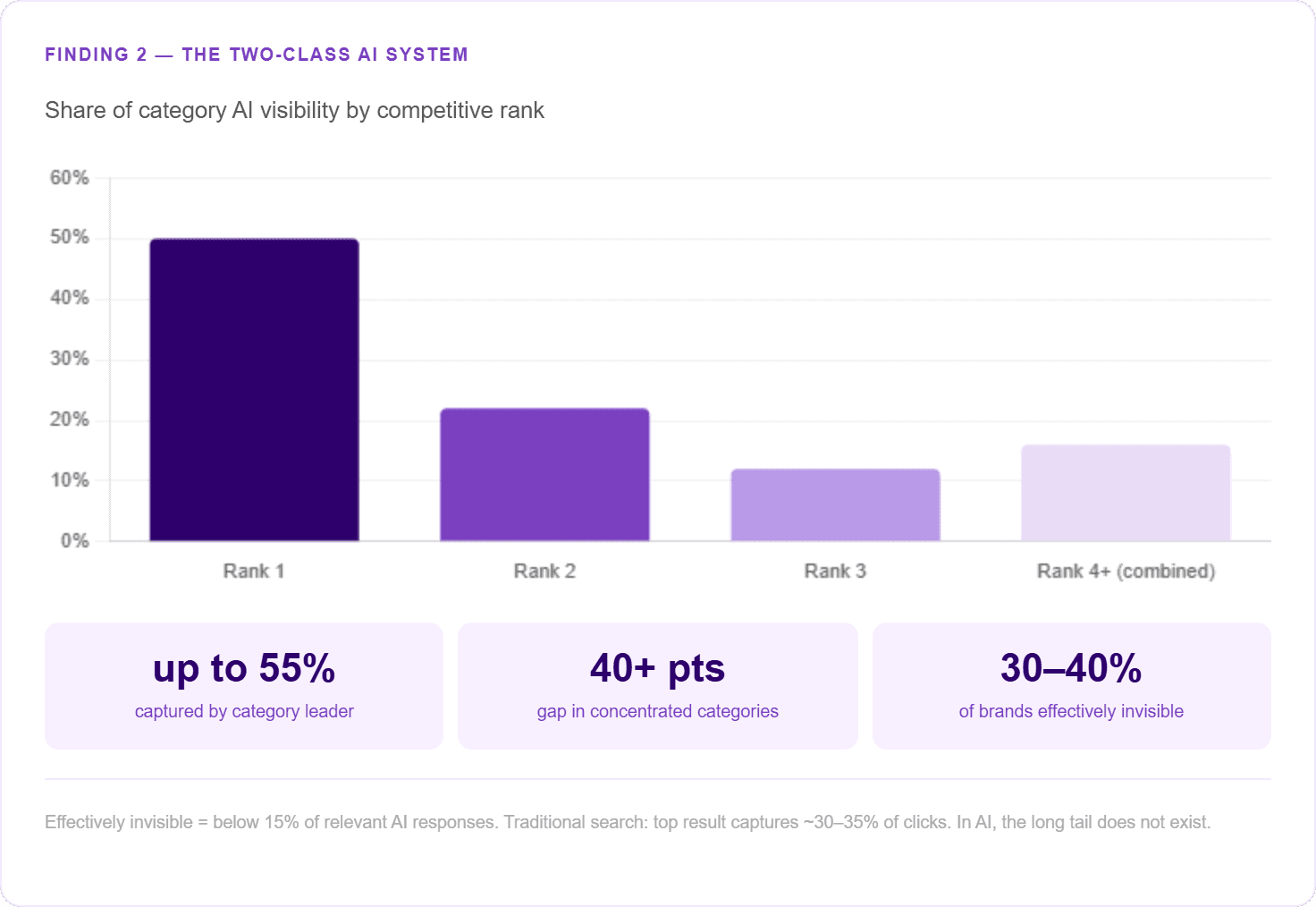
L'écart de visibilité entre les leaders du marché et les challengers varie fortement selon la catégorie. Sur des marchés fragmentés comme l'assurance, l'écart n'est que de 1 à 2 points de pourcentage. Cependant, dans les catégories fortement concentrées, un seul leader peut capter jusqu'à 55 % de l'ensemble des mentions d'IA, devançant son concurrent le plus proche de plus de 40 points.
La tendance est claire : les leaders détiennent un avantage structurel permanent, et cet écart se creuse à mesure qu'une catégorie mûrit.
La mort de la longue traîne
Dans la recherche traditionnelle, le premier résultat capte environ 30 % des clics, mais les positions de six à dix récoltent encore du trafic. La longue traîne existe. Avec l'IA, la « longue traîne » – cette visibilité secondaire qui maintient les marques challengers en vie – est de fait effacée. Alors que Google permet de découvrir des niches, la recherche par IA est une arène où le vainqueur rafle tout et concentre la présence au sommet absolu.
Sur l'ensemble de nos données, 30 % à 40 % des marques concurrentes établies sont virtuellement invisibles, apparaissant dans moins de 15 % des réponses d'IA pertinentes. Il ne s'agit pas de marques fragiles ; ce sont des acteurs majeurs du marché disposant de budgets importants et d'un solide positionnement SEO organique. Pourtant, dans les réponses générées par l'IA, elles n'existent tout simplement pas.
L'effet de seuil : Réponses vs notes de bas de page
Nos données révèlent un effet de seuil bien distinct basé sur la visibilité et la tonalité :
En dessous de 15 à 20 % de visibilité : Les marques ne sont presque jamais présentées de manière positive. Elles sont simplement énumérées de façon neutre comme de simples participants au marché.
Au-dessus de 60 % de visibilité : Les marques franchissent un seuil où l'IA les présente systématiquement avec un sentiment positif.
Cela crée un système à deux vitesses : les marques qui sont la réponse, et les marques qui ne sont qu'une simple note de bas de page.
Le dilemme du modèle : Les moyennes masquent la stratégie
La divergence entre les modèles vient aggraver ce défi. ChatGPT, Gemini, Perplexity et Claude ont souvent des avis basés sur les données fondamentalement différents sur le gagnant d'une catégorie.
Un score unique et global de visibilité sur l'IA applique une moyenne à plusieurs réalités concurrentielles contradictoires pour en faire un indicateur qui ne décrit précisément aucune d'entre elles. Si vous présentez un chiffre global de visibilité d'IA agrégé à votre équipe de direction, vous masquez vos risques stratégiques les plus critiques derrière une simple moyenne.
Résultat 3 : Le piège du SEO traditionnel
Ce fut notre conclusion la plus inattendue : environ une marque sur cinq dans nos données combine une forte présence en recherche organique avec un score de visibilité d'IA inférieur à 40 %. La menace pour ces marques performantes ne réside pas dans leur succès en SEO, mais dans le faux sentiment de sécurité qu'il leur procure. Parce que leurs tableaux de bord hérités du passé continuent d'afficher de la croissance sur un canal en déclin, elles restent aveugles à leur manque d'autorité structurelle dans l'écosystème de l'IA.
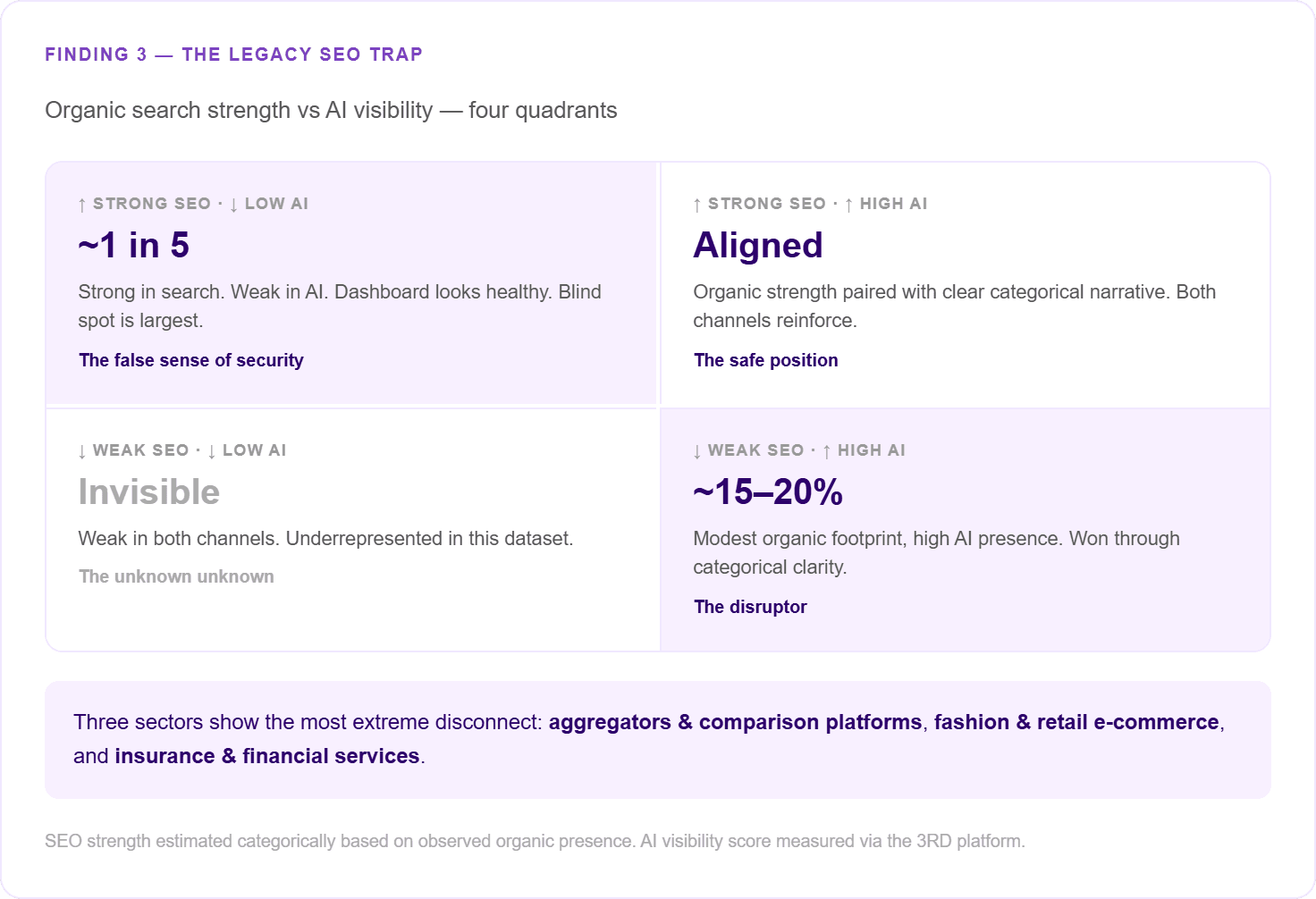
Ces entreprises ont bâti leur présence numérique sur les piliers traditionnels du SEO : le volume de contenu, l'autorité des backlinks, la couverture des mots-clés et l'optimisation technique du site. À l'ère de l'IA, ces fondations constituent un plancher, mais en aucun cas un plafond.
La recherche récompense le volume et l'exécution technique. L'IA valorise la clarté du discours, la dominance catégorielle et la concentration de sentiments positifs à travers ses sources d'apprentissage. Les deux canaux ne sont tout simplement pas aussi alignés que le supposent la plupart des équipes marketing.
Un décalage extrême à travers trois secteurs
Le fossé entre la performance de recherche et la présence sur l'IA est particulièrement marqué dans trois secteurs :
Les agrégateurs et comparateurs : Conçues pour servir d'intermédiaires entre les utilisateurs et les réponses, ces plateformes sont aujourd'hui contournées. L'IA supprime l'intermédiaire en répondant directement à la requête. Ces marques ne connaissent pas l'échec en raison d'une mauvaise exécution ; c'est simplement que le canal n'exige plus leur utilité fondamentale.
L'e-commerce de mode et de vente au détail : Bien que ces marques génèrent un trafic organique massif via des pages de listes de produits et des contenus éditoriaux, les modèles d'IA ignorent largement cette infrastructure lorsqu'ils formulent leurs réponses. Un bon classement de recherche ne se traduit plus par une autorité de catégorie au sein des écosystèmes d'IA.
L'assurance et les services financiers : Malgré des investissements traditionnels massifs dans le contenu pédagogique et les outils de comparaison, toutes les grandes marques de ces secteurs se regroupent autour de scores de visibilité d'IA similairement bas. Aucun acteur individuel n'a réussi à convertir ses investissements organiques historiques en différenciation sur l'IA ; les modèles les traitent comme totalement interchangeables.
L'implication stratégique
Les systèmes que vous utilisez pour mesurer le succès de votre marketing sont optimisés pour un canal confronté à un déclin structurel, ce qui vous prive de toute visibilité sur le canal même qui est en train de le remplacer.
La prochaine frontière : L'exactitude à grande échelle
Chaque conclusion de cette analyse mène à la même question inconfortable : Votre marque est présente dans la réponse de l'IA, mais cette réponse est-elle exacte ?
Les modèles d'IA ont fréquemment des hallucinations ou présentent avec assurance des faits obsolètes : des prix incorrects, des produits retirés de la vente présentés comme actuels, des fonctionnalités attribuées au mauvais modèle ou des affirmations du marché obsolètes depuis dix-huit mois. Ces inexactitudes sont énoncées avec une autorité absolue, à grande échelle, laissant souvent l'utilisateur avec peu ou pas de liens sortants pour vérifier ces assertions.
Alors que la visibilité et le sentiment peuvent être suivis mathématiquement, mesurer l'exactitude exige une approche technique complètement différente. Cela impose de lire l'intégralité du texte des réponses de l'IA, d'identifier les affirmations factuelles spécifiques et de les croiser avec des sources de vérité vérifiées.
Au volume auquel opère l'IA, l'audit manuel est impossible. Il nécessite une infrastructure conçue à cet effet.
Le risque lié à la volatilité
Les marques les plus exposées à ce risque ne sont pas nécessairement celles qui ont une faible visibilité. Le risque le plus élevé concerne les entreprises opérant dans des catégories à forte volatilité où les spécifications des produits, les règles de conformité et les prix évoluent plus rapidement que les cycles d'apprentissage et de navigation de l'IA :
Services financiers
Électronique grand public
Voyage et tourisme
Dans ces secteurs, une réponse d'IA obsolète, formulée avec assurance et sans lien, n'est plus seulement un échec marketing : c'est un risque juridique et de conformité.
La solution : La vérification automatisée des faits
Nous développons l'infrastructure nécessaire pour résoudre ce problème. Le fact-checking automatisé à l'échelle de l'IA – qui consiste à auditer systématiquement les déclarations textuelles des modèles d'IA sur votre marque et à signaler les inexactitudes avant qu'elles ne s'accumulent – sera très bientôt disponible sur la plateforme 3RD.
Trois indicateurs pour moderniser vos mesures
Votre infrastructure d'analyse existante n'est pas hors d'usage ; elle se contente de mesurer des indicateurs adaptés à un monde en déclin.
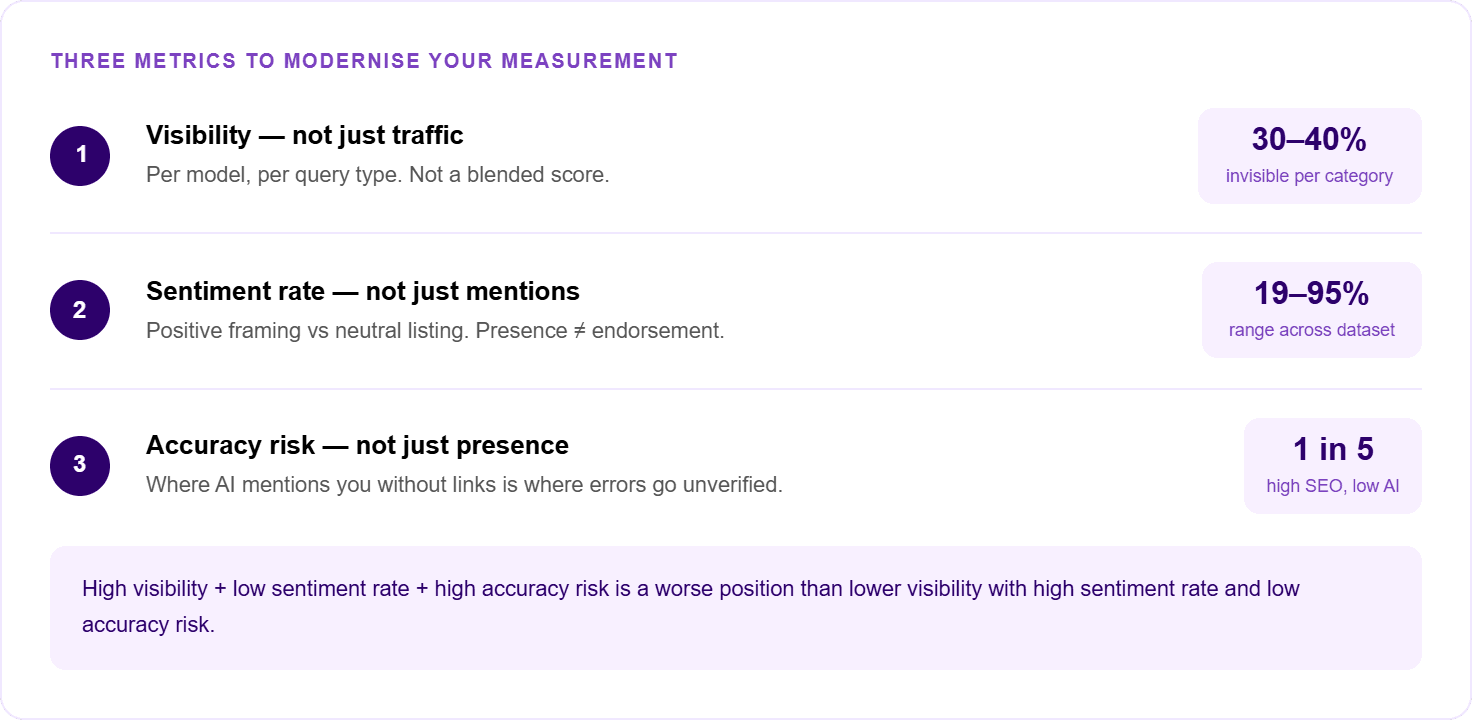
Les trois indicateurs suivants ne sont pas des substituts, mais des extensions indispensables pour apporter de la transparence à vos rapports actuels.
Mesurez la visibilité – pas seulement le traficFaites-vous partie des conversations d'IA, et sur quelles requêtes ? Évitez les scores de visibilité globaux. Exigez plutôt une répartition par modèle pour différents types de requêtes : recommandations, comparaisons et recherches exploratoires. Pour une marque présente sur un seul marché, l'ensemble de données minimal viable consiste en un suivi régulier de 40 à 60 prompts hors marque sur une période de 30 jours.
Mesurez le taux de sentiment – pas seulement les mentions« La marque X est l'une des différentes options » et « La marque X est la solution privilégiée » représentent des résultats commerciaux totalement distincts. Suivez le ratio entre sentiment positif et neutre parmi vos mentions d'IA. Une marque bénéficiant d'une grande visibilité mais associée à un sentiment majoritairement neutre est présente dans la conversation, mais ne la remporte pas. La variance de 19 % à 95 % observée dans nos données montre à quel point la réalité commerciale peut être masquée au sein d'un indicateur de visibilité unique.
Mesurez le risque d'exactitude – pas seulement la présenceSurveillez vos taux de mentions et de liens par modèle et par type de requête. C'est là où votre marque est mentionnée avec un sentiment positif mais sans lien sortant que votre exposition au risque d'inexactitude est la plus élevée. Pour atténuer cela, optimisez vos balises de données structurées : elles fournissent aux modèles d'IA des données précises et non ambiguës, réduisant ainsi la marge d'erreur des affirmations erronées formulées de manière assurée. Surveiller l'exactitude ne consiste pas seulement à éviter les erreurs ; c'est s'assurer que la « vérité terrain » de l'IA s'aligne bien avec les données officielles de votre marque. C'est le seul moyen de transformer un risque potentiel en une recommandation vérifiée.
La réalité globale
Ces indicateurs doivent être évalués conjointement. Une visibilité élevée combinée à un faible taux de sentiment positif et à un risque d'exactitude élevé constitue une position stratégique bien pire qu'une visibilité plus faible associée à un taux de sentiment élevé et à un faible risque d'exactitude. C'est cette combinaison qui révèle la réalité qu'aucun indicateur isolé ne peut restituer.
L'argument final
Votre tableau de bord analytique traditionnel ne faillit pas par dysfonctionnement. C'est sa conception même qui fausse la donne.
Il a été développé pour suivre les preuves d'influence dans un monde où l'interaction laissait des traces numériques claires : sessions, clics, pages vues et conversions. Ce monde n'a pas entièrement disparu, mais l'influence s'exerce de plus en plus au sein d'environnements générés par l'IA qui façonnent l'intention d'achat, contextualisent votre marque et réorientent le parcours des utilisateurs – tout cela sans laisser la moindre trace dans vos outils analytiques actuels.
Paradoxalement, les marques les plus exposées ne sont pas celles qui ont la visibilité d'IA la plus faible. Le risque le plus grand pèse sur les leaders du marché affichant les meilleures performances en recherche organique. Ce sont ces entreprises qui ont bâti toute leur infrastructure de mesure autour du canal précis que l'IA est en train de supplanter discrètement.
Leur angle mort est d'autant plus grand que leurs tableaux de bord historiques affichent une santé florissante.
La réalité du marketing moderne est désormais binaire : votre marque fait partie de la réponse de l'IA, ou elle n'existe pas. Et vous ne pouvez pas corriger un angle mort que vous refusez de mesurer.
3RD est une plateforme d'intelligence pour la visibilité de l'IA. Nous aidons les marques à comprendre comment elles sont représentées à travers les modèles d'IA, à identifier les écarts entre leur présence d'IA et leur positionnement cible, et à mesurer les indicateurs stratégiques dans un univers de recherche axé sur l'IA.