AI search
How to choose an AI visibility platform: a buyer's checklist for 2026
14 criteria, the demo questions to ask, red flags and a scoring template for choosing an AI visibility platform, plus a fact-checked shortlist of 8 tools.
Contents
Choose the platform that tells you why AI picks a competitor and what to do about it, on the models and markets your buyers use, with every number traceable to real answers.
Most AI visibility tools can show you a score. Far fewer can explain it, and fewer still help your team change it. That gap is where most buying mistakes happen.
I've bought marketing software for a decade, on both sides of the table: in-house at SaaS and e-commerce companies, and for 30+ client brands at an agency. AI visibility is the hardest category I've had to evaluate. The numbers move every day, every vendor counts differently, and the demo account always looks great.
So this guide is the checklist I'd want: the 14 criteria that separate the platforms, the questions to ask in a demo, the red flags, a scoring template you can copy, and a shortlist of eight platforms checked against their own public pages.
One disclosure. I work at 3RD, which is on the shortlist. We also track our own category in 3RD, and we're not winning it yet. You'll see our own numbers, good and bad, throughout.
The short answer
If you only read one section, read this.
- Monitoring is now a commodity. Every serious platform sends prompts to AI assistants and counts brand mentions. Don't pay a premium for a dashboard.
- The real differences are in three places. How the answers are collected, whether the platform explains why you lose, and who does the work after the diagnosis.
- Price is hard to compare. Every vendor counts a "prompt" differently. Convert every quote into answers per month before you compare.
- Pilot before you sign. Run 20–40 of your own buyer questions for at least two weeks, in your real markets. A demo account tells you nothing about your category, and a few days of data tell you very little about anything.
Here is what each of those means in practice.
What you need before you talk to vendors
Spend an hour on this first. It makes every demo shorter and every quote comparable.
- Your 20 most valuable buyer questions. Write them the way a buyer would ask an AI assistant: "What's the best payroll tool for a 50-person company in Denmark?", not "payroll software". These become your pilot prompts.
- Your markets. List each country and language you sell in. Denmark in Danish and Denmark in English are two different markets, because AI answers each language differently.
- The AI assistants your buyers use. ChatGPT is almost always on the list. Add Google AI Overviews if you depend on Google search, Copilot if you sell into Microsoft-heavy companies, and Perplexity or Claude if your buyers are technical.
- Five competitors. Name the brands you lose deals to, not only the biggest names in your industry.
- Who will do the work. Write down the names of the people who will act on the findings, and how many hours a week they have. This decides which kind of platform you need more than any feature list.
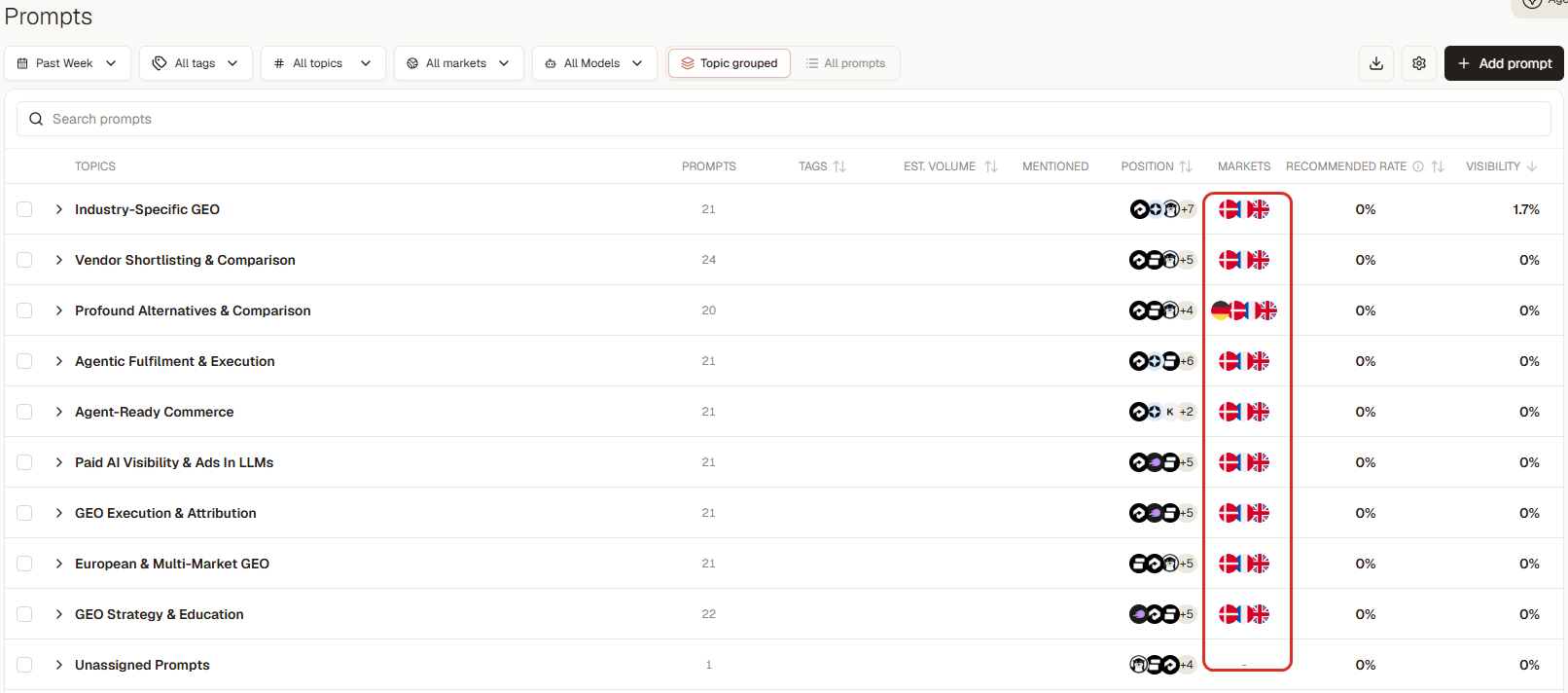
Here's what that setup looks like for us. We track 193 buyer questions about AI visibility tools, grouped into nine topics, in five markets.
193 buyer questions grouped into nine topics, tracked per market.
The 14 criteria that separate AI visibility platforms
The criteria are grouped in the order a buyer meets them: can I trust the data, does it explain the result, can we act on it, and does it fit our company.
Can you trust the data?
1. How the answers are collected. Platforms get AI answers in one of two ways. Some send questions through each AI provider's API (application programming interface). Others capture answers from the consumer chat interface people actually use. Interface answers can include features API answers don't, such as shopping cards or live web search. API answers are easier to run at scale and in many markets. Neither is wrong. What matters is that the vendor tells you which method it uses for each model.
2. Which AI models are covered, and which ones you can switch on. Ask for the exact list per plan. Many platforms advertise nine or more engines but include two to four on entry plans. Check that you can swap models later, because buyer behavior shifts.
This criterion matters more than most buyers think, because different assistants pick different winners. In aggregated 3RD data from 60 brands, the most visible competitor was a different brand on different assistants for 37 of them (62%), on the same prompt set. Inside one brand, the gap between its best and worst assistant was a median 16 points (83 brands).
We see it on our own account. This week, our only mentions came from Google AI Overviews. ChatGPT, Claude and Gemini named us zero times.
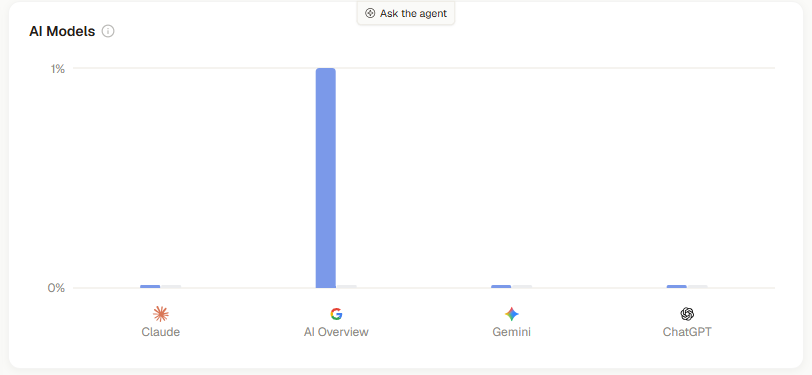
Visibility splits by model. Our only mentions this week came from Google AI Overviews.
3. Markets and languages. Ask how the platform defines a market. A good answer: one country plus one language, each tracked separately, with the market given to the AI model as context. A weak answer: "We support 50+ countries" with no detail on language.
4. How prompts are counted. This is where most pricing confusion starts. One vendor counts a prompt once, whatever the number of models. Another counts it once per model. A third counts it once per model and per market. Ask every vendor to state its count in this form:
answers per month = questions × models × markets × runs per month
5. Run frequency and answer variance. AI models are probabilistic. The same question can get a different answer tomorrow. A platform that runs each question once a week can't tell a real change from noise.
How big is the noise? In aggregated data from 111 brands and 732,000 AI answers, the median brand's daily visibility moved 12.5 points between its best and worst day in one month, with no change to its prompts. For 7 in 10 brands, at least one single-day reading was more than 5 points away from the brand's 30-day average. Smaller prompt sets were noisier: brands with fewer than about 100 answers a day swung roughly twice as much as brands with 230 or more.
Ninety days of our own category shows the same thing. Competitor scores swing 10 to 20 points from day to day, and a model change breaks the series.
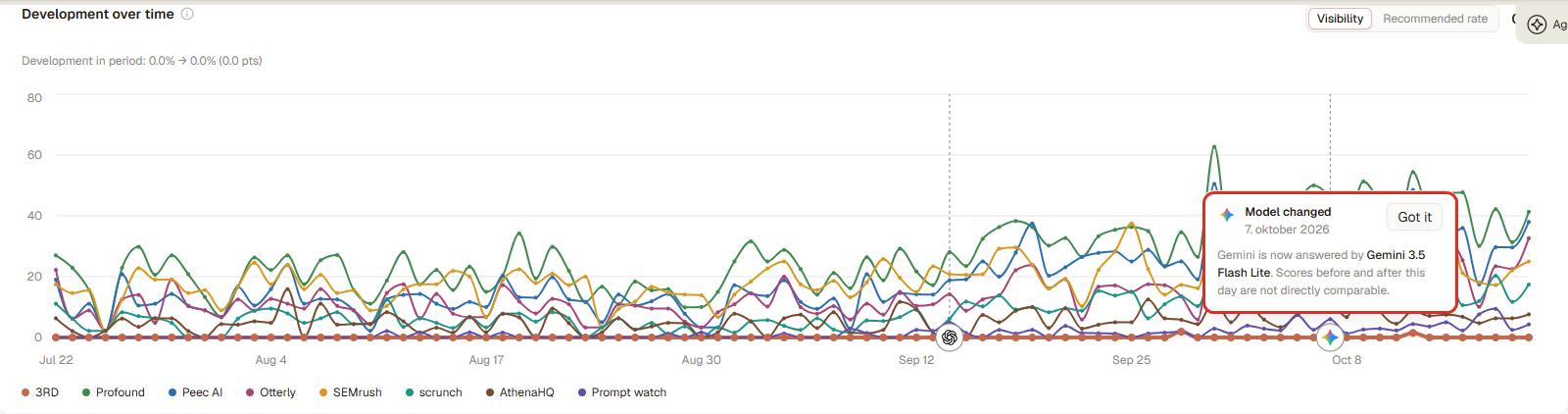
Ninety days of daily visibility. Competitor scores swing 10–20 points from day to day, and a model change on Oct 7 breaks the series.
So ask two things: how often each question runs, and how the platform shows you whether a change is real. A good answer includes daily runs and a way to flag model changes.
6. Traceability. Every score should open into the actual answers and the sources the AI cited. If you can't click from "visibility dropped 8 points" to the answers that changed, you can't explain the number to your CMO. Also check that the score shows its base. Ours this week reads "1 mentions in 639 responses", which is a very different statement from a bare "0.2%".
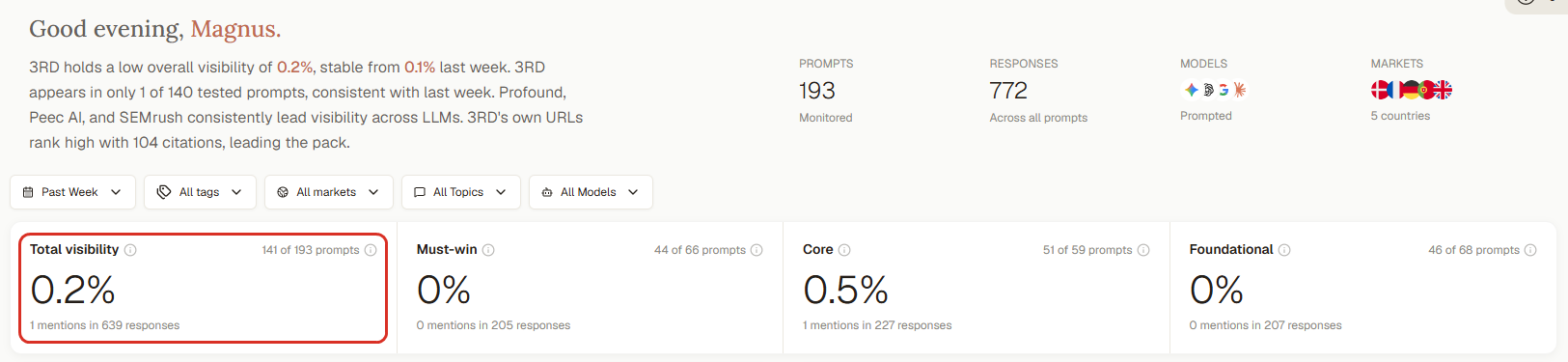
Our own starting point: 3RD at 0.2% visibility across 193 tracked buyer questions (week to Oct 19, 2026). Every score shows its base.
Does it explain why you're not chosen?
7. Diagnosis, not only description. A score tells you where you stand. A diagnosis tells you why AI picks a competitor: a missing comparison page, a third-party list that names them and not you, a page AI can't read. Ask the vendor to show a diagnosis for a real competitor in your category.
This is what a plain-language diagnosis looks like. It's our own, for Denmark, and it isn't flattering.
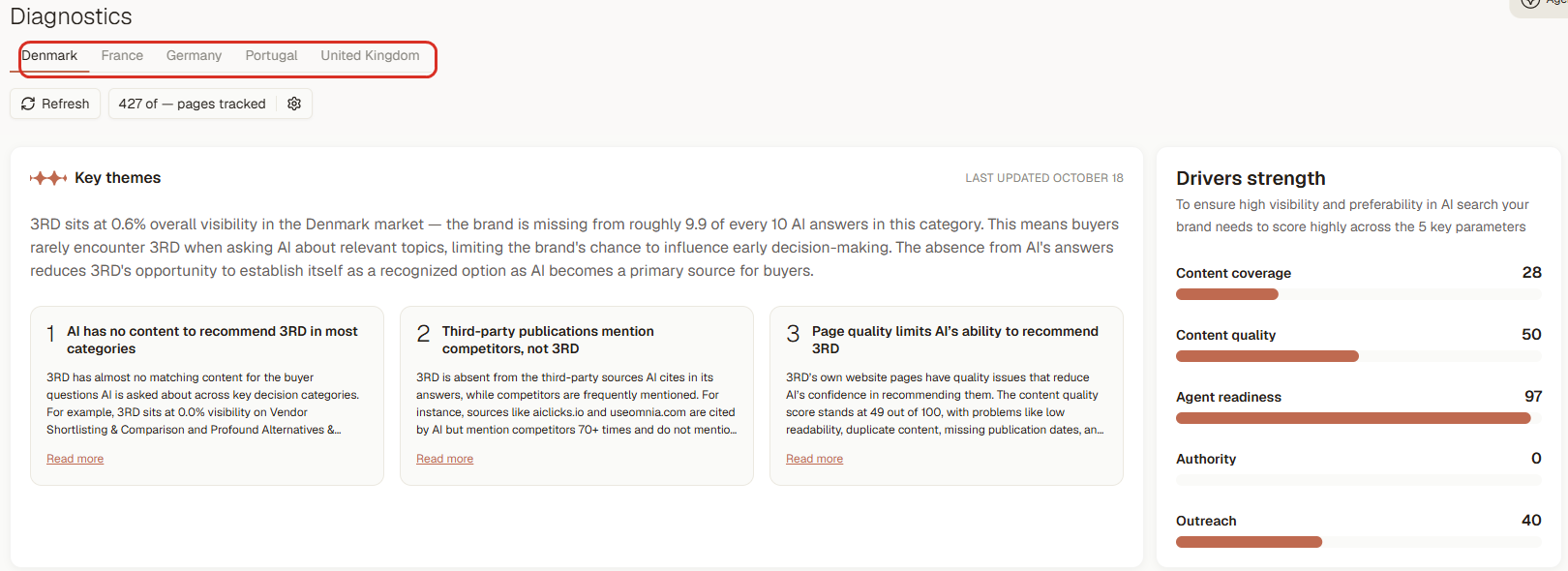
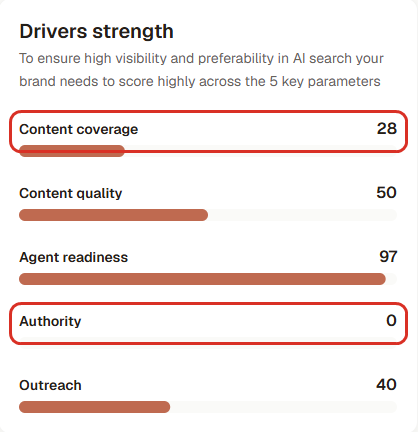
The Denmark diagnosis: no content for most buyer questions, and third-party pages name our competitors instead of us.
A good diagnosis also checks your own site. Ours flagged that a robots.txt on one of our subdomains blocks automated visitors, and that we have no Organization schema to tell agents who we are. We sell this category and still had fixes to make.
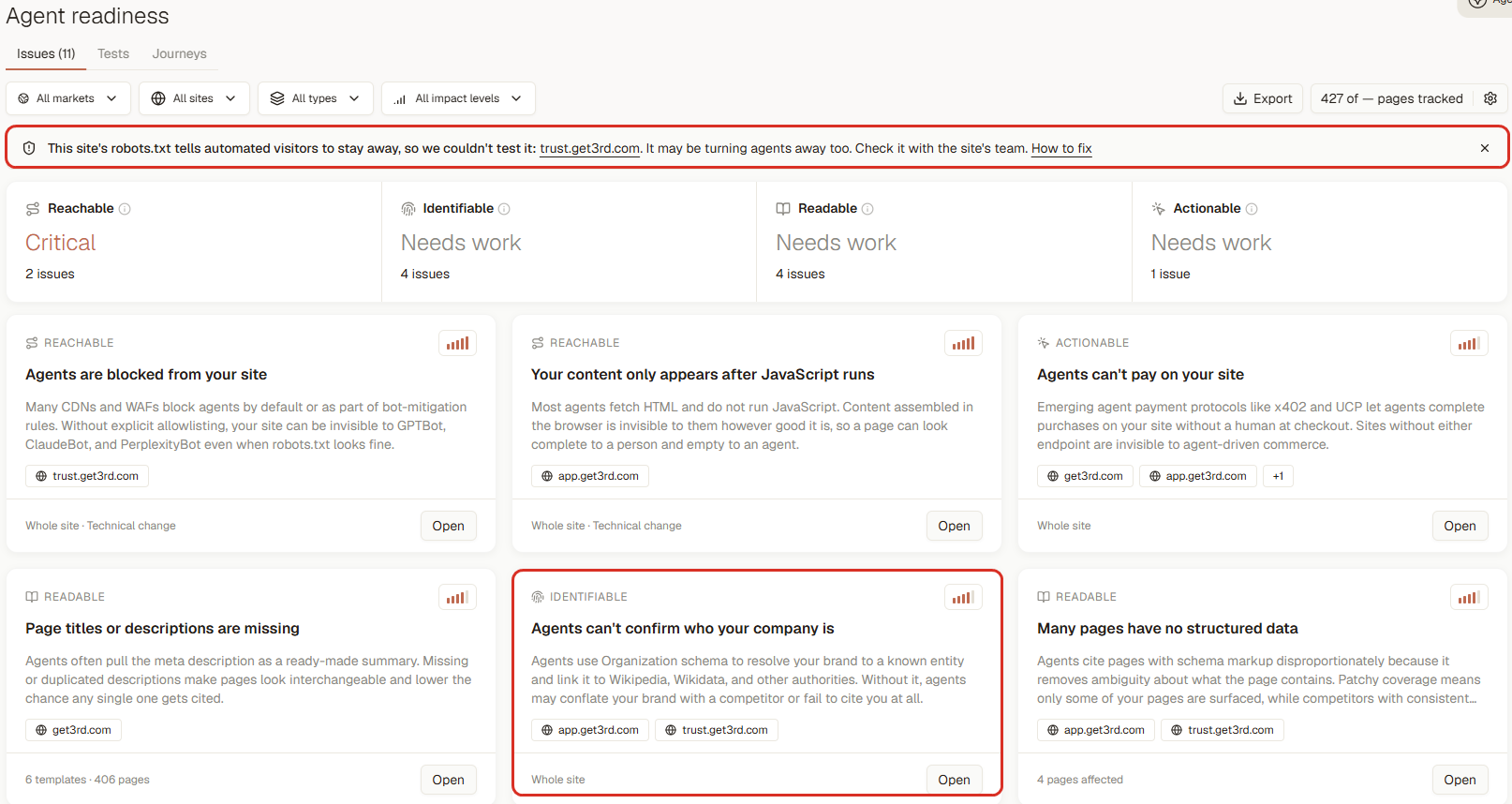
Our own agent-readiness report. Even an AI visibility company has fixes to make: an agent-blocking robots.txt and no Organization schema.
One caution here. Technical access is rarely the main problem. In aggregated data from 60 brands, the median crawlability score was 99 out of 100, and crawlability was the weakest driver for none of the 54 brands with all five drivers measured. Authority or content quality was the bottleneck for 42 of them. If a vendor leads with "we'll fix your crawlability", ask what else it finds.
8. Citations and sources. AI answers lean on the pages they cite. You need to see which pages are cited, whether they are yours (owned) or third-party (earned), and which third-party pages mention your competitors but not you. That list is your outreach plan.
9. Recommendation versus mention. Being named in a list and being recommended are different outcomes, and the gap is large. In aggregated 3RD data from 60 brands and 494,000 checked answers, the median brand was mentioned in 19.8% of answers but recommended over the alternatives in 0.2%. That's about one recommendation for every 65 mentions, and a quarter of the brands (15 of 60) were never recommended at all in the month.
3RD's definition is strict: the answer has to pick you over the alternatives, and being listed first doesn't count. Ask every vendor two things. Does the tool separate mentioned from recommended? And are branded questions left out of the measure? A question that names your brand inflates it.
Can your team act on it?
10. From diagnosis to a prioritized plan. Ask what you get after the diagnosis. A list of generic tips ("add FAQ schema") is not a plan. A plan ties each task to a goal, a set of prompts and an estimated impact, so the highest-value work comes first.
11. Who does the work, and what's automated. Platforms split three ways:
- Monitoring only: you get data, and your team or agency does everything else.
- Drafts with approval: the platform drafts pages, briefs or outreach, and a person checks and publishes.
- Autonomous execution: agents carry out tasks for you, sometimes publishing directly.
None is right for everyone. A team with a strong content function may only want the data. A two-person marketing team may need drafts. A regulated company may require a person to approve every change. Decide which you need before the demo.
12. Measuring impact. After your team ships a change, can you see whether it worked? Look for a before-and-after reading tied to the specific prompts the work targeted, compared against prompts you didn't touch, and kept separate from the estimate made beforehand.
The control matters because single before-and-after readings are close to a coin flip. In aggregated 3RD data, we looked at 117 completed tasks where visibility on the targeted prompts was compared with a control group of the same brand's untouched prompts. 29% moved up by more than 5 points against the control, 26% moved down by more than 5, and 44% stayed within 5 points. That doesn't mean the work fails. It means a platform without a control can't tell you which result you got. Expect days to weeks between publishing and a measurable shift, because AI models re-crawl and re-learn on their own schedules.
Does it fit your company?
13. Reporting and data access. Your CMO wants one page, not a dashboard tour. Check for scheduled reports, CSV export, an API, and a connector for your business intelligence tool. If AI-referred traffic matters to you, check which analytics tools connect (for example GA4 or Adobe Analytics) and on which plan.
AI-referred traffic is worth asking about, because it doesn't follow mentions closely. Last week AI sent us 48 sessions and 10 conversions, while our visibility averaged 0.2%. Those clicks came from AI citing our pages, not from AI recommending us.
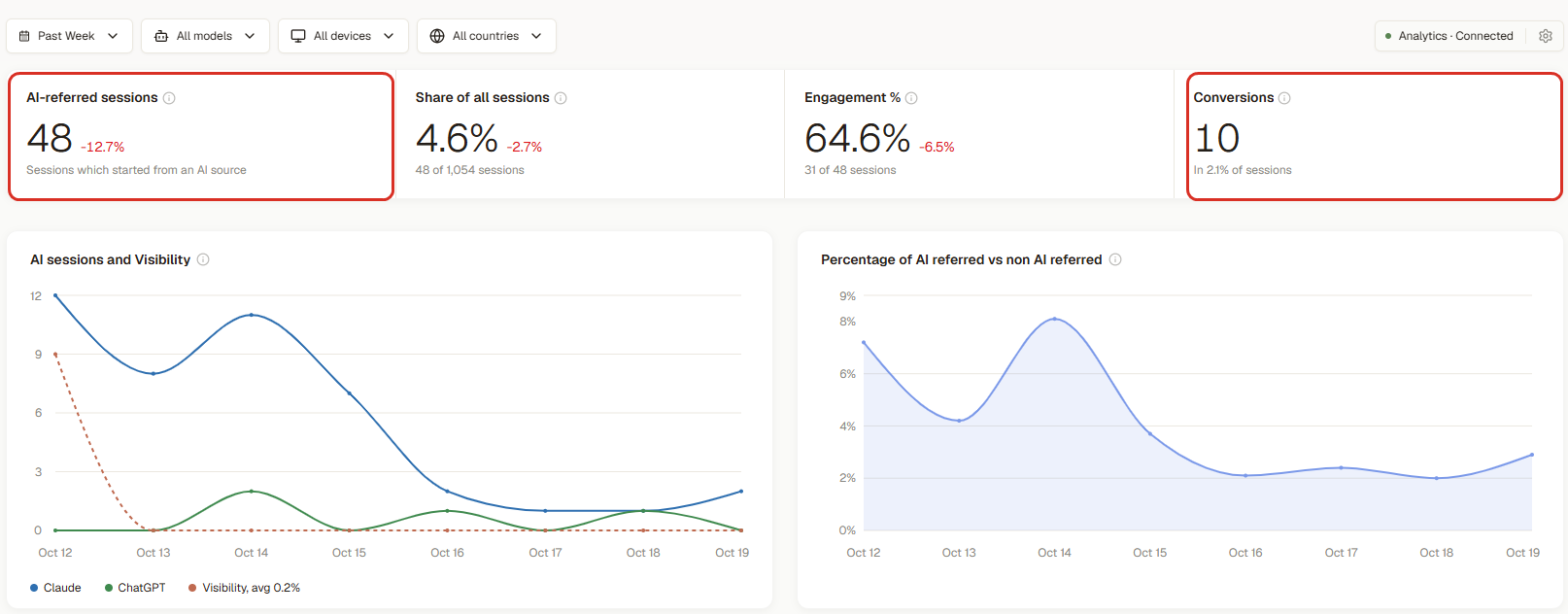
AI sent us 48 sessions and 10 conversions last week, while our visibility averaged 0.2%. Clicks come from citations, not only mentions.
14. Security, data location and commercial terms. Ask where data is stored, which AI providers process it, whether your data trains public models, and which certifications the vendor holds today versus "is working toward". Ask whether single sign-on (SSO) is available and on which plan. Finally, check whether prices are published and whether a trial runs on your own prompts.
Questions to ask in every demo
Use these word for word. A strong vendor answers each one in under a minute.
- "Show me one of our competitors' answers, and the sources the AI cited for it."
- "How do you collect answers from ChatGPT: API, interface, or both?"
- "If I track 30 questions on 3 models in 2 markets, how many prompts is that on your pricing?"
- "How often does each question run, and how do you show me a change is real and not noise?"
- "Why does our top competitor win this question? Show me the evidence."
- "Do you separate being mentioned from being recommended?"
- "What exactly happens after the diagnosis? Who writes the page, and who publishes it?"
- "After we ship a fix, where do I see whether it moved the number, compared with prompts we didn't touch?"
- "Can I export the raw answers and citations?"
- "Where is our data stored, and which certifications do you hold today?"
- "Can we run a trial on our own questions and markets before we sign?"
Red flags
- A single global score with no filters. One brand can sit at 50% on one model and 30% on another for the same questions. An average hides the model where you're losing.
- "Search volume" for prompts. No platform has real search volume for AI prompts. Any demand score is an estimate, and the vendor should explain how it's built.
- Tips that would fit any company. If the recommendations don't name your competitors, your pages and the sources involved, they weren't written for you.
- No way to see the answers. If the vendor shows only charts, you can't verify anything.
- Before-and-after "proof" without a control. As the task data above shows, a raw before-and-after reading goes up about as often as it goes down.
- Revenue promises. No platform can attribute organic AI visibility to revenue today, because most AI answers produce no click. A vendor who promises it is guessing.
- A demo that only uses a sample brand. Ask to see your own category, or run a trial.
A scoring template you can copy
Weight each criterion for your situation, score each vendor from 1 to 5, and multiply. The weights below suit a mid-size marketing team selling in several European markets. Change them to fit yours.
|
Criterion |
Weight (1–3) |
Vendor A |
Vendor B |
Vendor C |
|---|---|---|---|---|
|
1. Answer collection method |
2 |
|
|
|
|
2. Models covered and swappable |
2 |
|
|
|
|
3. Markets and languages |
3 |
|
|
|
|
4. Clear prompt counting |
2 |
|
|
|
|
5. Run frequency and variance |
2 |
|
|
|
|
6. Traceability to answers |
3 |
|
|
|
|
7. Diagnosis of why you lose |
3 |
|
|
|
|
8. Citations, owned vs. earned |
2 |
|
|
|
|
9. Recommendation vs. mention |
2 |
|
|
|
|
10. Prioritized plan |
3 |
|
|
|
|
11. Who does the work |
3 |
|
|
|
|
12. Measured impact, with a control |
2 |
|
|
|
|
13. Reporting and data access |
2 |
|
|
|
|
14. Security and terms |
2 |
|
|
|
|
Weighted total |
|
|
|
|
A two-week pilot that settles the decision
Two weeks is the minimum. With a median monthly swing of 12.5 points, a few days of data can point either way.
- Day 1: load the same 20–40 buyer questions into each shortlisted platform, in the same markets and on the same models.
- Days 2–7: don't react to daily numbers. Read the answers and check that the platforms detect your brand and competitors correctly. If your brand name is also a common word, check this carefully: we've seen unrelated pages counted as mentions.
- Day 8: ask each platform for its top three reasons a competitor beats you, with evidence.
- Days 9–14: act on one recommendation from each platform and note how long it took your team.
- Day 14: score each vendor with the template above. Hours saved for your team usually decide it.
The shortlist: eight AI visibility platforms compared
Facts come from each vendor's own pricing or product pages, checked on 18–19 October 2026. Where a vendor doesn't publish a detail, the table says so. Prices change often, so check before you buy. For a team-by-team view of the same tools, see Profound alternatives in 2026.
|
Platform |
AI models (public) |
Entry price (public) |
Markets |
Beyond monitoring |
Trial |
|---|---|---|---|---|---|
|
Profound |
Up to 9 on Enterprise; 3 on the trial |
Not published (Enterprise is custom) |
1 region and 1 language on the trial; custom on Enterprise |
Agents draft and publish to your CMS after an approval step |
Free: 50 prompts, daily for 7 days |
|
Peec AI |
3 per plan, more as paid extras |
€85, €205, €425 a month for 50, 150, 350 prompts (checked 18 Oct) |
Several countries from Pro |
Recommended actions, gap analysis, content optimization |
Not stated on the pricing page |
|
Otterly |
4 included (ChatGPT, AI Overviews, Perplexity, Copilot); Gemini, AI Mode and Claude as add-ons |
From $29 a month (15 prompts) to $489 (400 prompts) |
Multi-country support |
Recommendations and GEO URL audits |
Not stated on the pricing page |
|
Semrush AI Visibility Toolkit |
Mentions from ChatGPT, Google AI, Gemini and Perplexity |
$99 a month per domain, billed annually; 25 tracked prompts |
Not stated on the pricing page |
AI Visibility Score, share of voice, sentiment and an AI search site audit inside the Semrush suite |
7-day Semrush trial; not stated for the toolkit |
|
Scrunch |
ChatGPT, Claude, Gemini, Perplexity, AI Mode, AI Overviews, Meta |
$300 a month month-to-month ($250 billed annually), 350 custom prompts |
Not stated |
Page audits; AXP, an AI-friendly version of your site |
7 days, no card |
|
AthenaHQ |
5 on the free plan; 11 on Starter |
Free plan (300 credits); Starter $295 a month (3,600 credits) |
One region and language on Starter; multi-region on Enterprise |
Content optimization agent, on-page and off-page actions |
Free plan |
|
KIME |
2 (Explorer), 3 (Core), all on Enterprise |
€99 a month (50 prompts); €399 (200 prompts) |
Unlimited countries and languages |
AWX agents carry out tasks for you (10 or 30 a month) |
7 days |
|
3RD |
Up to 2, 3 or 4 by plan; up to 13 on Enterprise |
€99 a month (40 prompts); €299 (100); €499 (300); €84, €254, €424 billed annually |
1 market on Starter; any market from Pro; a market is one country in one language |
Diagnosis of why AI picks a competitor, Playbooks with prioritized tasks, 3RD Agent drafts you approve |
7 days, no card |
What each one is best for
- Profound suits large enterprises that want broad engine coverage and a full workflow suite, and can buy through a sales process. Pricing isn't public, so budget for a negotiation. It's also the brand AI names most often in our own tracking.
- Peec AI suits teams that want clean, affordable tracking with several models included on every plan. It gives you more answers per euro than most platforms on this list.
- Otterly suits small teams and solo marketers who want the lowest entry price, with GEO audits included.
- Semrush AI Visibility Toolkit suits teams already living in Semrush. Prompt volume is small at 25 tracked prompts.
- Scrunch suits teams that want large prompt volumes and an agent-facing version of their site.
- AthenaHQ suits teams that want to start free and try many models through a credit system.
- KIME suits teams that want agents to carry out tasks without a person drafting each one.
- 3RD suits marketing teams that want to know why AI picks a competitor and get a prioritized plan, with drafts their team checks before anything goes live. It tracks each country-language pair as its own market, which matters for European brands selling in several languages.
Worked example: evaluating 3RD with this checklist
Here is how a buyer would test 3RD against the criteria during the seven-day trial. Apply the same steps to every platform on your shortlist.
- Load your questions and markets. Add your 20 buyer questions, tier them Must-Win, Core or Foundational, and pick your market. Connect Google Search Console to get question suggestions based on the searches you already appear in. (Criteria 3 and 4.)
- Read the answers, not only the score. Open Conversations to see each AI answer, where your brand appears, and which sources were cited. Every score shows its base, for example "1 mentions in 639 responses". (Criteria 5 and 6.)
- Ask why you lose. Open Diagnostics. It compares you with your tracked competitors and links each finding to evidence, for example a competitor's comparison page cited in most answers where you have no equivalent. (Criteria 7 and 8.)
- Turn it into a plan. Create a Playbook with one goal, such as "Increase visibility to 70% for Must-Win prompts in ChatGPT". 3RD generates tasks with an impact estimate, so the highest-leverage work sorts to the top. (Criterion 10.)
- Ask 3RD Agent to do the next step. Ask "What should we fix first?", then ask it to draft the page. Every change appears as a card you edit, approve or decline. Nothing goes live without your approval, and publishing stays your move. (Criterion 11.)
- Check how impact is measured. Each completed task shows what actually moved for the prompts it targeted, against the brand's other prompts, kept apart from the impact estimate. (Criterion 12.)
The honest limits: 3RD's entry plan covers one market and two AI models. AI-referred traffic from GA4 or Adobe Analytics comes with Growth. 3RD is not yet SOC 2 or ISO 27001 certified; its controls follow those frameworks and the data is stored in EU regions. SAML single sign-on can be set up for Enterprise customers by agreement. See Security.
One data point most comparisons miss: the leader changes by model
3RD tracks the AI visibility category itself. Across 34 buyer questions about AI visibility tools, asked daily between 19 September and 18 October 2026, the brand AI named most often depended on which assistant answered:
|
AI model |
Most-named platform |
Visibility |
|---|---|---|
|
ChatGPT |
Profound |
45% |
|
Claude |
Otterly |
30% |
|
Gemini |
Semrush |
45% |
|
Google AI Overviews |
Peec AI and Semrush (tied) |
18% |
Same questions, same month, four different leaders. 3RD isn't named in these answers yet, which is part of why we wrote this guide.
Our category isn't unusual. Across 60 customer brands in 3RD, the leader differed by assistant for 62% of them. Two lessons follow for any buyer:
- Don't trust a single blended score. It hides the model where you're losing.
- Track the models your buyers use. A platform with fewer models that match your buyers beats one with many models that don't.
About the data
Our own numbers (overview, diagnostics, per-model chart, agent readiness, AI-referred traffic and the category leaders table) come from 3RD's own workspace, tracking 193 buyer questions about AI visibility tools in five markets; the leaders table uses the 34 questions where we track competitors (19 September – 18 October 2026). The customer findings come from aggregated, anonymised 3RD data between 19 September and 18 October 2026: daily variance from 111 brands and 732,000 AI answers; model disagreement, recommended-versus-mentioned and driver scores from up to 60 brands, capped at three per customer organization; task outcomes from 117 completed tasks with a control, across 44 brands (February to October 2026). The sample leans toward Nordic brands. No brand, domain or prompt is named. These are observational data, not a controlled experiment.
FAQ
What is the difference between an AI visibility platform and a GEO tool? They're mostly the same category. "AI visibility" describes what is measured, your presence in AI answers. GEO (generative engine optimization) describes the work of improving it. The best platforms do both: they measure, explain, and help you act.
How many prompts do we need? Start with 20–40 high-value buyer questions per market. Coverage of your Must-Win questions matters more than volume, but very small sets are noisy: in our data, brands with fewer than about 100 answers a day swung roughly twice as much day to day as brands with 230 or more. Multiply by models and markets to see the real usage on each vendor's pricing.
Which AI models should we track? The ones your buyers use. For most B2B and B2C brands that means ChatGPT plus Google AI Overviews or Gemini, then Copilot, Perplexity or Claude depending on your audience. Results differ a lot from model to model: the median brand in our data had a 16-point gap between its best and worst assistant.
Can any platform guarantee we'll appear in ChatGPT? No. AI models choose answers themselves and change them over time. A platform can show you why you're not chosen, and help you fix the causes: missing pages, weak third-party coverage, and pages AI can't read.
How long before we see results? Expect days to weeks between publishing a change and seeing it in AI answers, because models re-crawl and re-learn on their own schedules. Watch the trend over several weeks, not the daily number, and compare the prompts you worked on with the ones you didn't.
Next step
Write down your 20 buyer questions today, then start a free trial of 3RD with them, or compare 3RD with other platforms.