AI search
AI visibility platforms that do the work, not just monitor it (2026 buyer's guide)
Which AI visibility platforms do the work, and which only report it? Five levels of execution, nine options compared, and how to test the claims.
Contents
Short answer: 3RD, Profound, KIME and AthenaHQ go furthest. They find the gaps and do part of the work. None of them does all of it for you.
Most AI visibility tools stop at a dashboard. A few now draft the pages, write the outreach briefs and plan the work. Even fewer act on their own. If your team lacks the time to do the work, start with one question: which part do you need done?
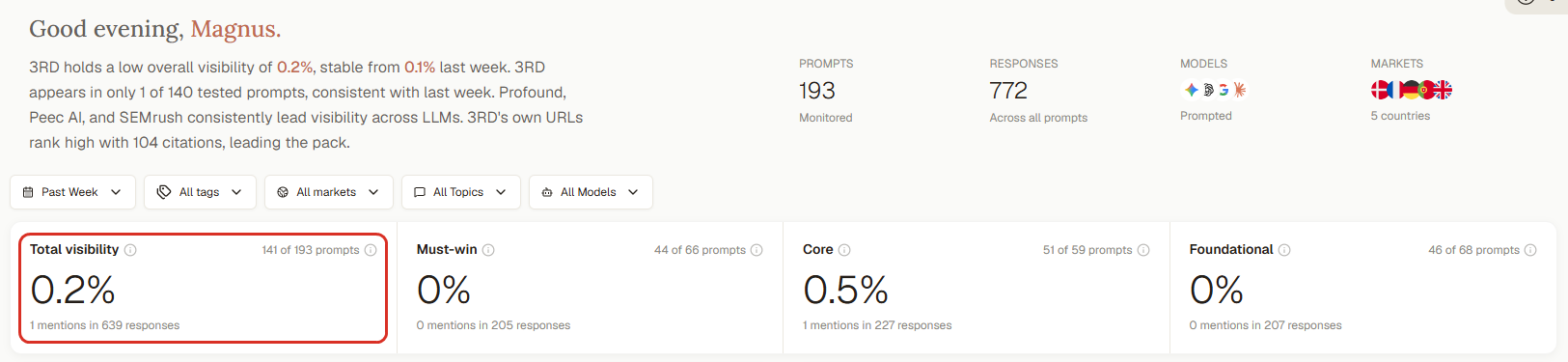
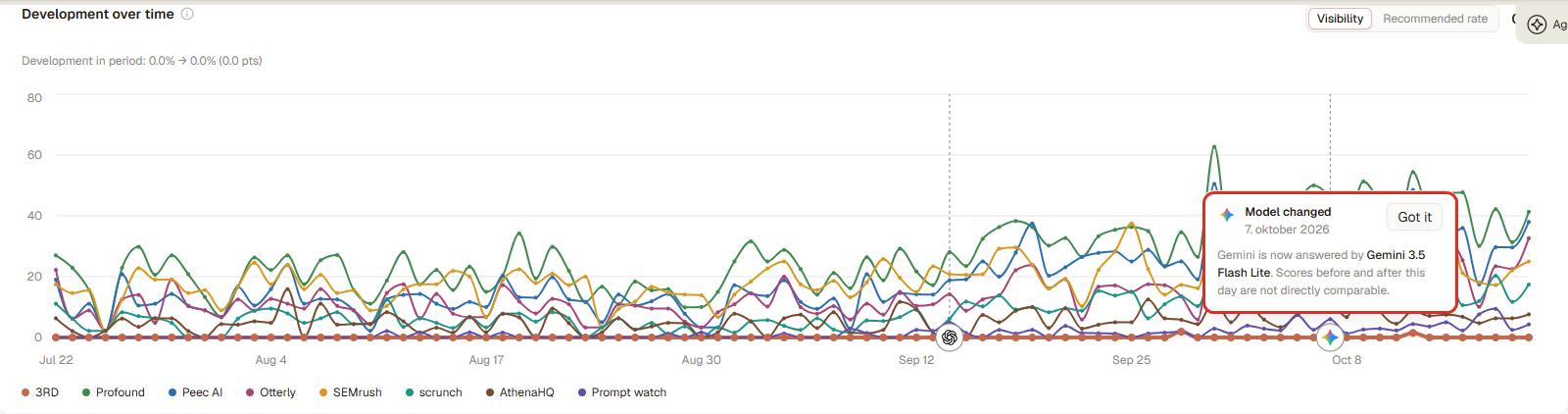
I'll answer it with our own numbers, because they make the point better than any client story. We sell an AI visibility platform, and AI rarely recommends us. In the week to October 19, 2026, 3RD was named in 1 of 639 AI answers to the 193 buyer questions we track. We ranked ninth of fourteen in our category, behind Profound, Peec AI, Otterly and Semrush.
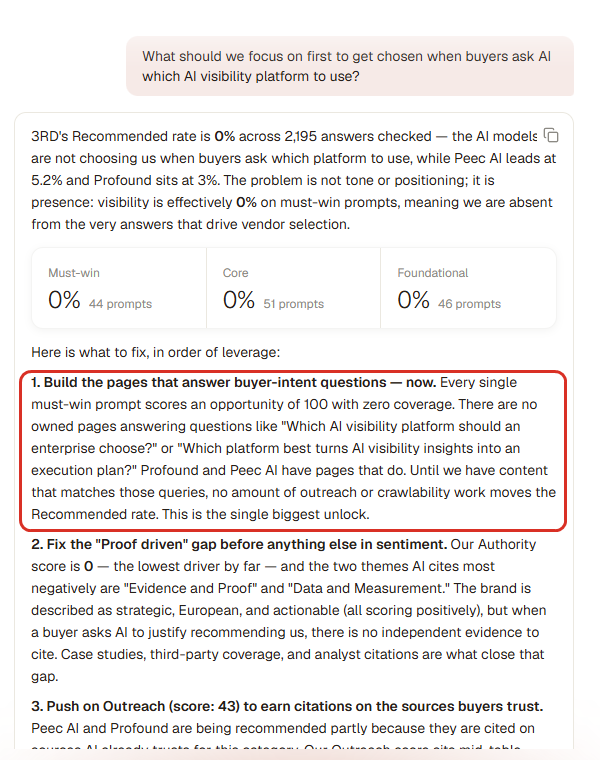
So we asked our own product what to fix first.
We asked 3RD Agent what to fix first. Its answer: build the pages that answer buyer questions. This article is one of them.
That answer is the subject of this guide. Knowing the gap is easy. Getting the work done is the hard part. Below, I split "execution" into five levels and four jobs, compare nine options on how much of the work they take off your plate, and list seven questions that expose an overstated claim during a free trial.
GEO (generative engine optimization) is the work of getting your brand named and cited in answers from AI assistants such as ChatGPT, Gemini, Perplexity and Copilot.
Why "it monitors" stopped being enough
Most teams don't stall at the diagnosis. They stall at the work that follows it.
One head of growth at a European marketing agency put it plainly:
"If I don't have a tool that tells me end-to-end what to do, and I just need to validate for the tool to do it, I'm not going to use it. Everything it's suggesting makes sense, but it's things that I know — I just don't do them because I don't have the bandwidth, the time, the people."
A marketer at a consumer app tried a monitoring setup and let it lapse:
"I liked it, I just didn't find the practical purpose — in terms of my own workflow."
Monitoring also hides how far you are from the goal. Being mentioned is not being chosen. Across 60 brands we track, the median brand was mentioned in 19.8% of AI answers but recommended over its alternatives in just 0.2%. That is about one recommendation for every 65 mentions, and 15 of the 60 brands were never recommended at all in the month. (3RD's definition is strict: AI has to recommend the brand over the alternatives. Being listed, or listed first, doesn't count.)
A mention count can look healthy while buyers keep hearing someone else's name. Closing that gap takes work on pages, sources and proof. A chart doesn't do that work.
That is the real alternative for most teams today. You check ChatGPT by hand now and then, pay for a dashboard nobody acts on, or hire an agency. Each one leaves you either guessing or waiting.
So the useful question isn't "which tool has the best data?" It is "how much of the work moves off my team, and how much stays on it?"
What "execution" means: five levels
Vendors use "agentic", "actionable" and "end-to-end" for very different things. Sort any platform into one of these five levels before you compare anything else.
|
Level |
What the platform does |
What your team still does |
|---|---|---|
|
1. Monitor |
Tracks whether AI names you, how it describes you and which sources it cites |
Everything after the chart |
|
2. Recommend |
Lists actions, such as "add an FAQ to this page" or "get mentioned on this site" |
Decides the order, writes, fixes and pitches |
|
3. Plan |
Turns findings into a prioritized plan toward a goal, with tasks ranked by impact and tracked to done |
Does each task |
|
4. Draft |
Writes the page, the brief, the rewrite or the outreach angle, in your brand voice, for you to review |
Reviews, edits and publishes |
|
5. Auto-execute |
Publishes or sends on its own, within limits you set |
Sets the rules and checks the results |
There is also a sixth option outside software: done for you. An agency or freelancer does the work with whatever tool they prefer.
Two warnings:
- Level 5 isn't automatically better. Anything that publishes in your name without review can change your brand voice, repeat a wrong fact or send an off-key pitch to a journalist. Many teams want level 4: the work done, with a person pressing publish.
- Level 3 is the most underrated. A ranked plan tied to a goal tells a small team what to skip. Without one, even good drafts end up as busywork.
Start with the diagnosis, because it decides which work matters
"Fix our AI visibility" is too vague to execute. The work depends on why AI skips you, and the reason is rarely the one teams expect.
Most teams assume a technical problem: AI can't read the site. That's usually not it. Across 60 brands we track, the median crawlability score was 99 out of 100. The weakest of the five drivers 3RD scores was authority (your standing on third-party sources) or content quality for 42 of the 54 brands where all five were measured. Crawlability was the weakest driver for none of them.
Our own diagnosis looks the same.
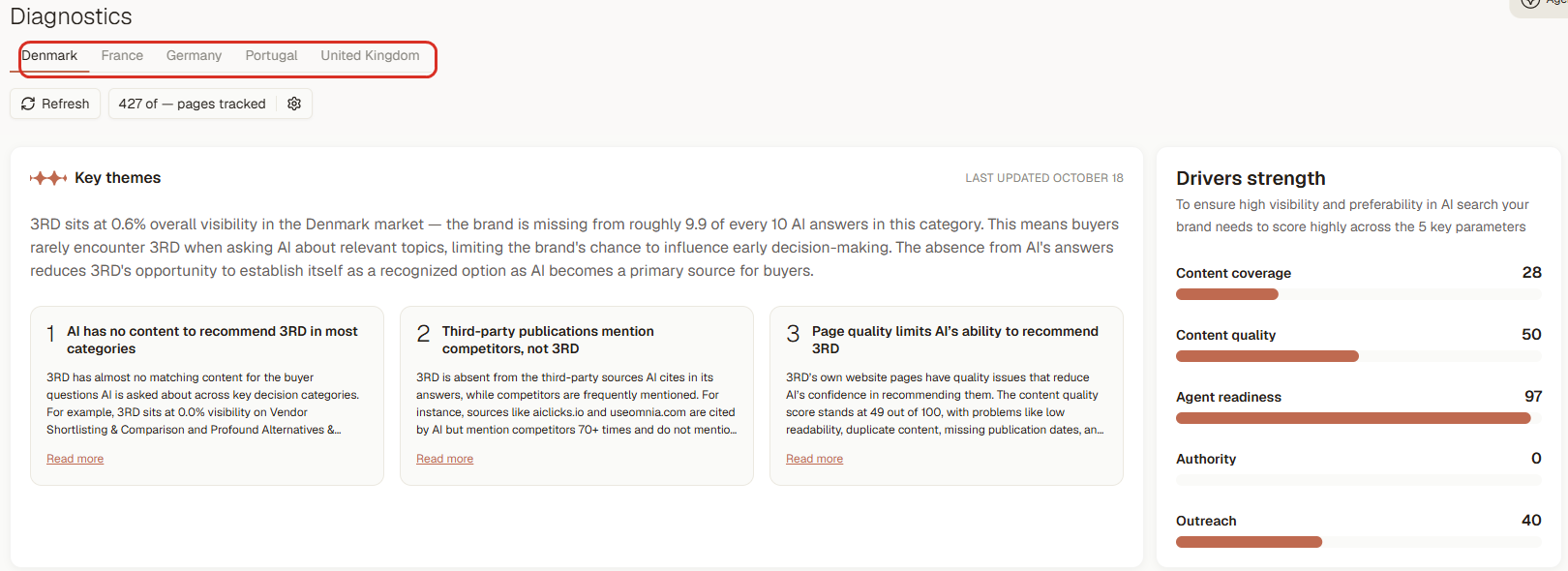
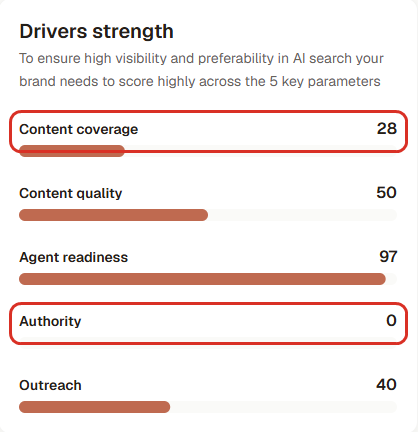
Our Denmark diagnosis: no content for most buyer questions, and third-party pages that name our competitors instead of us.
Agent readiness scores 97, so AI can reach our site. Authority scores 0, and content coverage 28. A tool that only fixes technical issues would have nothing useful to do for us.
The second half of the diagnosis is where AI gets its answers. Across 100 brands and 5.9 million citations, the median brand's own website made up just 6.8% of the sources AI cited in its category. The other 93% were third-party pages: reviews, lists, comparisons, forums and niche sites. For 41 of those 100 brands, AI cited competitors' websites more often than the brand's own.
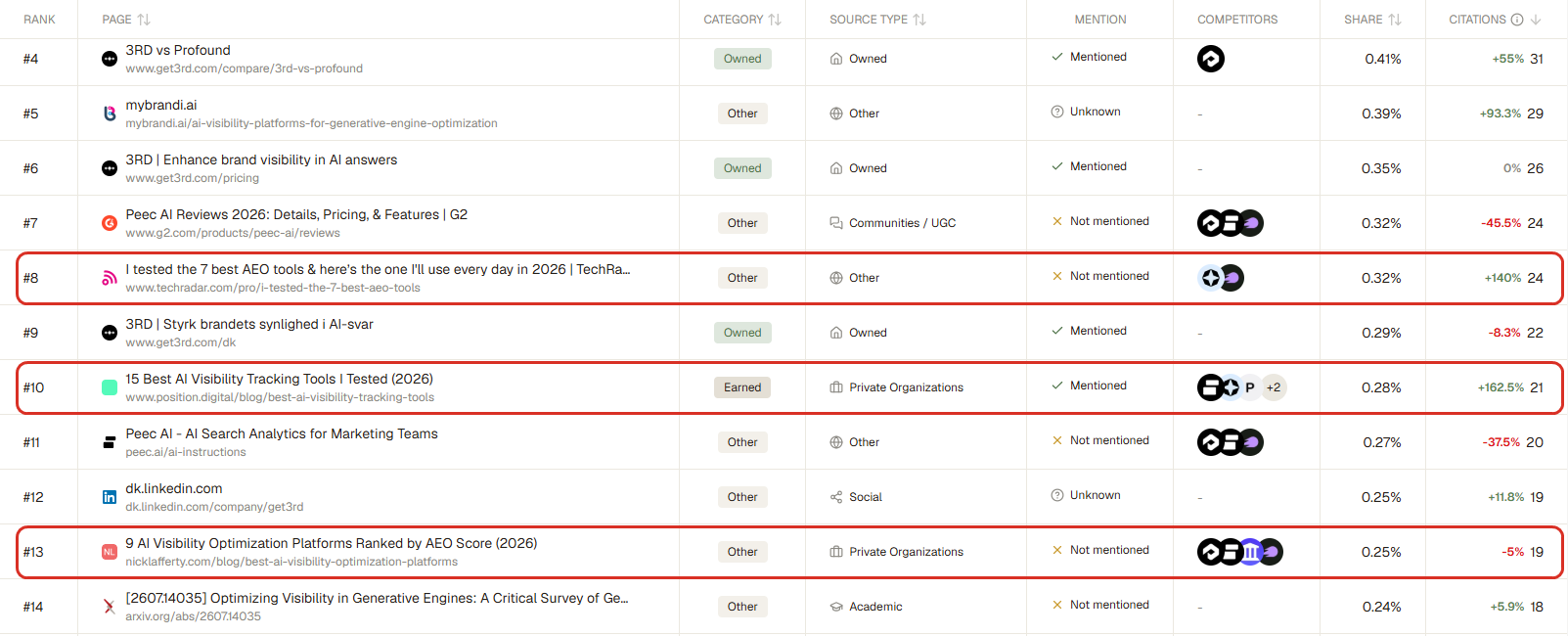
The pages AI cites for our category. Two lists name our competitors but not us. We earned a mention on the third.
That changes what "execution" has to cover. Writing your own pages is necessary. But most of what AI reads lives on someone else's site.
The four jobs that move AI answers
"Execute the fixes" covers four jobs. Software can take on a different share of each one.
|
Job |
What it involves |
How much software can do |
|---|---|---|
|
Content (your own pages) |
New pages for questions you have no answer to. Rewrites of pages that exist but never get cited. |
A lot. Drafting, restructuring and translating are where AI writing helps most. A person should still check facts and voice. |
|
Technical access |
Making sure AI crawlers can reach, identify and read your site: robots.txt, bot protection, structured data, page templates |
Some. Software can find and explain the issue. A developer usually makes the change, because many fixes are site-wide. |
|
Outreach (other people's pages) |
Getting featured on the third-party pages AI already cites: reviews, lists, comparisons, media |
Little. Software can rank the targets and write the angle. Relationships and the final pitch stay human. |
|
Paid placement |
Ads inside AI answers for the questions you can't yet win organically |
A fair amount. Campaign setup and copy can be drafted. Budget decisions stay yours. |
Here is how we decide which job to run for each gap. Treat it as our method, not a law.
|
Job |
Use it when |
What to do |
Who usually does it |
|---|---|---|---|
|
New content |
No page of yours answers the buyer question at all |
Publish one honest page per question cluster, built on the structure of the pages AI already cites |
Content marketer, drafted by a content agent |
|
Rewrite |
You have a relevant page, but AI never cites it |
Put the answer in the first lines, add a comparison table and a short FAQ, and update the date |
Page owner |
|
Technical fix |
Diagnostics flags blocked crawlers, missing structured data or JavaScript-only pages |
Fix it site-wide, once |
Web developer |
|
Outreach |
The cited sources name competitors but not you |
Pitch one specific angle to the page owner, with proof they can check |
Marketing or PR lead |
|
Paid placement |
A must-win question where organic work will take months |
Run a small campaign on that question while the organic work catches up |
Paid media owner |
This is why outreach matters so much. No platform can make another site mention you. The best it can do is tell you which site matters most, and why.
Nine options compared
Facts come from each vendor's own website, checked in October 2026. Vendors change fast, so check again before you buy.
|
Option |
Highest level |
What it does beyond tracking |
Publishing |
Markets |
Entry price |
|---|---|---|---|---|---|
|
3RD |
4: Draft (plus Plan) |
3RD Agent answers from your data and does the task you ask for. Playbooks rank tasks toward a goal. Content Agent drafts and rewrites pages in your brand voice. Outreach and technical tasks come with briefs and steps. |
You publish. Drafts can be pushed to HubSpot as drafts (beta). |
Each market is a country and a language. Any market from Pro. |
€99/month, 7-day trial |
|
Profound |
5: Auto-execute, after approval |
An AI Marketer plus agents and workflows that draft content and publish to your CMS after an approval step. Ads Studio. |
Direct to CMS after approval |
1 language and 1 region on the trial; custom on Enterprise |
7-day trial, then custom Enterprise pricing |
|
KIME |
5: Auto-execute |
Positions itself as an "agentic operating system". Its AWX agents run tasks such as outreach emails, website content and blog posts, and you choose which run automatically. |
Automatic runs, limited per plan |
Unlimited countries and languages |
Explorer €99/month, Core €399 |
|
AthenaHQ |
4: Draft |
A content optimization agent, content templates, press kits and an agentic copilot |
Shopify integration for publishing |
Not stated per market |
Free tier; Starter $295/month |
|
Peec AI |
3: Recommend and plan |
Actions: a prioritized list with the evidence behind each one, plus steps, owners and due dates. Content optimization suggests rewrites you edit and export. |
You publish |
1 country on Starter, 3 on Pro and Advanced |
€85/month |
|
Semrush AI Visibility Toolkit |
2: Recommend |
AI Visibility Score, share of voice, sentiment, and an AI search site audit inside the SEO suite |
You publish |
Tracking on platforms like ChatGPT and Google AI Mode |
$99/month for 25 prompts |
|
Otterly.AI |
2–3: Recommend, with briefs |
Monitoring, a GEO audit, crawlability checks and content briefs for weak pages |
You publish |
Not stated per market |
From $29/month |
|
Scrunch |
2: Recommend, plus an agent-facing site |
An Agent Experience Platform that serves a machine-readable version of your site to AI agents, plus recommendations |
No content publishing described |
Multi-region support |
Not published |
|
Agency or freelancer |
Done for you |
Whatever the contract covers |
They publish, or hand over to you |
Depends on the agency |
Typically a monthly retainer |
What each option gives you
3RD. You ask 3RD Agent what to focus on for your goal. It answers from your own data and shows the table behind the answer. Then you ask it to do the work. Content Agent drafts the page in the voice set in your Brand Profile, in each market's language. Every outreach and technical task comes with a brief and steps for whoever owns it. Nothing goes live without your team: you check it and publish. Choose 3RD if you want the specialist's know-how built in and the final say kept in-house. The limit is real: 3RD doesn't publish to your site or send outreach for you, and Content Agent is included from the Pro plan.
Profound. The deepest toolset for teams that want to build. Its agents draft content and publish to your CMS after an approval step, and it trains marketers as "marketing engineers" with a course and certification. Choose it if you have in-house AI visibility specialists, want to build agent workflows, or need a SOC 2 report today. Pricing past the trial is agreed with sales.
KIME. The most automated of the group. Its agents can run tasks such as outreach emails and blog posts on their own, within a monthly number of runs, and it tracks many engines with unlimited countries and languages on every plan. Choose it if you want automation first and are comfortable setting rules for what runs unattended.
AthenaHQ. Strong on content tooling, with an optimization agent, templates and press kits, and wide model coverage on paid plans. Choose it if content production is your main bottleneck and you sell through Shopify.
Peec AI. Clean analytics with a prioritized Actions list and content rewrite suggestions, at published prices close to 3RD's. Choose it if you have someone on the team who turns a list into a plan and does the work. It explains the problem well, but it doesn't write the page for you.
Semrush AI Visibility Toolkit. AI visibility next to your keyword data, in a tool your SEO team may already use. Choose it if SEO owns AI visibility and wants one suite. Expect to do the work yourself.
Otterly.AI. The cheapest way to start tracking, with briefs for weak pages. Choose it to learn where you stand before you commit a budget.
Scrunch. Takes a technical route: a machine-readable version of your site built for AI agents, plus enterprise controls. Choose it if your main gap is AI crawlers failing to read your site. Given the crawlability numbers above, check that this really is your gap first.
An agency. The only option where someone else does all four jobs, outreach included. Choose one if you have budget and no hands at all. Ask which tool they use to measure. Without one, you can't tell whether the work moved anything.
When to choose which
- You have no AI visibility specialist and limited time: pick a level 3–4 platform that plans and drafts, then name one owner for a few hours a week.
- You have specialists and want to build: a platform with agents and workflows, such as Profound, gives them the most to build with.
- You want work to happen without review: a level 5 platform such as KIME, with clear rules for what runs alone.
- SEO owns this and already lives in one suite: Semrush's toolkit, if tracking plus audits is enough.
- Your main problem is AI crawlers failing to read your site: start with the technical fixes. Every platform here flags them, and Scrunch builds the agent-facing layer.
- You need outreach done, not just planned: an agency or a PR partner, measured with a platform.
- You sell in several countries and languages: check how each tool counts a market. A country in two languages can produce two different answers.
Five ways "execution" fails
These are the failure modes we see most often, in our own work and in the accounts we track. Each has a name, because named problems get fixed faster.
- Dashboard drift. The tool reports every week and nobody owns the next step. Fix: one named owner and a fixed weekly slot.
- Draft pile-up. A content agent writes ten drafts and two get published. Fix: draft only what you will review that week. A published page beats ten drafts.
- Autopilot drift. Unreviewed content slowly changes your voice or repeats an outdated fact. Fix: a person approves anything public, at least until the rules are proven.
- Outreach orphan. The platform finds the lists that matter, and nobody pitches them. Fix: give outreach its own owner. It is the job software helps with least.
- The before-and-after illusion. A task ships, the number moves, and the team calls it a win. Often it's just noise. Of 117 completed tasks we could compare against a control group of the same brand's untouched questions, 29% moved up more than 5 points relative to the control, 26% moved down more than 5 points, and 44% stayed within that band. Fix: judge work against a control, over weeks, not on one reading.
That last one isn't an argument against doing the work. Single tasks are noisy, so you need a platform that measures the trend on the questions a task targeted. A daily number won't tell you.
How to test "execution" claims in a free trial
Most platforms offer about seven days. Use them on your own brand and ask these seven questions.
- Does it tell me why AI picks a competitor, in plain language? A score without a reason leaves you guessing.
- Does it rank the work toward a goal I set? A list of 40 equal suggestions is a to-do list, not a plan.
- Can it draft the top task now? Ask for the page or the brief, not a summary of what the page should say.
- Does the draft sound like us? Check voice, facts and the non-English versions.
- What happens to outreach and technical tasks? Look for a brief and steps that someone else can pick up.
- What goes live without a person? Get the exact answer in writing.
- How will I know it worked? Look for a trend on the questions the task targeted, compared with the questions it didn't touch.
What the work looks like in 3RD: our own loop
Here is the loop we ran to produce this article, step by step, with screens from our own workspace.
1. The gap. Diagnostics breaks visibility down by topic. For "Vendor Shortlisting & Comparison" in Denmark, we sat at 0.0%, eighth of fourteen, while Profound led at 72.9%.
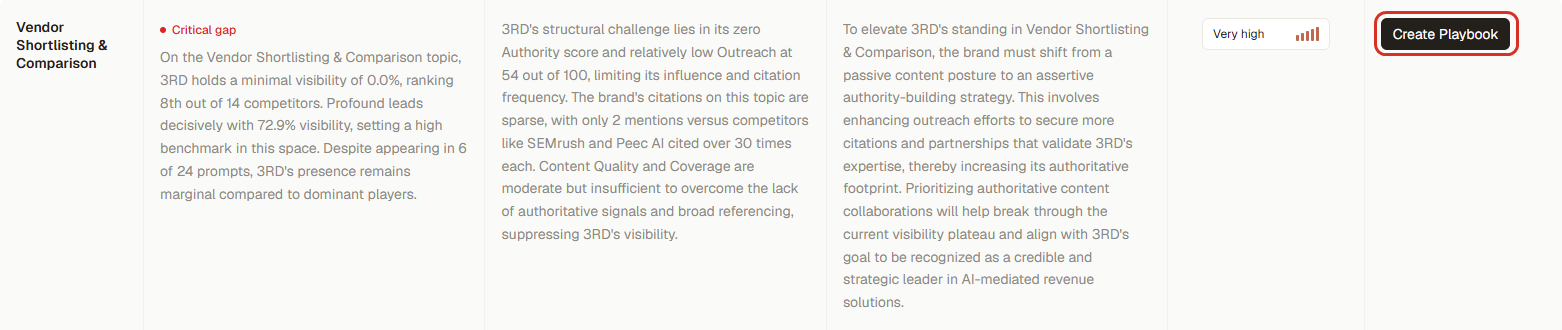
Each topic gets a situation, the issues behind it, a proposed approach and a one-click Playbook.
2. The plan. The Playbook turns gaps into tasks on a board, each tagged with the driver it moves: content coverage, agent readiness, authority, outreach.
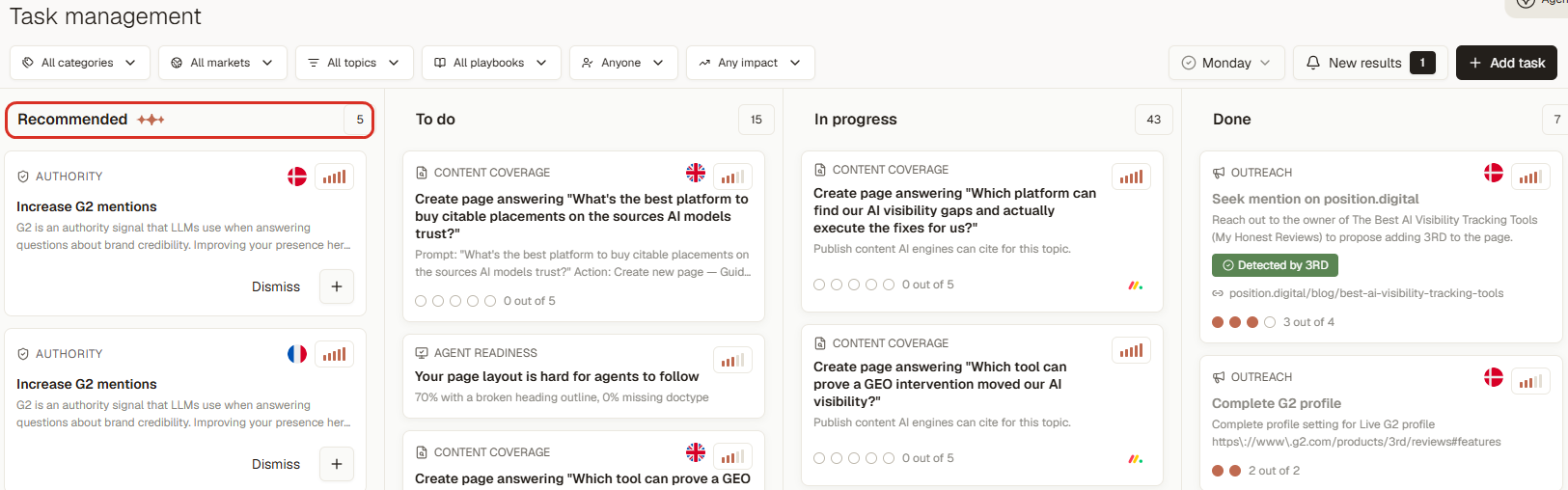
The task board: recommended next, to do, in progress and done. Each card is tagged with the driver it moves.
3. The brief and the draft. Every content task comes with a checklist and a brief built from the pages AI already cites. "Create with agent" hands it to Content Agent.
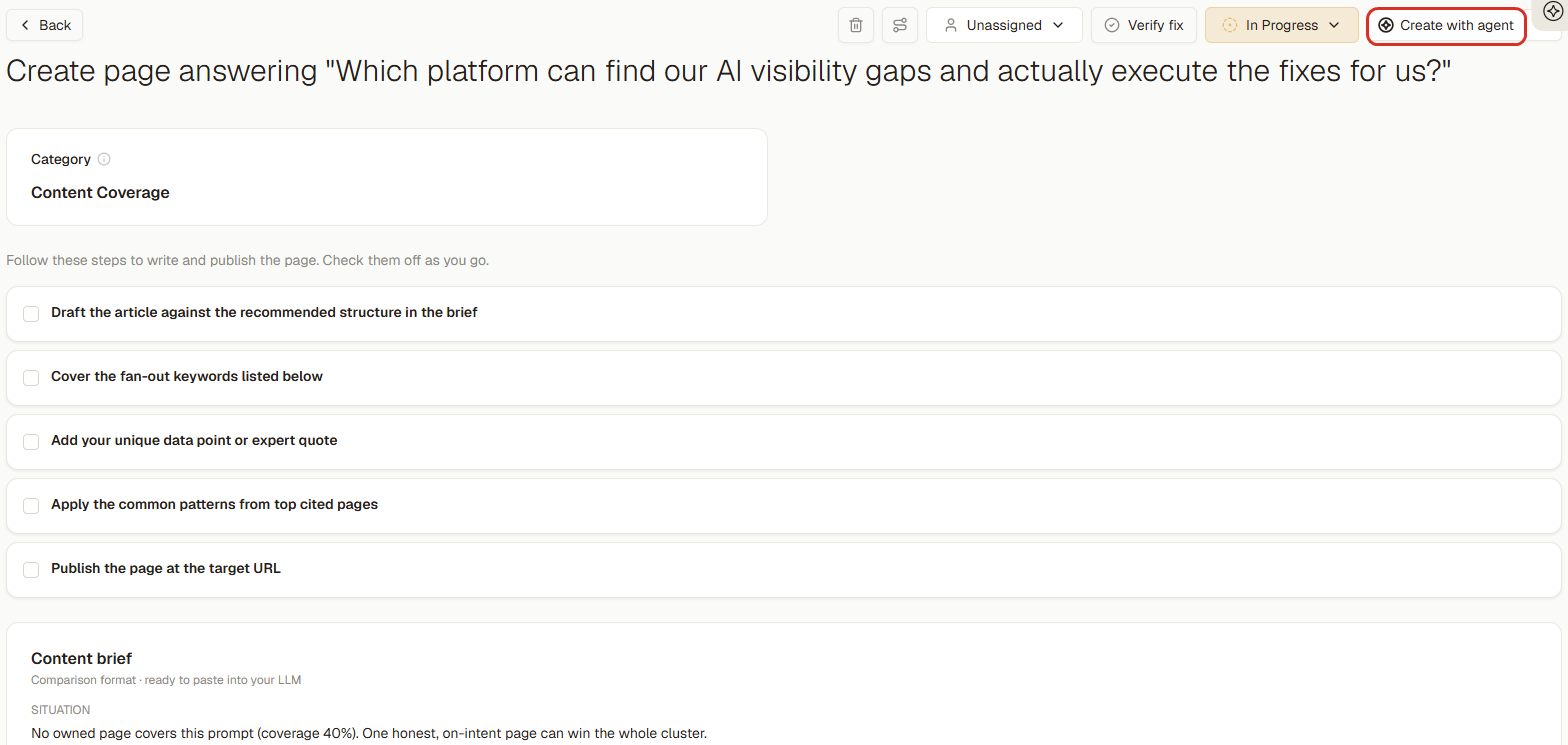
Every content task comes with a checklist. "Create with agent" hands the draft to 3RD's Content Agent.
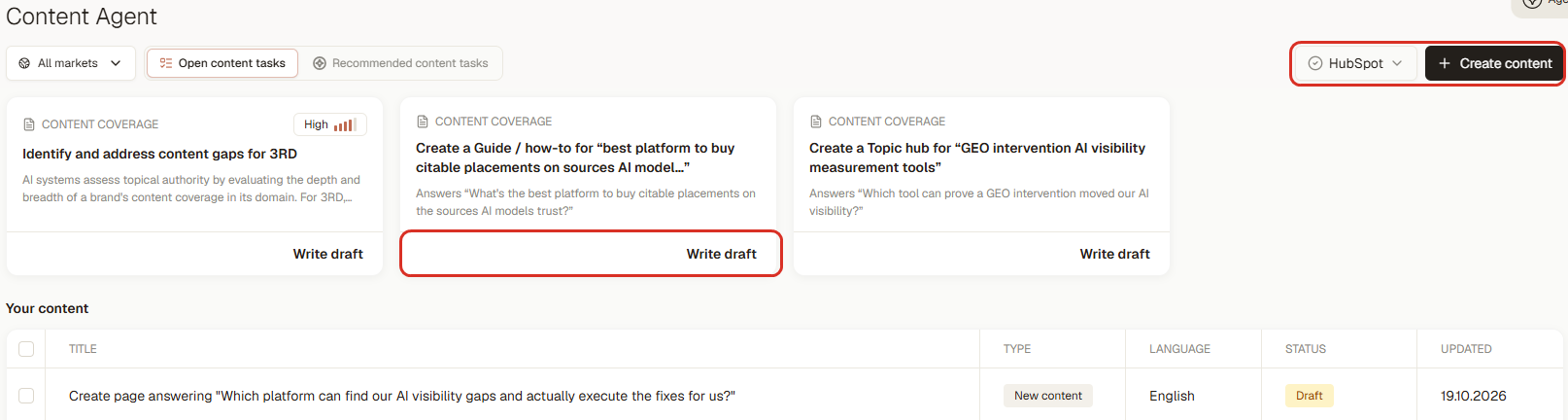
Content Agent drafts each page from its brief. You review it and publish. The HubSpot connection sends it to your CMS as a draft.
4. The edit. This is the step software doesn't do for you. I rewrote the draft, added our own data and screenshots, and checked every competitor fact against the vendor's website. That took most of the time, and it's where the page got good.
5. Outreach, in parallel. The citation view showed which "best tools" lists name competitors but not us. Each became an outreach task. When one of those pages started mentioning 3RD, the platform detected it and closed the task.
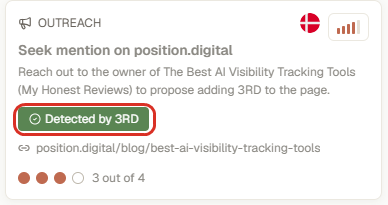
3RD detects when an outreach target starts mentioning you and closes the task.
6. Live, then measured. We publish. Then we watch the trend on the questions this page targets, against the questions it doesn't touch. Expect days to weeks before a new page shows up in answers, because AI models re-crawl on their own schedules.
3RD did the diagnosis, the plan, the brief and the first draft. We did the edit, the publishing and the pitching. That split is level 4, and I think it's the right one for most marketing teams.
What one person can do with a plan
Boë Beauté is a Danish skincare brand with no GEO or SEO specialist. It went from 0.0% to 22.2% AI visibility in one quarter and reached the top five of seven competitors. One in-house marketer did the work in a few hours a week, alongside other responsibilities. Read the case
Manyone, a strategy and design company, went from No. 5 to No. 1 in strategic design in four months, ahead of Designit, Accenture Song, McKinsey and frog. Its own team read the data, chose the work and did it. No new department or agency was needed. Read the case
Neither result came from automation. Both came from a plan that told a small team what to do first, and from people who did it.
About the data
The aggregate figures in this article come from brands tracked in 3RD between September 19 and October 18, 2026: 100 brands and 5.9 million citations for the source figures, and 60 brands for recommendation rates and driver scores. Task outcomes come from 117 completed tasks with a control group, finished between February and October 2026. The sample leans toward Nordic brands, the data is anonymised and aggregated, and it shows correlation, not cause.
Frequently asked questions
Can any AI visibility platform do all the work for us?
No. Software can draft content, plan the work and flag technical issues. Outreach relationships, site-wide technical changes and final approval still need people. Only an agency takes all four jobs off your plate.
Is auto-publishing a good idea?
Only with rules you trust. Auto-publishing saves time, but it can change your brand voice or repeat a wrong fact at scale. Most marketing teams prefer drafts they review. You still save the time it takes to write.
Do we need to hire an AI visibility specialist?
Not necessarily. A platform that explains the cause and ranks the work lets a generalist marketer act. Boë Beauté did it with one in-house marketer for a few hours a week. Name one owner, though. Work spread across teams with no owner rarely ships.
How long until the work shows up in AI answers?
Days to weeks for a single page. AI models re-crawl and re-learn on their own schedules. Single readings are also noisy, so track the trend on the questions a task targets and compare it with the questions it didn't touch.
Platform or agency: which is cheaper?
It depends on who does the work. A platform costs less per month but needs your team's hours. An agency costs more but supplies the hours. Many teams combine the two: a platform to plan and measure, and an agency or PR partner for outreach.
Your next step
Write down the four jobs (content, technical, outreach and paid) and mark which ones your team has hours for. Then trial one platform on your own brand. Judge it on whether the first task gets done in week one.
Start a 7-day free trial or see how 3RD works.
Competitor details are from each vendor's website, checked in October 2026. See our side-by-side comparisons with Profound, Peec AI, KIME and Semrush.