AI search
The best European AI visibility platform: languages, markets and EU requirements (2026)
How to choose an AI visibility platform for European markets: country–language tracking, local-language drafts, EU hosting, GDPR and the AI Act.
Contents
Short answer: choose a platform that tracks each country–language pair separately, drafts in native-quality local language, keeps your data in the EU under a DPA, and is clear about US model processing.
Most "best AI visibility tool" lists are written from the US. They test in English, in one market, and treat Europe as a translation setting. If you sell in Denmark, Germany, France and the UK, that misses the problem. AI assistants don't give the same answer in four languages. They give four different answers, citing four different sets of local sources.
I've run marketing across Nordic and European markets for most of my career, from e-commerce stores in Denmark, Sweden, Norway and the UK to B2B demand generation across the EU. The tool question for a European team is never just "does it support German?" It's three questions:
- Does it measure each market as its own market?
- Can it help us produce work that reads as written locally?
- Will our legal and security teams sign off on it?
This guide compares the platforms on those three questions, and is honest about where a US tool is the better choice.
A note on bias: I work at 3RD, a Danish company, and 3RD is on this list. Competitor facts come from each vendor's own website, checked on October 19, 2026, with sources at the end. Where a vendor doesn't publish something, I say so.
What "European" should actually mean
"European" is often used to mean "headquartered in Europe". That's the least important part. Here's what matters, in order.
|
What to check |
Why it matters |
What to ask the vendor |
|---|---|---|
|
Markets are country + language |
AI answers differ by country and by language. Denmark in Danish and Denmark in English are different answers |
"Is Switzerland–German a separate market from Switzerland–French?" |
|
Prompts run in the local language |
A question translated from English isn't the question a German buyer types |
"Who writes the prompts, and in which language?" |
|
Local-language work |
Briefs and drafts have to read as written in that language |
"Can I see a draft in Danish or Finnish?" |
|
Local sources |
AI cites different publications, review sites and directories per market |
"Can I see cited sources per market?" |
|
EU data hosting |
Your workspace data should stay in the EU |
"Which cloud regions? Where are backups?" |
|
DPA and sub-processors |
GDPR needs a data processing agreement and a list of who processes what, where |
"Send me the DPA and the sub-processor list" |
|
Honesty about US processing |
Every platform sends prompts to US-built AI models, because that's what it measures |
"Which steps send data to the US, under what safeguards?" |
|
Editorial control |
The EU AI Act's transparency rules for AI-generated text depend on human review |
"Can anything go live without our approval?" |
The last two rows are where vendors are least clear. More on both below.
Why each market needs its own measurement
Here's the clearest example I have, from our own account. 3RD tracks the same category of buyer questions ("which AI visibility platform should we use?") in five markets. In the 30 days to October 19, 2026, the leading platform was different by market:
|
Market |
Tracked questions with competitor data |
Leader |
Leader's visibility |
|---|---|---|---|
|
Denmark |
10 |
Peec AI |
53% |
|
France |
9 |
Profound |
44% |
|
United Kingdom |
11 |
Profound |
29% |
Same category, same month, different winner. In Denmark, Peec AI is named in about half the answers; in the UK, the leader is named in fewer than a third. If you only tracked English, you'd never see that Denmark is a different race.
These are small prompt sets (9–11 questions per market with competitor data), so read them as direction. Our German set has only four such questions, too few to report.
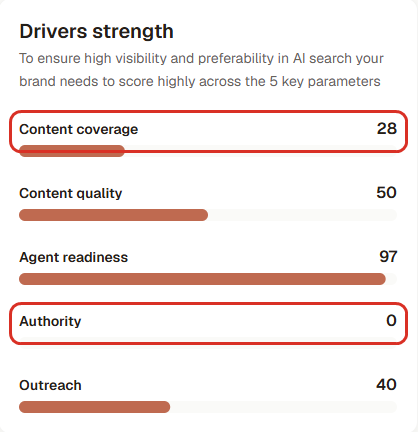
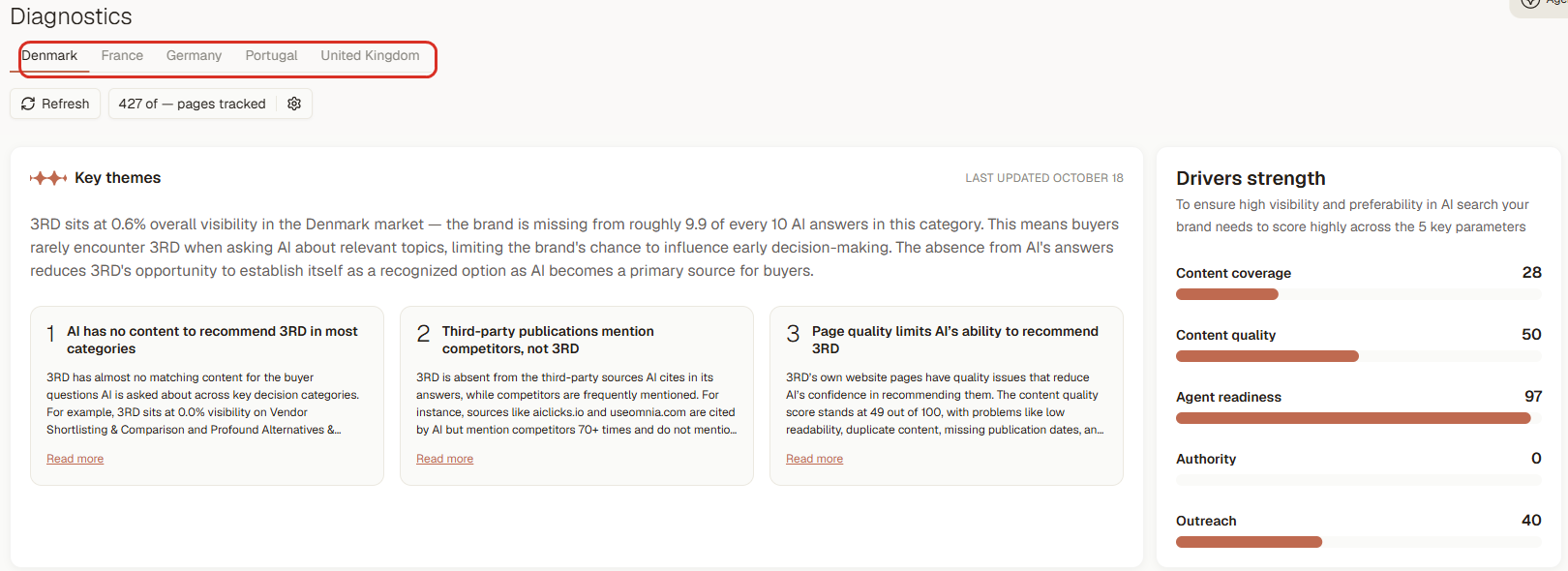
Our Diagnostics shows the same thing in plain words. In the UK, the problem is that buyers meet Profound first. In Denmark, the problem is that we have no content for most buyer questions, and Danish third-party pages name our competitors instead of us.
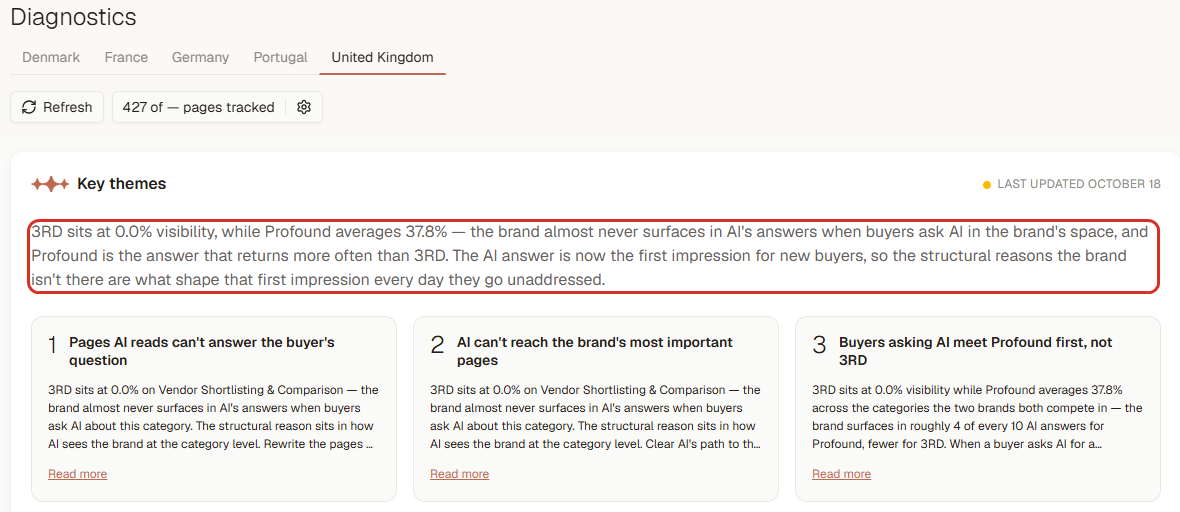
Diagnostics in the UK market: buyers asking AI meet Profound first.
The Denmark diagnosis is a different problem: no content for most buyer questions, and Danish third-party pages name our competitors.
Two markets, two diagnoses, two different plans. That's the case for country–language tracking in one example.
Models disagree too
It isn't only markets. Across 60 brands we track, 62% (37 of 60) had a different leading competitor on different AI assistants for the same questions. Within a brand, the gap between its best and worst assistant was a median 16 points.
So the unit of measurement for a European brand is market × model, not "Europe".
For how to set this up step by step, see how to track AI visibility by country and language. This page stays on choosing the platform.
The platforms compared
|
Platform |
Based in |
Data hosting (as published) |
Markets and languages |
Local-language work |
Security documents |
|---|---|---|---|---|---|
|
3RD |
Copenhagen, Denmark |
AWS (Frankfurt, Ireland) and Google Cloud (Belgium, Finland, Netherlands); AI analysis via OpenAI, Anthropic and Google in the USA under SCCs |
A market is one country in one language; any market from Pro |
Content Agent drafts per market, with a native-language proofread on every non-English draft |
DPA for every customer, sub-processor list, pen-test summary on request; no SOC 2 or ISO 27001 yet |
|
KIME |
Copenhagen, Denmark |
Not stated on the pages checked |
Unlimited countries and languages on every plan; each engine run in the market's language |
AWX agents carry out tasks |
Not stated on the pages checked |
|
Peec AI |
Berlin, Germany |
Google Cloud via Google Ireland; transfers to the US possible under the EU-US Data Privacy Framework or SCCs (privacy policy) |
Several countries from Pro |
Content optimization suggestions |
DPA linked |
|
Otterly |
Austria |
Not stated on the pricing page |
Pricing page says both "Unlimited Countries & Languages" and "Multi-country support (50+)" |
Recommendations |
Not stated on the pricing page |
|
Profound |
New York, USA |
Not stated on the pricing page |
Custom languages and regions on Enterprise; 1 language, 1 region on the trial |
Agents draft and publish to your CMS after approval |
SOC 2, SSO and SAML on Enterprise |
|
Semrush AI Visibility Toolkit |
Boston, USA |
Not stated on the pricing page |
Not stated on the pricing page |
Inside the Semrush suite |
Semrush company-level documents |
|
Scrunch |
USA |
Not stated on the pricing page |
Not stated on the pricing page |
Page audits; AXP |
SAML and OIDC SSO on Enterprise |
|
AthenaHQ |
San Francisco, USA |
Not stated on the pages checked |
One region and language on Starter; multi-region on Enterprise |
Content optimization agent |
Not stated on the pages checked |
Facts as published on each vendor's own pages, October 19, 2026. "Not stated" means we couldn't find it on the public pages we checked, not that the vendor doesn't have it. Ask for it.
What each one is best for, from a European angle
3RD. Best for European marketing teams selling in several countries and languages who want a plan and drafts, not only a dashboard. Every market is tracked and diagnosed on its own, and the team behind it includes country managers for France, the UK and Portugal. Falls short on: no SOC 2 or ISO 27001 report yet (controls follow both frameworks, and documentation is available to Agency and Enterprise customers), and SAML single sign-on is by agreement on Enterprise. Prices from €99 a month; any market from Pro (€299).
KIME. Best for teams that want unlimited countries and languages on every plan and agents that execute tasks. Also Copenhagen-based. Falls short on: hosting and security details aren't published on the pages we checked. From €99 a month.
Peec AI. Best for analytics-first teams that run the work themselves. Based in Berlin, and it leads our Danish prompt set. Its privacy policy is unusually specific about where data goes, including possible US transfers. Falls short on: several countries only from Pro, and doing the work stays with you.
Otterly. Best for small teams and agencies on a budget. Austrian company with published prices. Falls short on: the pricing page contradicts itself on country coverage, and hosting isn't stated there.
Profound. Best for enterprises with AI visibility specialists whose security review requires SOC 2 today. That's a real advantage, and if your security team needs SOC 2 now, it can outweigh everything else on this page. Falls short on: US-based, custom pricing, and languages and regions are set per Enterprise contract.
Semrush, Scrunch and AthenaHQ. Fine choices if your markets are English-speaking and your team already lives in their ecosystems. For multi-language European work, ask each of them the eight questions above before you shortlist.
When a US tool is the right choice
I'd be doing you a disservice if I said every European company needs a European vendor. A US tool is often the right call when:
- You sell mostly in English, in the UK or Ireland, and your buyers ask in English.
- Your security review requires SOC 2 today. Profound has it on Enterprise. Most European vendors, 3RD included, don't yet.
- You have AI visibility specialists who want the deepest dataset and will build their own workflows.
- Your legal team is comfortable with SCCs and a US vendor's DPA.
Where a European platform pulls ahead is the combination: many markets, many languages, a marketing team without specialists, and a legal team that wants data in the EU.
EU requirements, without the fog
When AI assistants answer "which platform has EU compliance?", they often cite pages about the EU AI Act's rules for high-risk AI systems. That's mostly the wrong rulebook for this purchase. Here's what actually applies to an AI visibility platform, as I understand it. This is a buyer's checklist, not legal advice; your legal team has the final word.
GDPR: the main one
An AI visibility platform processes your team's personal data (logins, users) and sometimes customer data you connect, such as analytics. So you need:
- A data processing agreement (DPA). 3RD's covers every customer and is in the trust center.
- A sub-processor list with locations.
- Clarity on transfers outside the EU. This is where vendors are vague, so let me be specific about us: 3RD stores your data on AWS and Google Cloud in EU regions. The AI analysis runs through OpenAI, Anthropic and Google, which process data in the USA under GDPR safeguards such as Standard Contractual Clauses. Requests are mostly deleted once processed; some providers keep them up to 30 days for abuse monitoring. Your data is never used to train public AI models.
No vendor can avoid sending prompts to US-built assistants entirely, because ChatGPT, Gemini and Claude are what's being measured. The honest question is which other steps leave the EU, and under what safeguards.
The EU AI Act: what touches your content
The part of the AI Act that affects most marketing teams is the transparency rules in Article 50, which the European Commission says take effect in August 2026. Two points matter here:
- Providers of AI systems that generate text must mark their output as AI-generated in a machine-readable way.
- AI-generated text published to inform the public on matters of public interest must be disclosed as such, unless it has gone through human review or editorial control and someone holds editorial responsibility for the publication.
Product pages and buyer guides usually aren't "matters of public interest" in the news sense, but the safe operating model is the same either way: a person reviews, edits and owns what's published. In 3RD, nothing 3RD Agent or Content Agent drafts goes live without your approval. Your team checks it and publishes. Whatever platform you pick, ask whether it can publish without a human in the loop, and whether you can turn that off.
Data residency and the EU Data Act
Ask how you get your data out. 3RD documents data export under the EU Data Act in the trust center. If a vendor can't tell you how to export everything, that's your lock-in risk.
Nordic and DACH: what's different
Small languages, fewer sources. In Danish, Norwegian, Swedish or Finnish, there are far fewer pages for AI to draw on than in English or German. Each local review site, trade body and publication carries more weight. Across 100 brands we track, competitors' websites out-cited the brand's own site for 41 of 100, and most citations went to a long tail of niche sites: associations, directories and specialist blogs. In a small language, that long tail is short, so getting onto it matters more.
Bilingual markets. Many Nordic buyers ask in English as well as their own language, and Switzerland has three main languages. Track each language as its own market. 3RD treats Switzerland–German and Switzerland–English as two separate markets for exactly this reason.
DACH buyers ask about data first. In German-speaking markets, the DPA, hosting regions and sub-processors usually come up in the first call, not the last. Have them ready before the demo.
The data in this guide leans Nordic. Most brands in our sample are Danish. That's useful if you're a Nordic team, and it's a caveat if you're not.
A buyer's checklist for European teams
Ask every vendor on your shortlist:
- Is a market one country in one language? Show me Denmark–Danish and Denmark–English side by side.
- Who writes the prompts, and are they written in the local language from scratch?
- Show me a draft in our smallest language. Who proofreads it?
- Can I see cited sources per market?
- Which cloud regions hold our data, including backups?
- Send the DPA and the sub-processor list with locations.
- Which steps send data to the US, and under what safeguards?
- Can anything be published without our approval?
- What security documents can our team review today (SOC 2, ISO 27001, pen-test summary)?
- How do we export all our data if we leave?
A vendor that answers all ten in writing within a week is a vendor your legal team will sign off on.
For the general evaluation criteria, see how to choose an AI visibility platform.
How this looks in 3RD
Our own workspace tracks five markets: Denmark (in Danish and English), France, Germany, Portugal and the UK.
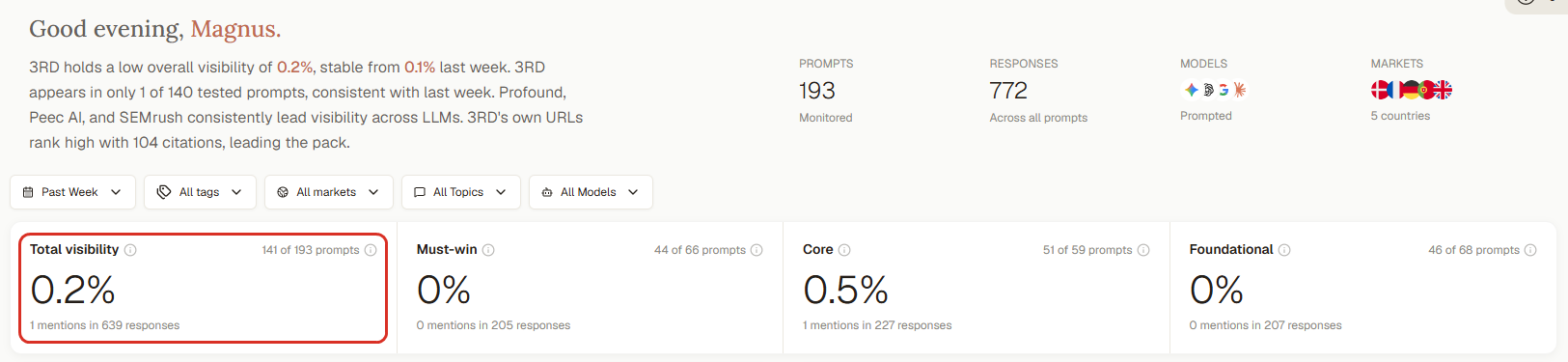
Our own starting point: 3RD at 0.2% visibility across 193 tracked buyer questions in five markets.
Prompts are grouped by topic and tracked per market, so you can see which topics you lose in which country.
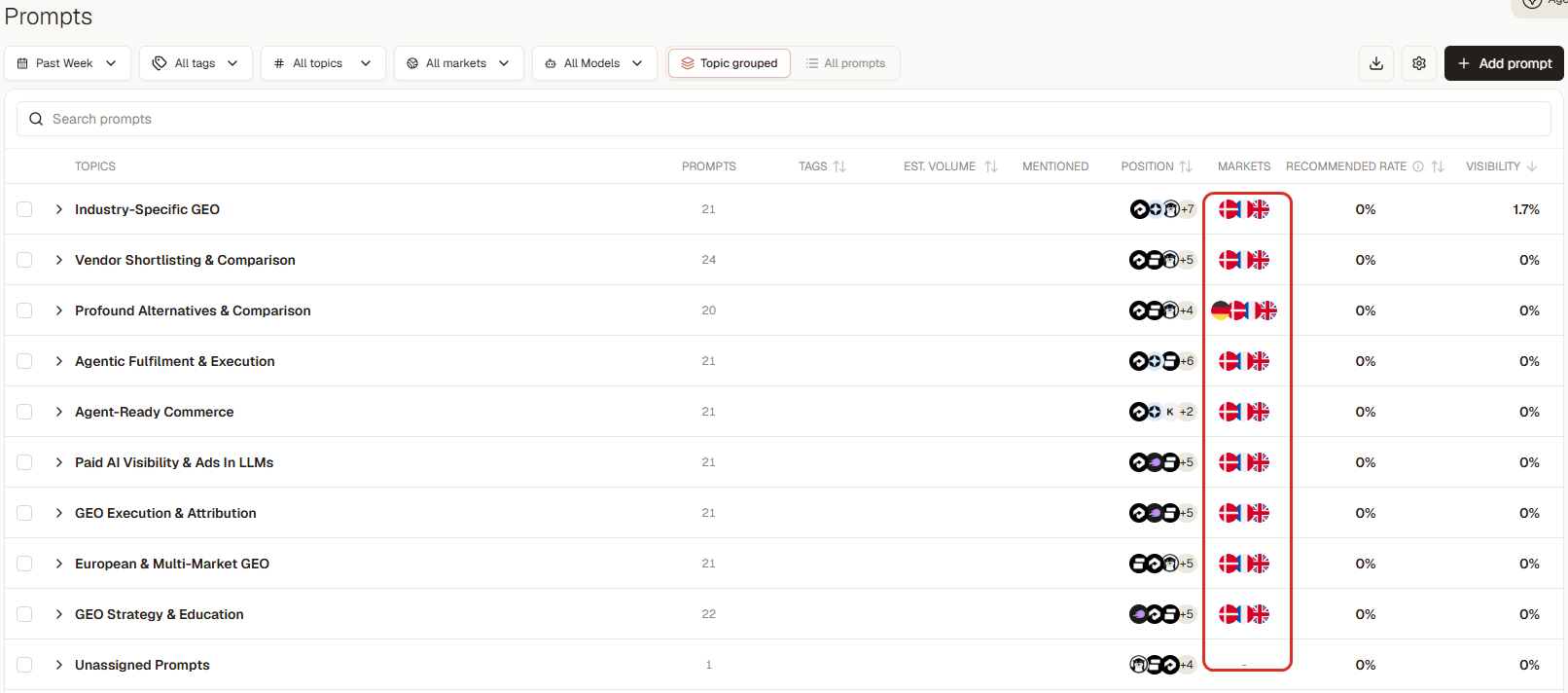
193 buyer questions grouped into nine topics, tracked per market.
Diagnostics, Playbooks and drafts then run per market. Content Agent drafts in the market's language, and every non-English draft gets a native-language proofread automatically. Your team still checks it and publishes.
We're not where we want to be. In our own tracking we're ninth of fourteen, and our visibility is near zero in every market. We asked 3RD Agent what to do first, and it told us to build the pages that answer buyer questions. This is one of them, and its Danish and French versions will follow.
About the data
The market comparison comes from 3RD's own account (competitor ranking per market, September 19 to October 18, 2026). The benchmarks come from brands tracked in 3RD in the same window: 60 brands for the model figures and 100 brands (5.9 million citations) for the source figures. The sample comes from 51 customer organizations and leans toward the Nordics, mostly Denmark. All data is anonymized and aggregated; no brand is named.
FAQ
What is the best European AI visibility platform? The best one for you tracks each country–language pair separately, works in your local languages, keeps data in the EU under a DPA and is clear about US processing. 3RD and KIME (both Copenhagen), Peec AI (Berlin) and Otterly (Austria) are European options; they differ on languages, who does the work, and published security detail.
Is there a GDPR-compliant AI visibility tool? Look for a DPA, a sub-processor list and EU hosting, then ask which steps leave the EU. 3RD hosts data in EU regions and states that its AI analysis runs through US providers under Standard Contractual Clauses. Every platform sends prompts to US-built assistants, because that's what it measures.
Does the EU AI Act apply to AI visibility tools? Mostly through the transparency rules for AI-generated content, which take effect in August 2026. The practical rule: keep a person reviewing and owning what you publish. Confirm the details with your legal team.
Why track AI visibility by country and language? Because the answers differ. In our own tracking, Peec AI led in Denmark at 53% while Profound led in France (44%) and the UK (29%), in the same category and month.
Which GEO platform should a Nordic or DACH company choose? One that treats each country and language as its own market, drafts in small languages at native quality, and gives your legal team the DPA and hosting details up front. If your security review needs SOC 2 today, weigh that first.
Start a 7-day trial with your own markets, or read how 3RD measures.