AI search
How to track AI visibility by country and language
AI answers change by country and by language. Here is how to set up markets, write native prompts, size each set and report across markets.
Contents
Track each country–language pair as its own market, with native prompts written the way local buyers ask. Never average markets into one number.
That is the short version. The longer version matters, because the mistakes here are expensive and quiet. A single global score can tell you that you are fine while you are invisible in the market where most of your revenue sits.
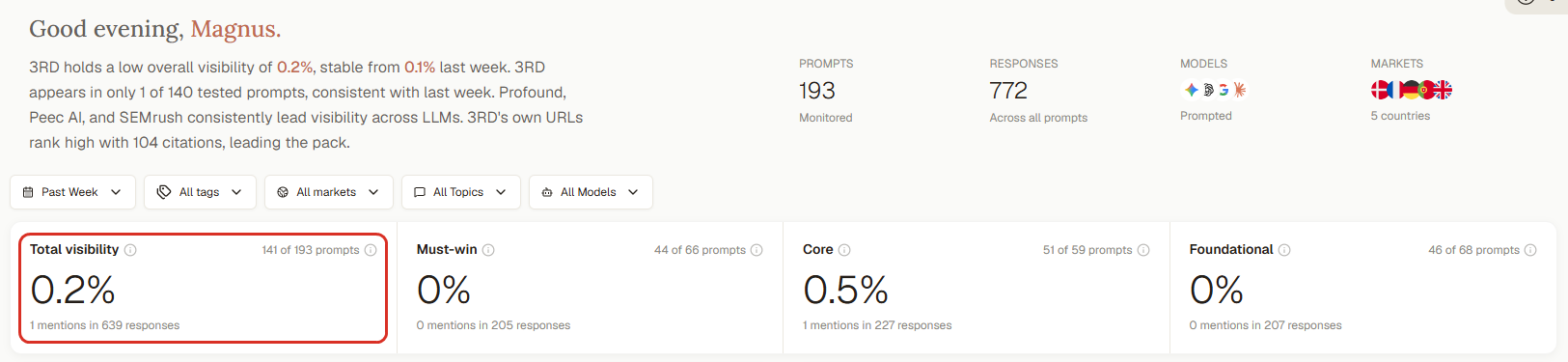
Here is what I mean, from our own account. 3RD tracks five markets: Denmark, France, Germany, Portugal and the UK. In the 30 days to October 19, 2026, the competitor that led our category was a different company depending on where we looked:
|
Market |
Leader in our category |
Leader's visibility |
Our visibility |
|---|---|---|---|
|
Denmark (all prompts) |
Peec AI |
53% |
0.3% |
|
Denmark, Danish-language prompts |
Peec AI |
50% |
0.3% |
|
Denmark, English-language prompts (4 prompts) |
Profound |
100% |
0% |
|
United Kingdom |
Profound |
29% |
0% |
Source: 3RD's own tracking, competitor ranking per market, Sep 19 – Oct 19, 2026.
Same category. Same competitors. Same month. A different winner in Copenhagen than in London, and a different winner again when the same Danish buyer asks in English.
The last row also shows the second lesson of this guide: four prompts are not enough to conclude anything. Profound at 100% on four prompts is a hint, not a finding. I'll come back to sample size in step 3.
This guide covers how to set markets up, how to write prompts per market, how big each prompt set needs to be, and how to report across markets without lying to yourself. If you are new to measuring AI visibility at all, start with how to measure your brand's visibility in ChatGPT, Perplexity and Google AI Overviews, then come back. If you are choosing a vendor for multi-market tracking, see the best European AI visibility platform.
The short answer
- A market is a country plus a language. Denmark in Danish and Denmark in English are two markets, because AI answers each one differently.
- Write prompts natively. Translate a prompt and you measure a question nobody asks.
- Balance the sets. Same topics and the same prompt-type mix in every market, so the numbers are comparable.
- Size each set for the decision you want to make. Small sets swing about twice as much as large ones.
- Pick assistants per market. Which assistant favors you differs, and it differs by a lot.
- Read cited sources per market. The pages AI leans on are partly local, so your outreach list is too.
- Report per market, never as one blended average.
Why one global number misleads
A blended number hides three things that matter to a multi-market team.
Different leaders. In our data across customer brands, the competitor with the highest visibility differed by assistant for 62% of brands (37 of 60). Add markets on top and the picture fragments further. A brand can lead in one country and be absent in the next, and an average of the two describes neither.
Different sources. AI answers lean on third-party pages, and many of those pages are local. A Danish answer can cite a Danish LinkedIn post or a Danish trade publication that never appears in a UK answer.
Different noise. Smaller markets usually get smaller prompt sets. Smaller sets swing more. If you average a noisy small market with a stable large one, the small market's random swings show up as movement in your headline number.
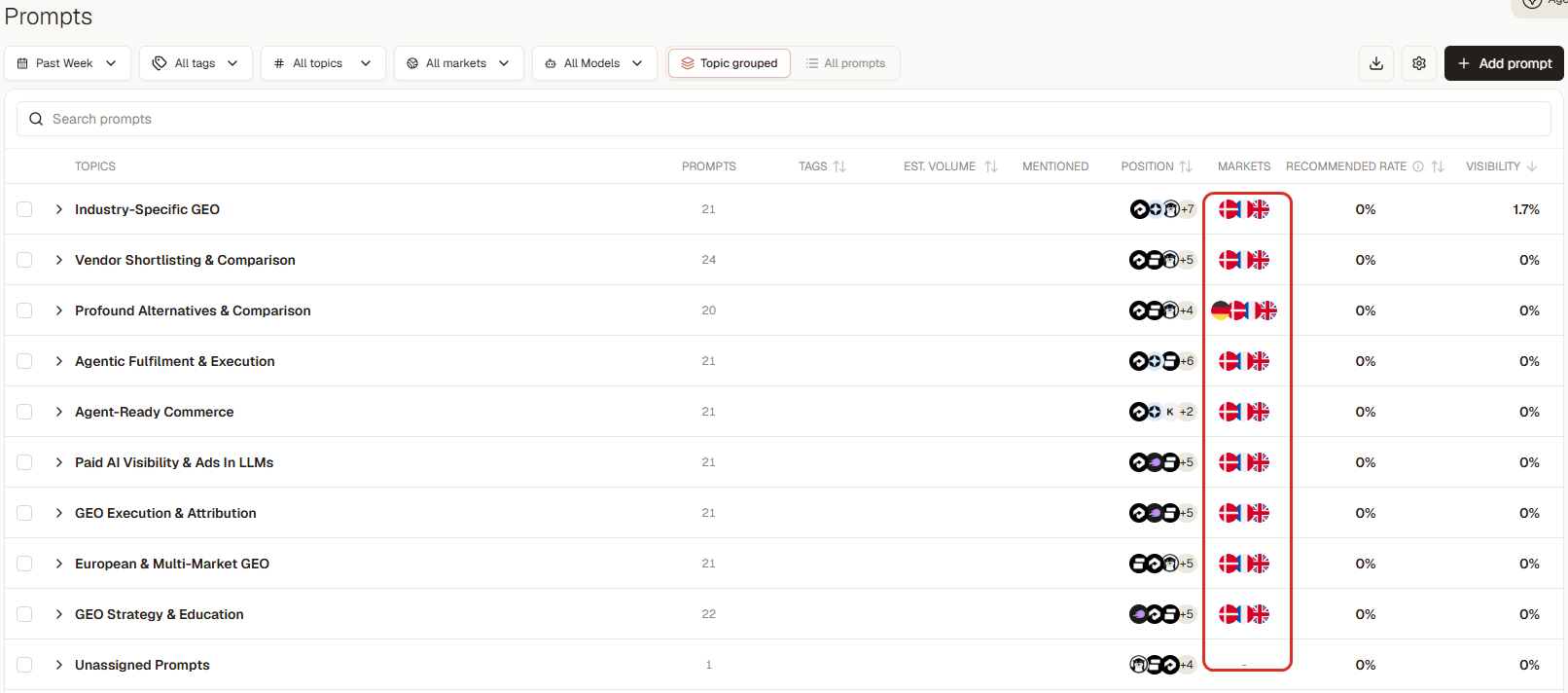
Our own prompt set: nine topics, each tracked per market. The flags show which country–language pairs each topic runs in.
What you need first
|
You need |
Why |
Where it comes from |
|---|---|---|
|
A list of the countries you sell in, ranked by revenue or pipeline |
Decides which markets get the most prompts |
Finance or CRM |
|
The language your buyers use in each country |
Decides how many markets you really have |
Sales and customer success |
|
Local competitors per country |
Your rank depends on the set you compare against |
Sales, win/loss notes |
|
One native speaker per language |
To write and review prompts |
Your team, a local partner or agency |
|
A prompt budget |
Prompts × assistants × markets is what you pay for |
Your plan or tool pricing |
Step 1: Define markets as country–language pairs
The most common setup mistake is to think in countries. Think in pairs.
Ask two questions per country:
- Which language do buyers in this country use when they research what you sell?
- Do some buyers switch language for this kind of question?
In many European countries the answer to the second question is yes. Danish and Dutch professionals often research software in English. Belgian buyers split between French and Dutch. Swiss buyers split between German, French and Italian. Each of those is a separate market, because the answer to an English question asked from Denmark is not the answer to the same question asked in Danish.
Our own setup shows the effect. Our Denmark market runs prompts in both Danish and English. On the Danish prompts, Peec AI led at 50%. On the small English set, Profound appeared in every answer. We would never have seen that split with one "Denmark" market.
Rule of thumb we use: if more than roughly a fifth of a country's buyers research your category in a second language, track that language as its own market. If fewer do, put your budget into the main language first.
Step 2: Write native prompts, don't translate
A translated prompt measures a question that nobody local asks. Buyers in each country use their own words, their own reference points and their own competitors.
Three things change when you write natively:
- The words. The category name often differs from the literal translation. A Danish buyer is more likely to ask whether a tool can see "om vi bliver nævnt i ChatGPT" (whether we are mentioned in ChatGPT) than to use a translated category label like "AI-synlighedsplatform".
- The frame. Buyers in different countries anchor on different things: price in local currency, local compliance, local service, a local reference customer.
- The competitors. A local challenger may matter more than the global leader. If you leave it out, you misread your rank.
Here is the same buying intent, written three ways:
|
Market |
Translated prompt (weak) |
Native prompt (better) |
|---|---|---|
|
UK, English |
Which platform best turns AI visibility insights into an execution plan? |
Which platform best turns AI visibility insights into an execution plan? |
|
Denmark, Danish |
Hvilken platform omsætter bedst AI-synlighedsindsigter til en eksekveringsplan? |
Hvilket værktøj kan fortælle os, hvad vi skal gøre for at blive nævnt i ChatGPT? |
|
France, French |
Quelle plateforme transforme le mieux les insights de visibilité IA en plan d'exécution ? |
Quel outil nous dit quoi faire pour être cité par ChatGPT ? |
The translated versions are grammatical. They are also not how anyone asks. We learned this on our own account: several of our Danish and French prompts were first written as translations of the English set, and they read like it.
How to write native prompts:
- Start from real buyer language: sales call notes, support tickets, local search queries and local forum threads.
- Have a native speaker write the prompt from the intent, not from the English sentence.
- Keep the intent identical across markets, so the topic and prompt-type mix stay comparable.
- Include local brands in your competitor set for that market.
- Review the prompt set every quarter. Language drifts, and so does what buyers ask.
Step 3: Balance and size each prompt set
Comparable markets need comparable prompt sets. Use the same topics in every market, and the same mix of Must-Win, Core and Foundational prompts.
Then size each set for the decision you want to make with it.
The datapack behind this blog shows why size matters. Across 111 customer brands we track, the median brand's daily visibility swung 12.5 points between its best and worst day in a month, with no change to its prompts. And the size of the prompt set mattered a lot:
|
Answers per day |
Median daily standard deviation |
Median best-to-worst range |
Median share of days more than 5 points off the 30-day average |
|---|---|---|---|
|
24–94 |
4.5 points |
16.7 points |
30% |
|
101–229 |
2.5 points |
10.3 points |
4% |
|
230 or more |
2.1 points |
8.7 points |
4% |
Source: 3RD customer data, 111 brands, Sep 19 – Oct 18, 2026.
Brands with the smallest daily answer volume swung about twice as much as the largest. That is the trap in small markets: the market gets fewer prompts because it matters less, and then its numbers look dramatic because they are noisy.
Our rules of thumb for sizing:
- Primary market: enough prompts per topic to read each topic on its own. Then judge topics on 30-day averages, not days.
- Secondary market: fewer topics, the same depth per topic. Better to track three topics properly than nine topics with two prompts each.
- Exploratory market: a small set to learn who leads and which sources matter. Do not report its trend as a KPI yet.
- Any market: do not act on a single day. Compare equal windows, and mark known changes such as a model update. Our guide on proving a GEO change moved your AI visibility covers the method.
Step 4: Pick the assistants that matter per market
Which assistants to track is a market decision, not only a global one.
Two findings from our customer data argue for tracking more than one assistant per market:
- For brands tracking at least three assistants, the gap between the best and worst assistant was a median 16 points (83 brands). More than half (45 of 83) were mentioned at least twice as often by their best assistant as by their worst.
- The share of citations that point to the brand's own site also differs by assistant. In AI Mode it was a median 12.0% and in Claude 3.2%.
What to weigh per market:
- Which assistants your buyers use. ChatGPT is on almost every list. Microsoft-heavy enterprises use Copilot. Buyers who start in Google meet AI Overviews.
- Availability. Not every assistant feature launches in every country at the same time. Check that an assistant actually serves answers in the market before you budget for it.
- Budget. Every assistant multiplies the prompts you pay for. Start with two or three per market and add more once you know which ones move.
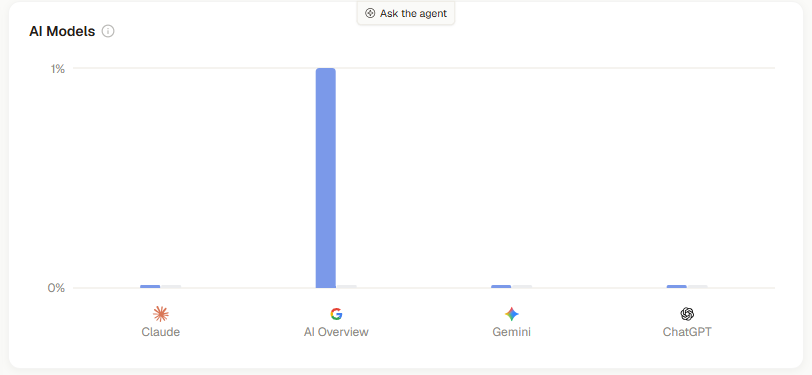
Visibility splits by assistant. In our own account, our only mentions in that week came from Google AI Overviews.
Step 5: Compare cited sources per market
AI answers are built from sources. Some of those sources are global, and some are local. Your outreach list should follow.
Here is what the top cited domains for our own category looked like in Denmark and the UK over the same month:
|
Rank |
Denmark |
UK |
|---|---|---|
|
1 |
get3rd.com (our own site) |
get3rd.com (our own site) |
|
2 |
g2.com |
g2.com |
|
3 |
tryprofound.com |
reddit.com |
|
4 |
reddit.com |
tryprofound.com |
|
5 |
peec.ai |
linkedin.com |
|
Local or list sources in the top 15 |
dk.linkedin.com |
nicklafferty.com, evertune.ai, frase.io, zapier.com |
Source: 3RD's own tracking, cited domains per market, Sep 19 – Oct 19, 2026.
Three things stand out.
- Some sources travel. G2 was the most-cited third-party domain in both markets. That makes it a global priority.
- Some sources are local. The Danish LinkedIn domain showed up in Denmark. In the UK, "best AI visibility tools" lists from independent sites and tool vendors made the top 15.
- Being cited is not being mentioned. Reddit was cited 243 times in Denmark and 320 times in the UK, and none of those Reddit pages mentioned us. Being present on a source is the goal, not just knowing it exists.
This is why I run outreach per market. A list that wins in London may never be read in Copenhagen. The method for earning a place on those pages is in how brands build the trust and authority that make AI recommend them.
Step 6: Report across markets without averaging
Leadership will ask for one number. Give them a table instead.
A simple multi-market report:
|
Market |
Visibility (30-day avg) |
Change vs previous 30 days |
Rank |
Leader |
Top cited source you are missing from |
Next action |
|---|---|---|---|---|---|---|
|
Market A |
|
|
|
|
|
|
|
Market B |
|
|
|
|
|
|
Rules that keep it honest:
- One row per country–language pair. Never merge Danish and English Denmark.
- Weight by revenue, not by prompt count. If you need one summary line, weight markets by their share of pipeline, and say that you did.
- Show market consistency. Your weakest market's visibility as a share of your strongest tells leadership how uneven you are. 3RD's AI Ontology reports this as a signal called market consistency.
- Flag small markets. Mark any market whose prompt set is too small to read week to week.
- Mark model changes. When an assistant switches model, scores before and after are not directly comparable.
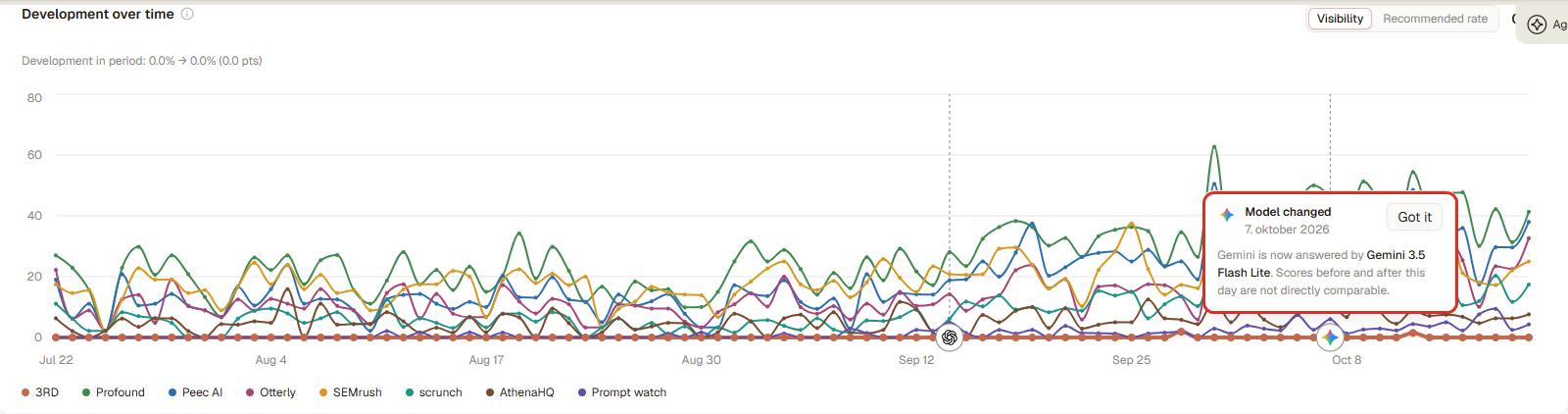
A model change on Oct 7 breaks the trend line. Mark changes like this in every market's report.
Step 7: Budget your prompts
Cost in AI visibility tracking grows with prompts × assistants × markets. Adding a market multiplies everything below it, so decide in this order:
- Markets by revenue.
- Topics per market: the Must-Win topics first.
- Prompts per topic, sized as in step 3.
- Assistants per market, starting with two or three.
On 3RD, a market is a country–language pair, and plans differ in how many markets they include: Starter covers one market and the higher plans add more. Check current allowances on our pricing page.
Common pitfalls
|
Pitfall |
What it looks like |
Fix |
|---|---|---|
|
Treating a country as one market |
"Denmark is flat" while Danish rises and English falls |
Split by language |
|
Translated prompts |
Grammatical prompts nobody asks |
Have native speakers write from the intent |
|
Global competitor set everywhere |
You look strong in a market where a local brand leads |
Add local competitors per market |
|
Uneven prompt sets |
One market looks volatile only because it has fewer prompts |
Same topics, same mix, a minimum depth per topic |
|
Reading a small market daily |
A 15-point "drop" that is noise |
Read small markets on 30-day averages only |
|
One global outreach list |
Pitching UK lists to win Danish answers |
Build the list per market from cited sources |
|
Blended headline number |
Leadership sees "steady" while a key market collapses |
Report per market, weighted by revenue |
|
Ignoring model changes |
A jump that is really a new model |
Mark the change and compare windows on the same model |
Worked example: how we track 3RD across five markets
Here is our own setup, warts included.
Markets. We track Denmark (Danish and English), France, Germany, Portugal and the UK. Denmark gets both languages because many Danish B2B buyers research software in English.
Diagnosis per market. 3RD's Diagnostics page runs per market and explains in plain words why AI doesn't pick us there. The two markets read differently.
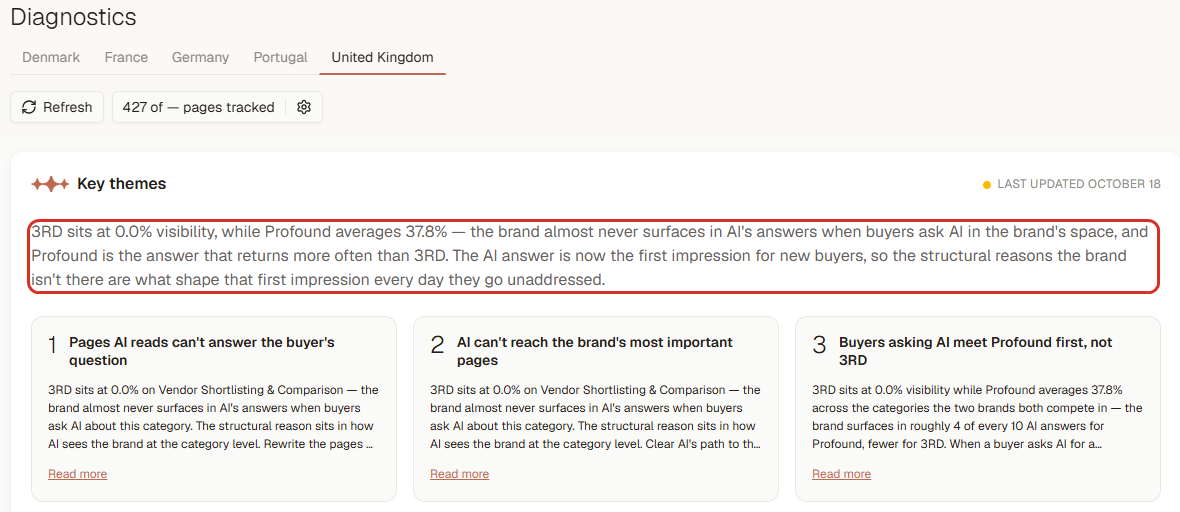
In the UK, buyers meet Profound first. Diagnostics names the reasons in plain words.
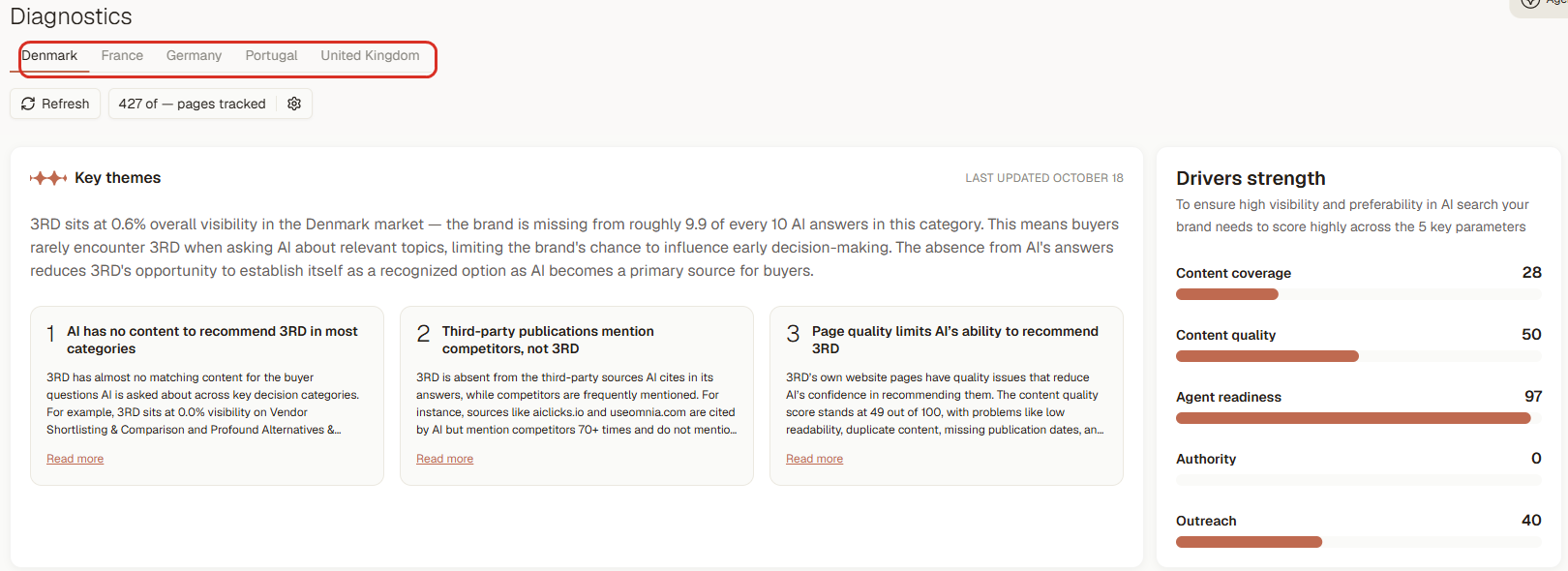
In Denmark the diagnosis is different: no content for most buyer questions, and third-party pages that name our competitors instead of us.
What we changed because of it.
- We split work by market. UK work focuses on the "best AI visibility tools" lists that dominate UK answers. Danish work starts with Danish-language pages and Danish sources.
- We publish each article in English first, then write the Danish and French versions natively, not as translations. 3RD's Content Agent runs a native-language proofread on every non-English draft; a native speaker on our team still reviews it before it goes live.
- We read our small English-in-Denmark set as a signal, not a KPI.
What 3RD does in this workflow, and what it doesn't.
- A market in 3RD is a geography plus a language, such as Denmark – Danish. Every number can be filtered by market.
- You can ask 3RD Agent to add a market, and it tracks the new country in its own language. Its "Fix the wrong language" skill finds prompts left running in a language the market no longer uses.
- The prompt generator writes prompts per topic, per market, from your brand, competitors and topics. You still review them, and we recommend a native speaker does.
- 3RD Agent and Content Agent draft. You check and publish. Nothing goes live without you.
About the data
The customer findings come from 3RD's own research: we analysed 111 brands tracked in 3RD between September 19 and October 18, 2026, covering more than 18,000 prompts and 732,000 AI answers; model comparisons use a subset of 60 to 83 brands. The sample leans toward Nordic brands, and the data is anonymised and aggregated. The market tables for 3RD itself come from our own workspace.
FAQ
How many markets should I track in AI visibility? Track every country–language pair that drives meaningful revenue, and no more at first. Most teams start with their primary market and one or two secondary markets, then add more once the first ones are read reliably.
Can I translate my English prompts into other languages? You can, but you will measure the wrong thing. Translated prompts are rarely how local buyers ask. Have a native speaker rewrite each prompt from its intent, using local words, local competitors and local reference points.
Do AI assistants really answer differently by country? Yes. In our own tracking for the same category and month, Peec AI led in Denmark at 53% and Profound led in the UK at 29%. The sources cited also differ: some, such as G2, matter everywhere, and others are local.
How many prompts do I need per market? Enough to read each topic on a 30-day average. In our customer data, brands with fewer than about 100 AI answers a day swung about twice as much as brands with 230 or more. Small sets are fine for exploring a market, not for KPIs.
Which GEO tools handle prompts by country and language? Several platforms now track multiple markets, but they differ in how they define a market, how they count prompts and whether they write prompts natively. 3RD treats each country–language pair as its own market. For a vendor comparison, see the best European AI visibility platform and our buyer's checklist.
Start with one decision: list your countries, then write down which language buyers use for your category in each. That list is your market setup. See how 3RD tracks markets.