Industry news
Muse, Grok Bot, and Instinct: how AI agents change what customers do, and what marketers measure
Muse, Grok Bot, and Instinct don't just answer. They choose and act for your customers. What changes in buying behavior, and in managing AI visibility.
 Magnus WindeløvOct 20, 2026 · 10 min read

Contents
Short answer: Muse, Grok Bot, and Instinct are AI agents that act, not just answer. Customers stop comparing brands themselves and hand the decision to the agent. For marketers, being mentioned in AI answers stops being enough. What counts is being the brand the agent picks.
Since August 2026, three new AI products have changed what "AI search" means. Until now, ChatGPT or Gemini recommended a brand, and a person clicked, compared, and decided. With these agents, the person says what they want. The agent does the comparing, the deciding, and most of the doing.
This article covers what each product is, how they change the way customers buy, and what that means for the marketers who manage how AI sees their brand. It also says plainly what 3RD can and can't measure here.
The three agents, in plain words
All three work the same basic way. You tell the agent what you want, in a chat or a text message. It searches, opens websites, fills in forms, and uses the accounts you've connected. It asks before sensitive steps such as paying.
|
|
Muse |
Grok Bot |
Instinct |
|---|---|---|---|
|
Made by |
Meta |
xAI |
Spear Street Technology (San Francisco) |
|
Launched |
September 8, 2026 |
Beta since August 11, 2026 |
Invite-only, 2026 |
|
Who it's for |
Consumers, plus a version for small businesses |
Work tasks. Bundled with high-end Grok and Cursor plans |
Busy individuals. You text or call it |
|
What it does |
Researches, books, fills in forms, negotiates, buys with your approval |
Runs on its own cloud computer and works through multi-step tasks in your apps |
Bookings, bill negotiation, email follow-ups, scheduling |
|
Price |
Free, $20, and $100 a month |
About $120–200 a month, depending on plan |
Free during private access. No public price |
Muse is growing fastest. It reached No. 1 in the US App Store and passed ChatGPT in the US iOS free rankings in mid-September. TIME reported more than 5 million downloads by early October.
Grok Bot is an always-on agent that signs into the apps you already use and works through a task until it needs your approval. xAI positions it as a digital coworker. It's still in beta.
Instinct has no app. You text or call it, and it acts through your email, calendar, and messages. It's invite-only.
A note on the numbers: download counts, prices, and funding vary from source to source, and the products change every few weeks. Treat every figure here as "as of October 2026." The direction is clear even where the numbers aren't.
How customer behavior changes
From asking to delegating
With a chat assistant, the customer asks, reads the answer, and does the rest. With an agent, the customer states a goal: "book a table for six on Friday," "find me a cheaper phone plan," "get three quotes for a new roof." Then they approve the result.
The research, the comparison, and the shortlist all happen out of sight. The customer sees one or two options, not ten.
Fewer visits, fewer comparisons
When a person compares, they visit sites, read reviews, and notice brands they didn't plan to buy from. When an agent compares, the person often never sees the brands that lost. A brand can lose a sale without the customer ever knowing it existed.
The agent knows the customer
Muse builds a running profile of each user, and it updates as the person uses it. TIME reported this as a privacy concern, and it is one. It also means the agent's choice depends on what it knows about this one person: their budget, past bookings, and preferences.
Two customers asking the same question can get different picks. Recommendations become more personal, and harder to see from the outside.
Trust moves from the brand to the agent
Customers who delegate trust the agent to choose well. They approve the result rather than check every option. That gives the agent's judgment real weight, and it rewards brands the agent can describe clearly and confidently.
It may not stick, and that's worth watching
CNBC points out that Muse's challenge is getting people to keep using it once the novelty wears off. Privacy concerns could slow it down too. Downloads aren't habits. But all three products point the same way: customers want to hand off tasks, not just get answers.
How managing AI visibility changes
1. From being mentioned to being chosen
An agent acts on a recommendation, not a mention. That makes the gap between the two much more expensive, and it's already wide.
In our research across 60 brands and 494,000 AI answers, checked in 3RD between September 19 and October 18, 2026, the median brand was mentioned in 19.8% of answers. It was recommended over the alternatives in just 0.2%. A quarter of the brands (15 of 60) were never recommended once in the month.
3RD's definition of "recommended" is strict, so the absolute level is low by design. The ratio is the point: about one recommendation for every 65 mentions. If you only track mentions, you're tracking the number that matters less.
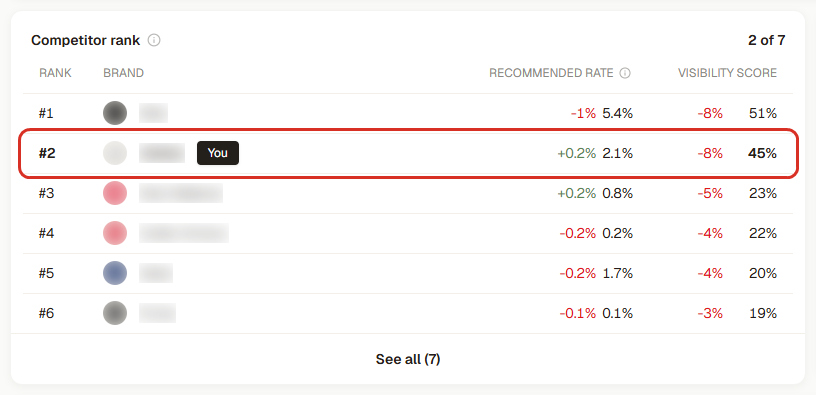
Competitor rank for a sportswear brand over the past week. On visibility, the brand is close behind the leader: 45% against 51%. On recommendations, the gap is wider: 2.1% against 5.4%. An agent acts on the second number. Demo workspace; brand names blurred.
2. The sources matter more than your homepage
Agents search and read before they act, just like chat assistants. They read the same web, and most of that web isn't yours.
Across 100 brands and 5.9 million citations in 3RD, the median brand's own website made up just 6.8% of the sources AI cited in its category. The other 93% were third-party pages: reviews, comparison sites, directories, forums, trade press.
So the job doesn't change, but the stakes rise. What those sources say about you shapes the agent's choice.
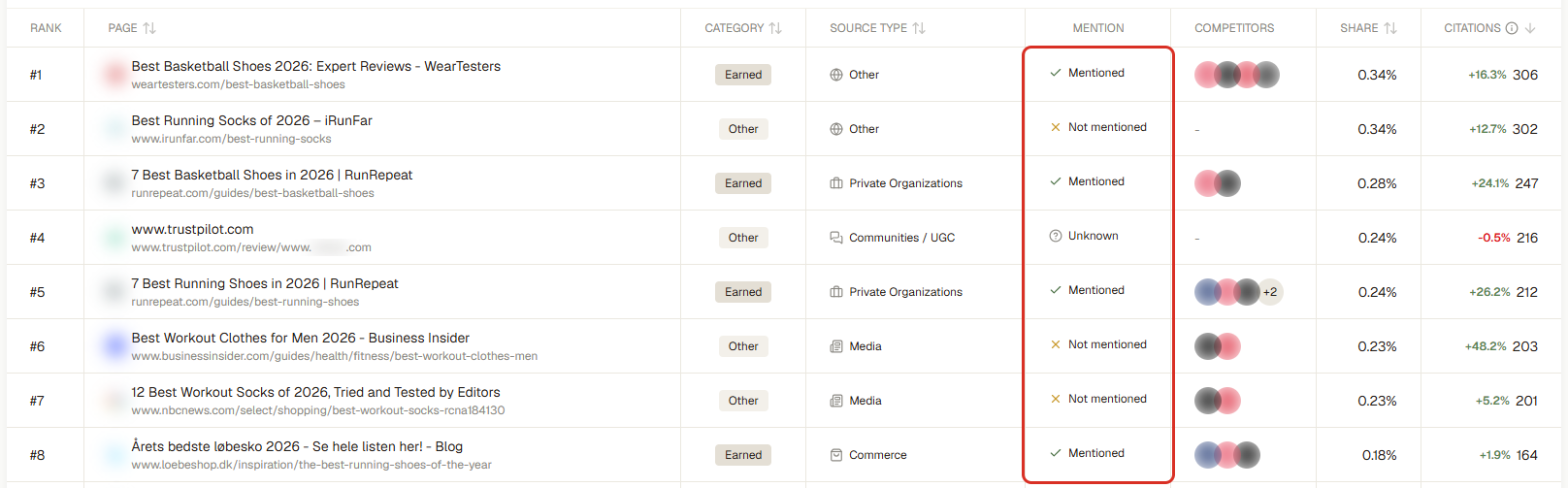
The sources AI cited most often for a sportswear brand's prompts over the past week. Most are review and buying-guide pages. Several of them, like a best running socks guide and a best workout socks list, don't mention the brand at all. Those pages are the work. Demo workspace; brand names blurred.
3. Your website gets a new kind of visitor
When an agent visits your site, it's there for one real customer, right now. It needs to find the price, the opening hours, the availability, or the booking form, and finish the job.
Things marketing used to treat as hygiene start to decide the sale:
- Prices, hours, and availability in plain text, not only inside images
- Forms an agent can fill in without guessing what a field means
- Structured data that says who you are and what you sell
- A way to book, buy, or request a quote without a phone call
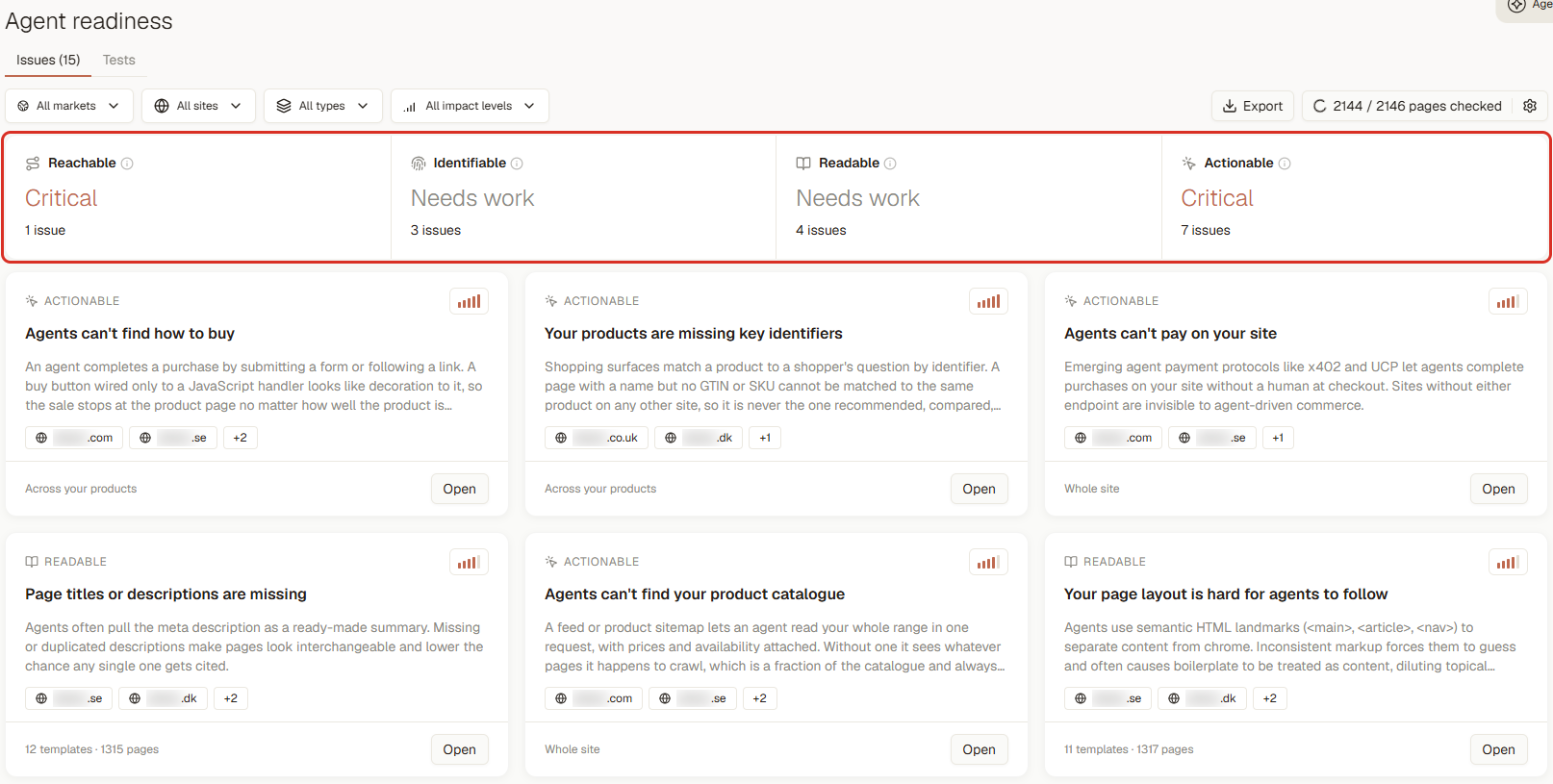
An agent readiness check on an online store: 2,144 of 2,146 pages checked, 15 issues. Agents can't find how to buy, because the buy button only works through JavaScript. Products lack identifiers such as GTIN or SKU. And agents can't pay on the site. Demo workspace; brand names blurred.
For the shopping side of this, see AI assistants are starting to buy for your customers. Is your brand ready?
4. Analytics see less of the journey
If the agent compares and the customer only approves, fewer people browse your site. Some agents identify themselves, and some don't. Reporting on these agents also says no major agent maker commits to obeying robots.txt, the file sites use to tell crawlers what to skip.
Traffic and clicks will tell you less about why you won or lost. What AI says about you, and how often it picks you, will tell you more.
5. The list of assistants keeps growing
A year ago, most teams watched ChatGPT. Now it's ChatGPT, Gemini, Google AI Overviews, Copilot, and more, and agents are arriving on top. Chasing each new product one by one doesn't scale.
The good news: agents build on the same foundations. They search, read the same sources, and favor the brands AI already describes well. Work that gets you chosen in today's AI answers carries over.
It also helps to look at each assistant on its own. The same brand can look strong in one and weak in another.
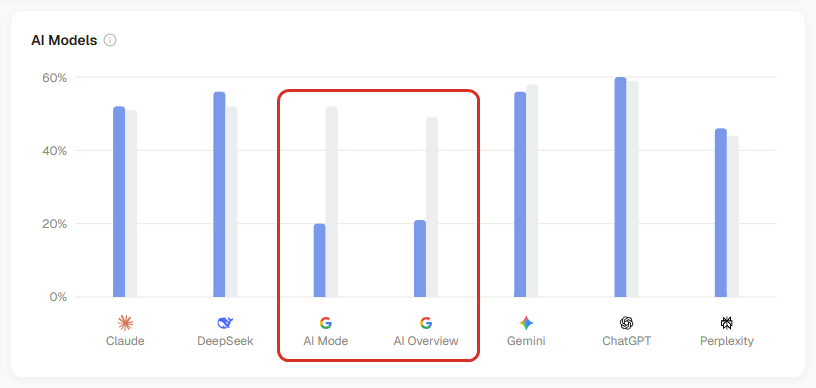
Visibility per AI model for one brand over the past week. It's about 60% in ChatGPT, but only about 20% in Google AI Mode and AI Overviews. One average hides that gap. Demo workspace; brand names blurred.
Why this matters for marketers in the Nordics
Yes, this is a US consumer story for now. That's the reason to prepare in the Nordics now, not later.
You get a head start, if you use it. These products launched for US users first. Whatever they reward there, they'll likely reward here when they arrive. Improving how AI describes you takes months, not days.
B2B isn't exempt. Grok Bot is sold as a work agent. Muse now has a small-business version. Supplier research is the kind of tedious task people will delegate: "find three suppliers that fit our needs, compare prices, and book intro calls." If your pricing page says only "contact us," an agent comparing three options has nothing to compare.
Most teams are already guessing. Most marketing teams we speak with can't say why ChatGPT recommends a competitor over them. Agents make that guess more expensive, because the agent acts on it.
What to do now
- Track whether AI recommends you, not just whether it mentions you. Compare your recommended rate with your competitors' on the questions your buyers actually ask.
- Find the sources AI cites in your category. Then work on what those pages say about you: reviews, comparison sites, directories, trade press.
- Make your key facts easy to find. Put prices, availability, and how to buy where a machine can read them.
- Make your key action possible without a phone call. Book, buy, start a trial, or request a quote.
- Watch the agents, but don't chase them. Read the launch news. Spend your time on what every assistant and agent reads.
What 3RD covers, and what it doesn't
Honesty first: 3RD doesn't track what Muse, Grok Bot, or Instinct do. It doesn't see their sessions, the tasks they run, or the brands they pick for a user. No one outside those companies can see an agent's private sessions with a user.
What 3RD does track is the AI answers these agents build on.
|
Product |
Does 3RD track the agent's actions? |
What 3RD can track instead |
|---|---|---|
|
Muse (Meta) |
No |
Nothing inside Muse. 3RD can track Llama, Meta's open model family, but that is a separate product, not the Muse app. |
|
Grok Bot (xAI) |
No |
Answers from Grok, xAI's assistant. 3RD tracks Grok like any other assistant. |
|
Instinct (Spear Street Technology) |
No |
Nothing specific to Instinct. It reads the same web the other assistants read, so the sources below still apply. |
These are the assistants 3RD can monitor today. You choose which ones to track for your brand.
|
Assistant |
Made by |
|---|---|
|
ChatGPT |
OpenAI |
|
Gemini |
|
|
Google AI Overviews |
|
|
Google AI Mode |
|
|
Claude |
Anthropic |
|
Perplexity |
Perplexity |
|
Microsoft Copilot |
Microsoft |
|
Grok |
xAI |
|
Llama |
Meta |
|
DeepSeek |
DeepSeek |
|
Mistral |
Mistral AI |
|
Kimi |
Moonshot AI |
|
Solar |
Upstage |
For each assistant you track, 3RD measures:
|
What 3RD measures |
What it tells you |
|---|---|
|
Visibility |
How often AI mentions your brand on the questions your buyers ask, per assistant and per market |
|
Recommended rate |
How often AI recommends you over the alternatives, next to your competitors |
|
Cited sources |
Which pages AI cites in your category, and whether they mention you |
|
Agent readiness |
Whether agents can reach your site, tell it's yours, read your pages, and act on them. This checks your site, not a specific assistant. |
Each issue 3RD finds becomes a task. Then 3RD Agent helps your team do the work, in your brand voice. Publishing stays with your team.
FAQ
What is a personal AI agent? An AI that completes tasks for you instead of only answering questions. It searches, opens websites, fills in forms, and uses your connected accounts. It asks for approval before sensitive steps like paying.
How is an AI agent different from ChatGPT? ChatGPT answers, and you act on the answer. An agent acts for you: it compares the options, makes the booking or purchase, and asks you to approve.
Is Muse available in Denmark or the rest of the Nordics? Coverage so far is about US users. Check Meta's own pages for current availability.
How do AI agents choose which company to use? None of the three makers documents how its agent picks. What we know: agents search and read before they act, and Muse uses what it knows about the user. Brands that AI already describes well, in sources it trusts, are in the strongest position.
Does this matter for B2B companies? Yes. Work agents like Grok Bot are built for research and admin tasks, and supplier research is both. If an agent can't find your price, your fit, or a way to book a call, it moves to the next company.
Sources (as of October 2026): TechCrunch on Muse, TechCrunch on what's coming to Muse, CNBC on Muse downloads, CNBC on Muse retention, TIME on Muse and privacy, CNN on agents and Amazon, VentureBeat on Grok Bot, TechCrunch on Instinct, AI Crawler Check guide to personal agents. 3RD data: aggregated and anonymized customer brands, September 19 to October 18, 2026 (recommended rate: 60 brands, 493,856 answers; citations: 100 brands, 5.9 million citations).
Head of Marketing