
AI commerce
AI Assistants Are Starting to Buy for Your Customers. Is Your Brand Ready?
AI shopping agents now pick products from feeds, product pages and reviews. What changed in 2026, how agents choose, and a readiness checklist.
 Magnus WindeløvJan 15, 2026 · 16 min read
Contents
Short answer: To get chosen by AI shopping agents, give them complete product feeds, clearly structured product pages and trusted third-party proof. Then track which products they actually recommend.
Updated October 19, 2026. We first published this in January 2026, the week Google announced its Universal Commerce Protocol. A lot has happened since, so we rewrote it as our main guide to agentic commerce.
Agentic commerce means an AI assistant does part of the shopping for the buyer. It researches the options, compares them, and in some cases completes the purchase. The buyer may never visit your website.
The rule from January still holds. If the AI doesn't find, understand and recommend you, you won't be chosen.
Before 3RD, I ran SEO and paid search for four e-commerce stores in Denmark, Sweden, Norway and the UK. Back then the product feed decided whether you showed up in Google Shopping. In 2026 it decides whether an AI assistant can even consider you. The work looks familiar. The stakes are higher, because the assistant names a handful of products, not a page of results.
What changed is the detail. Checkout inside AI assistants turned out to be the unstable part, and the platforms keep changing it. Product discovery is where brands win or lose today. This guide covers:
- Where ChatGPT, Google, Microsoft Copilot, Perplexity and Amazon stand in October 2026
- How AI agents choose which products to recommend
- An agent-readiness checklist for a CMO or e-commerce lead
- What to do in the next 90 days
- Who helps with what, including where 3RD helps and where it doesn't
The short answer
Being agent-ready comes down to five things:
- Agents can reach your site. Your robots.txt and bot protection let AI crawlers in.
- Agents can read your products. Your product feeds and structured data carry price, availability, identifiers and policies.
- Your product pages answer buyer questions. Use cases, sizing, comparisons and ingredients are written out, not hidden in images.
- Other sources vouch for you. Reviews, retailer listings and editorial "best of" lists name your products.
- You measure what AI recommends. You know which products and which shops appear in shopping answers, per market.
The platforms build the checkout. Shopify and the payment networks build the plumbing. Your job is the part no platform can do for you: making your products the obvious pick.
What changed in agentic commerce in 2026
Here is the state of play as of October 2026, from each company's own announcements.
|
Platform |
What shoppers can do |
What it means for brands |
Status |
|---|---|---|---|
|
ChatGPT (OpenAI) |
Ask for products and get shopping results with prices and shops. Purchases now happen in merchants' apps inside ChatGPT or on the merchant's own checkout. |
Product feed integration matters most. OpenAI moved Instant Checkout "to Apps" in March 2026, according to an OpenAI spokesperson quoted by Digital Commerce 360. |
The Agentic Commerce Protocol (ACP), built by OpenAI and Stripe, remains an open standard under the Apache 2.0 license. |
|
Google AI Mode and Gemini |
Buy eligible products with Google Pay without leaving the conversation. The brand stays the merchant of record. |
Google's Universal Commerce Protocol (UCP), launched January 11, 2026, powers checkout. Merchant Center gets new product attributes for conversational shopping. |
US first. Checkout is expanding to Canada and Australia, then the UK (Google, May 19, 2026). Universal Cart is rolling out in Search and Gemini in the US. |
|
Microsoft Copilot |
Buy inside Copilot without visiting the retailer's site. |
Launched January 8, 2026 with PayPal, Shopify and Stripe. The retailer stays the merchant of record. |
US, on Copilot.com first. |
|
Perplexity |
Check out with PayPal in the chat. |
PayPal merchants became discoverable in Perplexity in November 2025. |
US users. |
|
Shopify |
Shoppers buy from Shopify stores in ChatGPT, Copilot, AI Mode and Gemini. |
Agentic Storefronts (March 24, 2026) syndicate your Shopify Catalog to these channels. Brands on other platforms can join through Shopify's Agentic plan, now available worldwide. |
Live in ChatGPT and Copilot. Select brands in AI Mode and Gemini. |
|
Amazon |
Amazon's shopping assistant researches products and can "Buy for Me" from other stores on select items. |
A closed system. Amazon's own product data and reviews drive it. |
Live in the US. |
|
Payment networks |
Agents pay with scoped tokens and spending limits the buyer sets. |
Visa Intelligent Commerce, Mastercard Agent Pay and Google's Agent Payments Protocol (AP2) handle trust and payment. |
Pilots and early rollouts. |
Two lessons stand out.
Checkout is moving. Discovery is not. In 2026 one major platform pulled back its native checkout and others are still US-only. Building your whole plan around one checkout integration is a bet on a moving target. Being recommended in the answer is valuable whichever checkout wins.
Feeds now decide a large share of shopping answers. Tracking data published by Profound and reported by Search Engine Journal on September 9, 2026 found that the share of ChatGPT Shopping recommendations coming from integrated merchant feeds jumped from 8.26% to 61.54% on July 10, 2026. In the same period, the top 10 merchants' share of references rose from 22.5% to 41.8%, and the number of distinct merchants named fell from 13,524 to 10,607. OpenAI hasn't confirmed what caused the shift. But the direction is clear: if your products aren't in a feed the assistant trusts, you're competing for a shrinking share.
How AI agents choose which products to recommend
No AI platform publishes its ranking formula. What we can see is what each platform asks merchants for, and what shows up in the answers. Together they point to seven inputs.
- Structured product data. Feeds and on-page markup carry the facts an agent needs to compare: product name, brand, GTIN (the barcode number) or MPN (manufacturer part number), price, availability, variants, shipping and returns. Missing fields make a product harder to compare, so it gets skipped.
- Product pages that answer questions. Buyers ask assistants things like "which self-tanner works for sensitive skin?". The page that says so plainly, in text, gets quoted. A page that hides the answer in an image or a PDF doesn't.
- Reviews and ratings. Shopping answers often show a rating next to each product. Ratings on your own pages and on retailer pages both count.
- Distribution. Answers name shops, not only products. If retailers carry your rivals and not you, the answer sends buyers to a rival.
- Third-party proof. Editorial lists, comparison articles, review sites and forums shape which brands an assistant trusts in a category. This is bigger than most brands expect. Across 100 brands and 5.9 million citations tracked in 3RD, the median brand's own site made up just 6.8% of the sources AI cited in its category. Review and comparison sites were cited for 82 of those 100 brands.
- A clear brand identity. The assistant has to know that your brand, your site and your products belong together. Consistent names, Organization markup and an entry in public knowledge bases such as Wikidata help.
- Reachability. If your bot protection blocks AI crawlers, the best product page is invisible. Check this first, because it's often a one-line fix with a big effect.
The good news on reachability: it's usually fine. Across 60 brands we checked in 3RD, the median crawlability score was 99 out of 100. The weakest of the five drivers was almost always authority or content quality: one of the two was the bottleneck for 42 of 54 brands, and crawlability for none.
"Usually fine" isn't "always fine", though. When we ran 3RD's agent-readiness check on our own site, it flagged a robots.txt on one of our subdomains that turns automated visitors away, and no Organization markup to tell agents who we are:
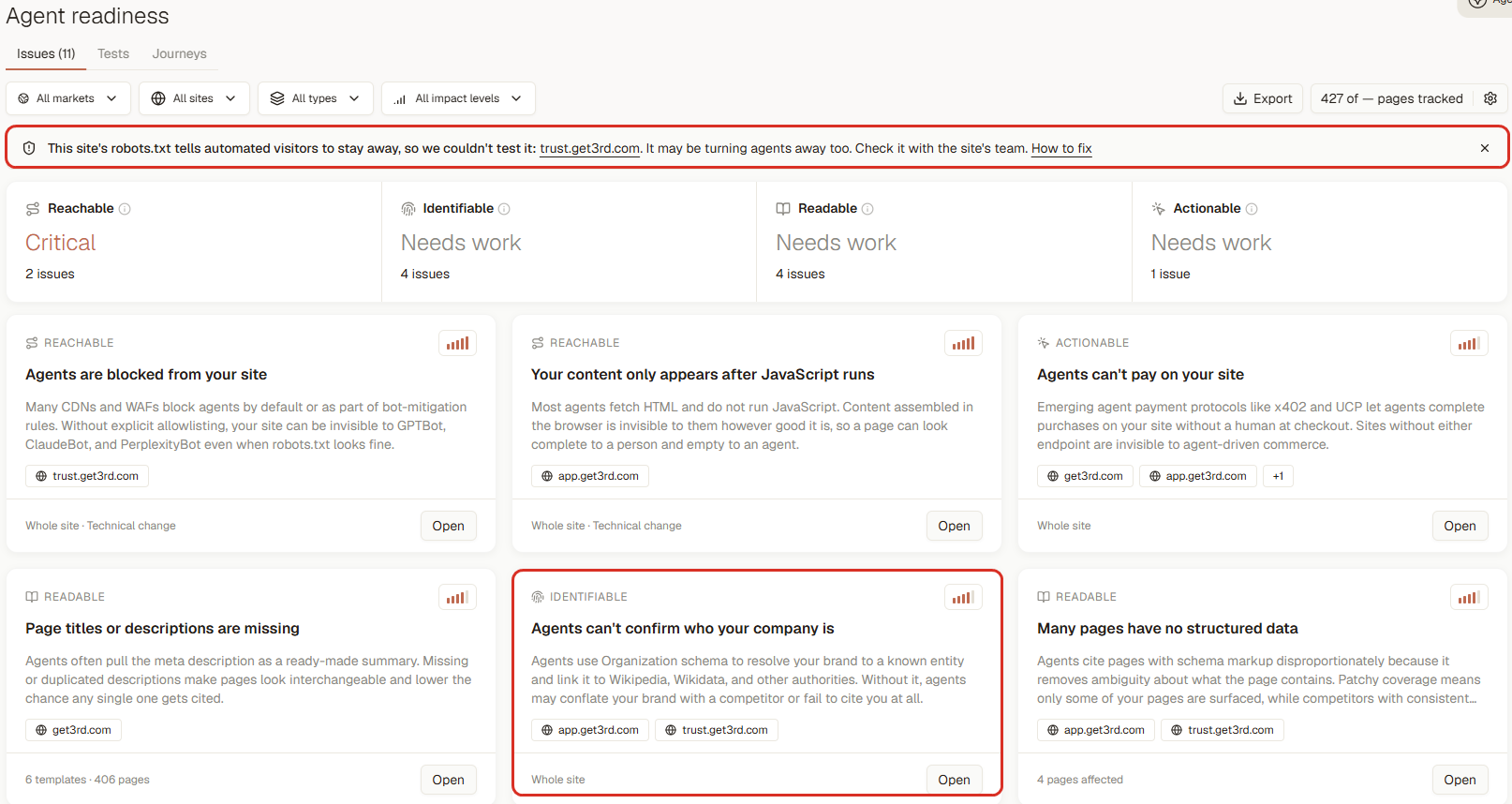
Our own agent-readiness report, October 2026. Even an AI visibility company has fixes to make.
We wrote about several of these in depth: why LLMs read your product data, not your brand manifesto, how to structure your brand knowledge with JSON-LD schema, and what product detail pages need in the agentic era.
The agent-readiness checklist
Use this table to find your gaps. Most brands we see are strong on two or three rows and have never looked at the rest.
|
Area |
What "ready" looks like |
Usual owner |
How to check |
|---|---|---|---|
|
Crawl access |
AI search crawlers are allowed in robots.txt and not blocked by your CDN or bot protection |
Developer |
Test your top product pages as each crawler; review CDN bot rules |
|
Product feeds |
Products are in Google Merchant Center and in the feed channels for ChatGPT (directly or through Shopify Catalog) |
E-commerce |
Check feed diagnostics for missing or rejected fields |
|
Identifiers |
Every product carries a GTIN or MPN, brand, and variant data |
E-commerce |
Count products missing identifiers in the feed |
|
Structured data |
Product, Offer and rating markup on every product page, matching the feed |
Developer |
Validate a sample of templates with a schema testing tool |
|
Product page content |
Each top product page answers the five questions buyers ask most, in text |
Content |
Ask an assistant those questions and see whether your page is cited |
|
Policies |
Shipping, returns and warranty are written on the page and in the feed |
E-commerce |
Compare feed policy fields with what the page says |
|
Reviews |
A steady flow of reviews on your site and on the retailers that carry you |
CRM / e-commerce |
Count reviews per top product, per channel |
|
Distribution |
The retailers AI names in your category carry your products |
Sales / partnerships |
List the shops named in shopping answers for your top questions |
|
Brand identity |
Brand and product names are consistent everywhere; Organization markup is in place |
Brand / developer |
Ask assistants "who makes X?" for your top products |
|
Measurement |
You know which of your products AI recommends, where, and next to whom |
Marketing |
A monthly check of the same shopping questions, per market |
The bottom row is where most teams start by hand. Someone asks ChatGPT a few shopping questions, takes screenshots, and pastes them into a slide. That tells you something once. It can't tell you whether you're gaining ground, because answers change from run to run. Across 111 brands tracked daily in 3RD, the median brand's visibility moved 12.5 points between its best and worst day in a single month, with no change to its prompts.
Four ways agent readiness goes wrong
- Checkout-first planning. The team spends a quarter on one checkout integration while the product pages still can't answer a buyer's question. The integration changes; the missing answers stay missing.
- Blocked by your own security. A CDN (content delivery network) or bot-protection rule quietly turns AI crawlers away, and nobody on the marketing side knows. Test it rather than assume it.
- Feed and page disagree. The feed says €49 and in stock; the page says €59 and sold out. Agents compare the two, and a mismatch makes the product harder to trust.
- The screenshot baseline. One round of manual checks becomes "our AI position" for a whole quarter. A single day can be several points off the real picture.
What a CMO should do in the next 90 days
Weeks 1–2: get a baseline.
- Write 20 shopping questions per market, the way your buyers would ask them. "Best running shoe for flat feet under €150" beats "running shoes".
- Run them in the assistants your buyers use. Record which products appear, in what position, and which shops the answer links to.
- Note the gaps: questions where a rival appears and you don't, and questions where your product appears but the link goes to another shop.
Weeks 3–6: remove the blockers.
- Fix crawl access. Make sure your robots.txt and bot protection let AI search crawlers reach your product pages.
- Get your feeds complete. Fill missing identifiers, availability, shipping and returns fields. If you're on Shopify, check that your products flow through Shopify Catalog to the AI channels. If you're not, look at Google Merchant Center first, then the AI channels your buyers use.
- Align structured data with the feed. The price and availability on the page should match the feed.
Weeks 7–12: give agents a reason to pick you.
- Rewrite your top 20 product pages to answer the questions from step 1, in plain text.
- Close distribution and review gaps on the retailers AI already names in your category.
- Re-run your baseline questions and compare. Then decide where paid placement makes sense for high-value questions you still can't win organically.
Don't wait for checkout to reach your market
Native checkout is mostly US-only today. Google has said Canada, Australia and then the UK come next. If you sell in Europe, it's tempting to wait.
That would be a mistake, because most of the list above doesn't depend on checkout. It splits into two kinds of work:
- Durable work survives model updates and checkout changes: complete product data, structured pages, a clear brand identity, reviews and third-party proof.
- Perishable work may need redoing: a specific checkout integration, or your position on one prompt this month.
Do the durable work now. It pays off in discovery today and in checkout when it arrives.
Who helps with what
Agentic commerce isn't one product category. Different vendors build different layers, and no single vendor covers all of them.
|
Layer |
What it does |
Examples (as of October 2026) |
|---|---|---|
|
AI shopping surfaces |
Where buyers ask and, in some cases, buy |
ChatGPT, Google AI Mode and Gemini, Microsoft Copilot, Perplexity, Amazon's shopping assistant |
|
Commerce protocols |
Shared standards so agents can browse, check out and handle orders |
OpenAI and Stripe's Agentic Commerce Protocol, Google's Universal Commerce Protocol |
|
Commerce platforms |
Syndicate your catalog and checkout to AI channels |
Shopify Agentic Storefronts and Shopify Catalog |
|
Payments |
Let agents pay safely within limits the buyer sets |
Stripe, PayPal, Visa Intelligent Commerce, Mastercard Agent Pay, Google's AP2 |
|
Feed management |
Clean and enrich product feeds for each channel |
Feed management tools and your commerce platform's own feed features |
|
AI visibility platforms |
Show whether AI recommends your brand and products, explain why not, and plan the fixes |
3RD, and other AI visibility tools; Profound offers ChatGPT Shopping tracking on its Enterprise plan |
|
Agencies |
Do the implementation work across feeds, content and outreach |
E-commerce and SEO agencies |
So when someone asks "which vendors are building for agent-initiated purchasing?", the honest answer is: the AI platforms, Shopify and the payment networks. When the question is "who helps us get chosen once agents are buying?", that's where AI visibility platforms and agencies come in.
Where 3RD helps, and where it doesn't
Does 3RD help brands become agent-ready for AI-driven purchasing? Yes, on the parts that decide whether agents can read you and whether they choose you. 3RD doesn't build checkout, connect your feeds or publish to your store.
What 3RD does:
- Agent readiness. 3RD tests every site you track in four stages: Reachable (can an agent read your site at all?), Identifiable (can it tell your site and products belong to your brand?), Readable (can it parse your pages?) and Actionable (can it act on what it finds?). Each issue explains why it matters and how to fix it, names the page templates it affects, and can become a task. See how 3RD works.
- Product tracking. 3RD records which products AI names when someone shops your category, at what position, at what price and rating, and which shops the answer links to. Upload your catalog as a CSV and 3RD matches it by GTIN, then MPN, then attributes. That also shows catalog gaps: products AI keeps recommending that you have nothing like. Product tracking is in closed beta, covers ChatGPT shopping answers only today, and is listed as "coming soon" on our Monitor page.
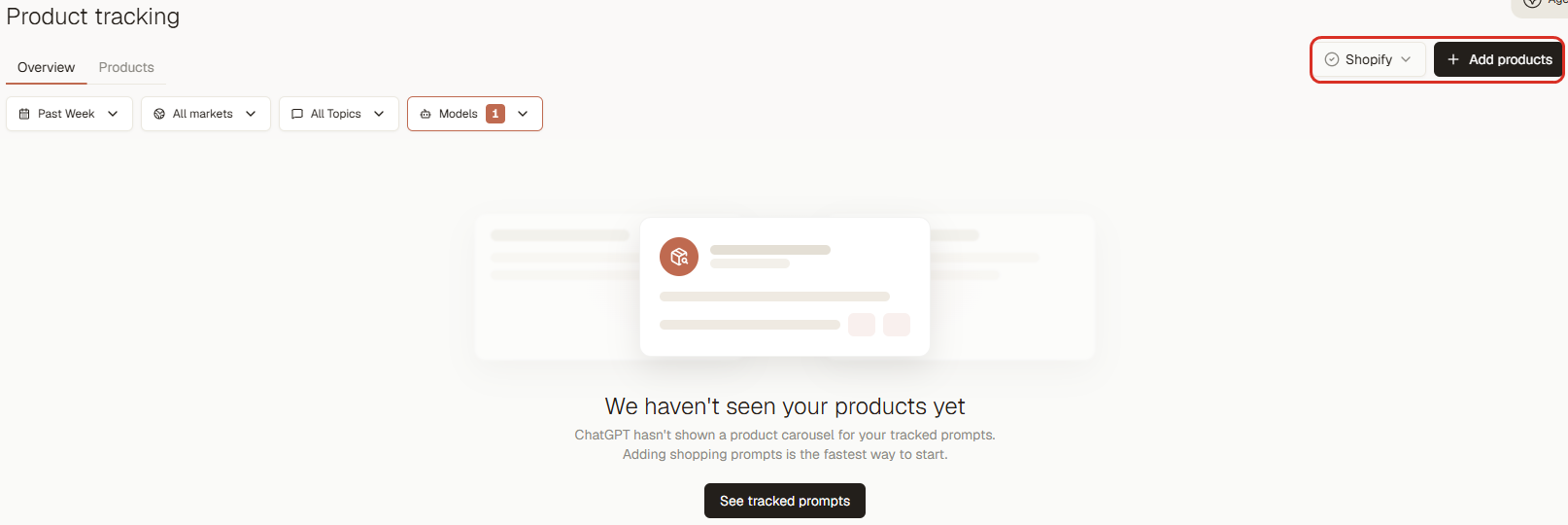
Product tracking watches ChatGPT's product carousels for your catalog. Shown empty here: 3RD sells software, not products.
- Diagnosis and a plan. 3RD's Diagnostics explain which drivers hold you back: content coverage, content quality, crawlability, authority and outreach. Playbooks turn them into tasks ranked by estimated impact.
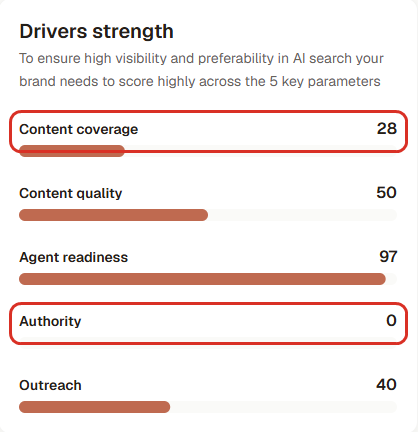
Our own five drivers in Denmark. Agent readiness is strong; authority and content coverage hold us back.
- The work. Ask 3RD Agent what to focus on, then ask it to draft the product and category content in your brand voice. You check it and publish.
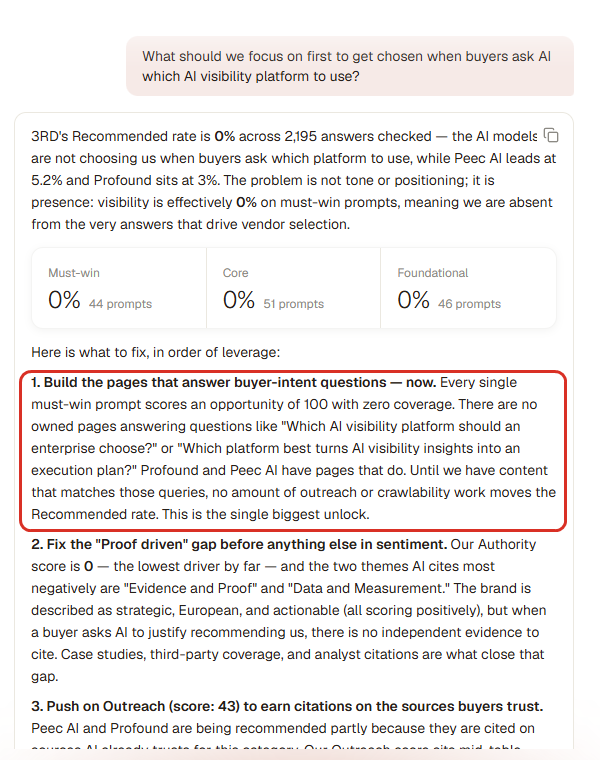
We asked 3RD Agent what to fix first for our own brand. Its first answer was content, not technical work.
- Paid placement. For must-win questions where you're still invisible, 3RD can launch ads in ChatGPT conversations through OpenAI Ads, which is being rolled out by region. See Act.
What 3RD doesn't do: run checkout, implement UCP or ACP, manage your product feeds, or publish to your store. Your commerce platform and developers own those.
Is 3RD a leader in agent-ready commerce? Not in the plumbing. The AI platforms, Shopify and the payment networks lead there. 3RD's focus is narrower: showing whether AI recommends your brand and products, explaining why it picks a competitor, and planning the work that changes it.
A worked example: from zero to the top five
Boë Beauté is a beauty brand that sells to consumers. Its buyers had started asking ChatGPT which products fit their skin before they ever reached a website. Across thousands of prompt runs, Boë Beauté didn't appear once. Larger competitors had years of coverage and bigger teams. Boë Beauté had no GEO or SEO specialist.
The plan followed the order in this guide:
- A foundation AI could understand. Structured, verifiable company and category information, including a Wikidata entry, so AI recognized Boë Beauté as a distinct brand.
- Pages AI could read. Readability, structured data, site structure and crawl access, each fix tied to a failure 3RD observed in how AI read the site.
- Questions with a right to win. Content where the brand is genuinely different: self-tanning for sensitive skin.
- Outside proof. Outreach to the sources that shape AI answers in the category.
After one quarter, Boë Beauté's weekly visibility rose from 0.0% to 22.2%, and it ranked in the top 5 of 7 tracked competitors. One marketer did the work in a few hours a week. Read the full Boë Beauté case.
About the data
The 3RD figures in this guide come from customer brands tracked in 3RD between September 19 and October 18, 2026: daily visibility for 111 brands (732,000 AI answers), citation sources for 100 brands (5.9 million citations) and Diagnostics scores for 60 brands. The sample leans toward Nordic brands, and we report medians across brands. The data is anonymised and aggregated; no brand is named. It is observational, not a controlled experiment. Screenshots are from 3RD's own workspace.
Further reading on the 3RD blog
- Accenture is right about agentic commerce: why the shift is now structural, not an edge case.
- Agentic shoppers outspent humans in Q1: what retailers should and shouldn't read into the numbers.
- The end of the click: how AI assistants rewrite the rules of e-commerce marketing.
- Retail just moved into the conversation: retail didn't only integrate with AI, it moved inside it.
- AI is disrupting shopping: why the change may rival the rise of e-commerce itself.
- Black Friday 2025: AI took over: what the biggest shopping week showed about AI-driven sales.
- LLMs don't read your brand manifesto: they read your product data.
- What European companies can learn from PDPs in the agentic era: product detail pages written for language models.
- JSON-LD schema explained: how to structure your brand knowledge for AI.
FAQ
What is agentic commerce? Agentic commerce is shopping where an AI assistant does part of the work for the buyer: research, comparison and sometimes the purchase. In 2026 that happens in ChatGPT, Google AI Mode and Gemini, Microsoft Copilot, Perplexity and Amazon's shopping assistant.
Which platforms make our products discoverable and purchasable by AI agents? Discovery comes from feeds and readable product pages: Google Merchant Center, the ChatGPT shopping feed channels and, for Shopify brands, Shopify Catalog through Agentic Storefronts. Purchasing inside the assistant runs on Google's UCP, Microsoft's Copilot Checkout, PayPal in Perplexity and merchant apps in ChatGPT, mostly in the US so far.
Do we need to implement UCP or ACP now? Not as a first step for most brands. If you're on Shopify, much of it is handled through Shopify Catalog. Start with complete feeds, structured product pages and crawl access, because those also decide whether you're recommended at all.
Is agentic checkout available in Europe? Not broadly, as of October 2026. Google has said its UCP checkout comes to Canada and Australia first, then the UK. Discovery in AI answers already affects European buyers, so the readiness work pays off now.
Does 3RD help brands become agent-ready? Yes. 3RD tests whether agents can reach, recognize, read and act on your site, tracks which products AI recommends (closed beta, ChatGPT only), and turns the gaps into a ranked plan. 3RD Agent drafts the content and you publish. 3RD doesn't run checkout or manage feeds.
See which of your products AI recommends today. Start a 7-day free trial, no card needed, or see how 3RD works.
Head of Marketing