AI commerce
AI visibility for e-commerce: how to get your products recommended in AI answers
How AI product discovery works, what decides which brands get named, and the order to work in, from an e-commerce marketer and 3RD's own data.
Contents
Short answer: Shoppers now ask AI which product fits their problem. To get named, become a brand AI understands, answer the questions you can genuinely win, and earn mentions on the sources AI already trusts.
Product discovery used to start in a search box. More and more of it now starts in a conversation. A shopper describes a problem ("my skin stings from self-tanner"), asks what fits, and gets a short list of brands and products. The list is the shortlist. Brands that aren't on it often never get a click.
I spent two years running SEO and paid search for four e-commerce stores in Denmark, Sweden, Norway and the UK. Back then the work was keywords, product feeds and category pages. That work still matters. What's new is that an AI model now sits between the shopper and your shop, and it names only a handful of brands.
This guide covers how AI product discovery works, what decides which products get named, how to measure it per category and market, and the order to do the work in. It ends with a real case: a skincare brand that went from not appearing once to the top five in its category in one quarter.
Buying inside the chat (checkout, payment protocols and product feeds for agents) has its own guide: AI assistants are starting to buy for your customers. This page is about the step before: being discovered and recommended.
The short answer
If you only have five minutes, here is the method.
- Write the questions your shoppers ask AI, per category and per market. Start with problems and needs, not product names.
- Measure which brands AI names for those questions today, on the assistants your shoppers use. Separate being mentioned from being recommended.
- Make sure AI understands who you are. Consistent company and product facts, a clear category, structured data.
- Pick the questions you have a right to win, where your product is genuinely different, and build pages that answer them directly.
- Earn mentions on the sources AI cites in your category: review sites, comparison articles, specialist blogs and the retailers that carry you.
- Wait for the trend, not the next answer. Read results over weeks, per category, not from one screenshot.
The rest of this guide explains each step and the mistakes I see most often.
How shoppers use AI to find products
Shoppers don't ask AI the way they typed into Google. They describe their situation. In e-commerce I see four kinds of question, and each needs a different answer from you.
|
Question type |
Example |
What the shopper wants |
What AI needs from you |
|---|---|---|---|
|
Problem |
"Why does self-tanner sting on sensitive skin?" |
To understand the problem |
A clear explanation that names your approach |
|
Category ("best X for Y") |
"Best self-tanner for sensitive skin" |
A shortlist |
Proof from third parties that you belong on it |
|
Comparison |
"Brand A vs Brand B for sensitive skin" |
A decision |
Honest, specific differences |
|
Brand or product |
"Is Brand A any good?" |
Reassurance |
Consistent facts, reviews, clear policies |
The category question is where the shortlist gets written. It is also where most brands are missing, because AI fills that answer from sources other than your website.
AI answers these questions in two formats.
- A text answer that names brands. "For sensitive skin, look at A, B or C." This happens in ChatGPT, Gemini, Claude, Perplexity, Copilot and Google's AI Overviews and AI Mode.
- A shopping answer with product cards. ChatGPT shows product carousels with prices, ratings and shops for many shopping questions. The answer names specific products, from specific makers, sold by specific shops.
You need to be in both. The text answer decides whether your brand is on the shortlist. The shopping answer decides which product and which shop gets the click.
Mentioned is not recommended
Being named in an answer is not the same as being recommended. In 3RD, Visibility is the share of answers that mention your brand. Recommended rate is stricter: the share of answers that recommend your brand over the alternatives. Being mentioned or listed first doesn't count.
The gap is large. Across 60 brands we track in 3RD, with 494,000 AI answers checked between September 19 and October 18, 2026, the median brand was mentioned in 19.8% of answers but recommended over the alternatives in 0.2%. A quarter of those brands (15 of 60) were never recommended at all in the month, even though AI mentioned them.
For e-commerce this matters more than in most categories. A shopper who reads "A, B and C are all options" may still pick the cheapest. A shopper who reads "for sensitive skin, A is the one built for it" usually buys A. Track both numbers, and judge yourself against competitors, not against 100%.
What decides which brands AI names
No AI company publishes its ranking formula. What we can see is which sources the answers cite, what the models say when asked about a brand, and what changes when brands act. From that, six inputs matter in e-commerce.
1. Being understood as a brand
AI has to know who you are before it can recommend you. If your company name, category, products and claims are inconsistent across your site, retailers and directories, the model may confuse you with another company or skip you.
What helps:
- One consistent description of what you sell and who it's for, everywhere you appear.
- Organization and Product structured data on your site.
- A Wikidata entry with your basic facts, when you qualify for one.
- Product names that are used the same way on your site and at retailers.
2. Pages that answer the questions
Your product pages were built to convert visitors who already chose you. AI needs pages that answer the shopper's question before they chose. That usually means:
- Guide pages for the problems your product solves.
- Category pages that explain who each product is for, not just a grid.
- Product pages with the facts a comparison needs: ingredients or materials, sizes, use cases, what it's not for.
Write the answer in the first two sentences of a section. Use tables for specifications. Put claims next to the evidence.
3. Third-party proof
Most of what AI cites isn't your website. Across 100 brands and 5.9 million citations in our data, the median brand's own domains made up just 6.8% of the sources AI cited in its category's answers. The other 93% came from third parties.
Which third parties? It varies by category, but some patterns hold:
- Review and comparison sites (Trustpilot and consumer test and price comparison sites, among others) were cited for 82 of 100 brands.
- Competitors' own websites out-cited the brand's own site for 41 of 100 brands.
- Reddit appeared as a source for 85 of 100 brands, but took a median of only about 1% of a brand's citations.
- The biggest share is a long tail of niche sites: specialist blogs, trade bodies, directories and affiliate pages.
So the work is mostly off your site. The job is to find the specific pages AI cites for your category questions, and get your brand onto them with a real reason to be there.
4. Distribution: the shops that carry you
Shopping answers name shops, not just products. If AI keeps sending shoppers to a retailer that stocks your competitor and not you, distribution is a direct visibility lever. 3RD's own documentation puts it plainly: AI shopping answers lean heavily on merchant listings.
5. Product data
Price, availability, identifiers (GTIN or MPN), variants, shipping and returns. AI compares products on these facts, so missing or inconsistent data makes your product harder to include. The full checklist for feeds and structured data is in our agentic commerce guide.
6. A real difference
AI shortlists are short. A product that is "also good" rarely makes one. A product that is clearly the best fit for a specific need ("for sensitive skin", "for flat feet", "for small apartments") has a reason to be named. Pick the needs where you are genuinely the best answer and build there first.
Category prompts vs product prompts
E-commerce brands often track the wrong questions. They track their own product names, see high visibility, and conclude they're fine. Questions that name your brand will almost always mention you. They tell you little about discovery.
Split your tracking in two.
|
|
Category and problem prompts |
Branded and product prompts |
|---|---|---|
|
Example |
"Best self-tanner for sensitive skin" |
"Is Brand A self-tanner good?" |
|
What it measures |
Whether you get discovered |
Whether AI describes you correctly |
|
Where to look |
Visibility and Recommended rate vs competitors |
Sentiment, accuracy, the sources cited |
|
Typical share of your prompt set |
70–80% |
20–30% |
The split in the last row is our working rule, not a law. In 3RD, branded prompts are left out of Visibility and Recommended rate unless you choose to count them, for exactly this reason.
How to measure product discovery, per category and market
A shopper in Denmark asking in Danish gets a different answer from a shopper in the UK asking in English. AI answers differ by country and by language, so 3RD tracks each market as a country–language pair. Denmark – Danish and Denmark – English are two markets.
A practical setup for an e-commerce brand:
- One topic per category you sell in. Topics become the filter for every number.
- 20–40 prompts per topic per market. Mostly problem and "best X for Y" questions, written the way shoppers talk.
- Mark your Must-Win prompts: the questions closest to a purchase in your best categories.
- Track the assistants your shoppers use. ChatGPT is almost always one of them. Add Google's AI Overviews and AI Mode if Google search matters to you.
- Read the trend weekly, not daily.
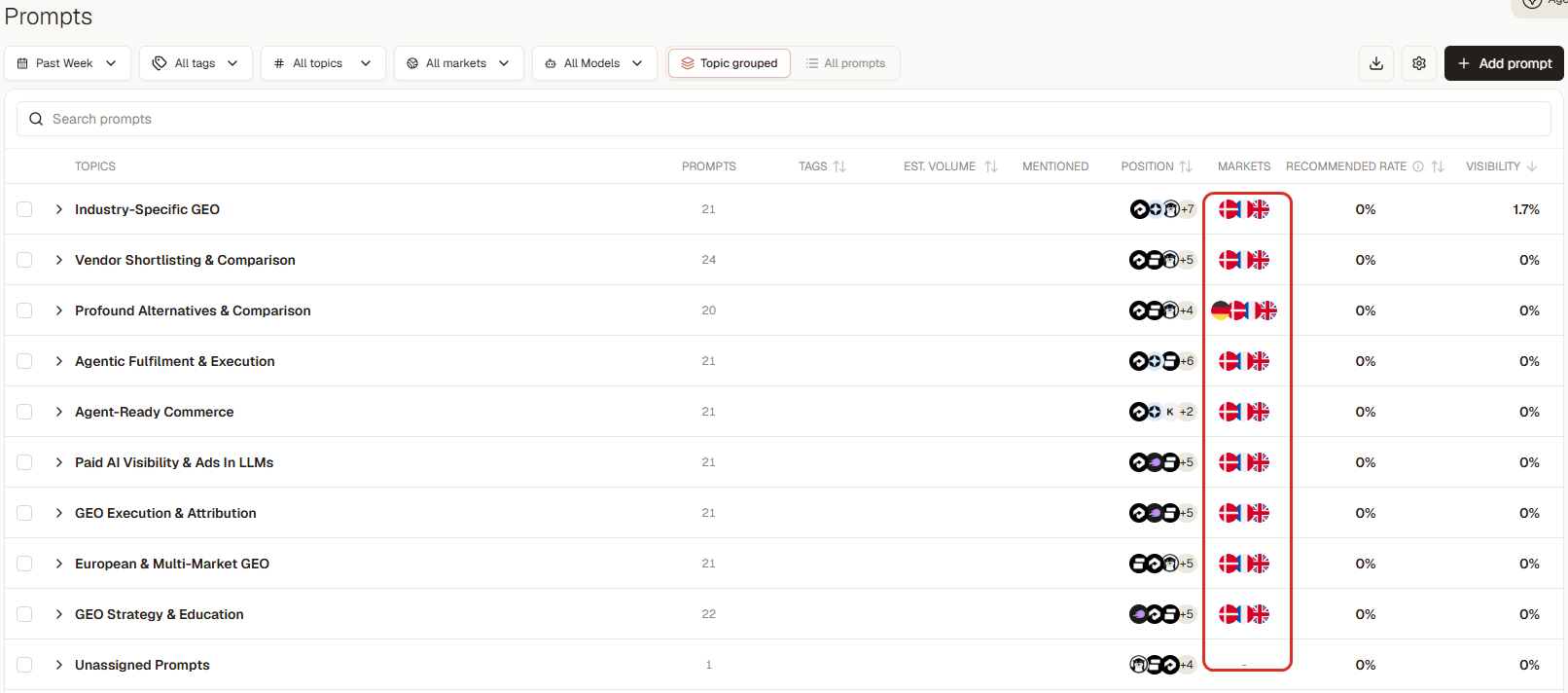
Prompts grouped into topics and tracked per market. In e-commerce, a topic is usually a category or a need.
The last point matters more than it sounds. Across 111 brands tracked daily in 3RD between September 19 and October 18, 2026, the median brand's visibility swung 12.5 points between its best and worst day in a single month, with no change to its prompts. Smaller prompt sets swung about twice as much as larger ones. One screenshot of one ChatGPT answer tells you almost nothing.
Products, not just brands
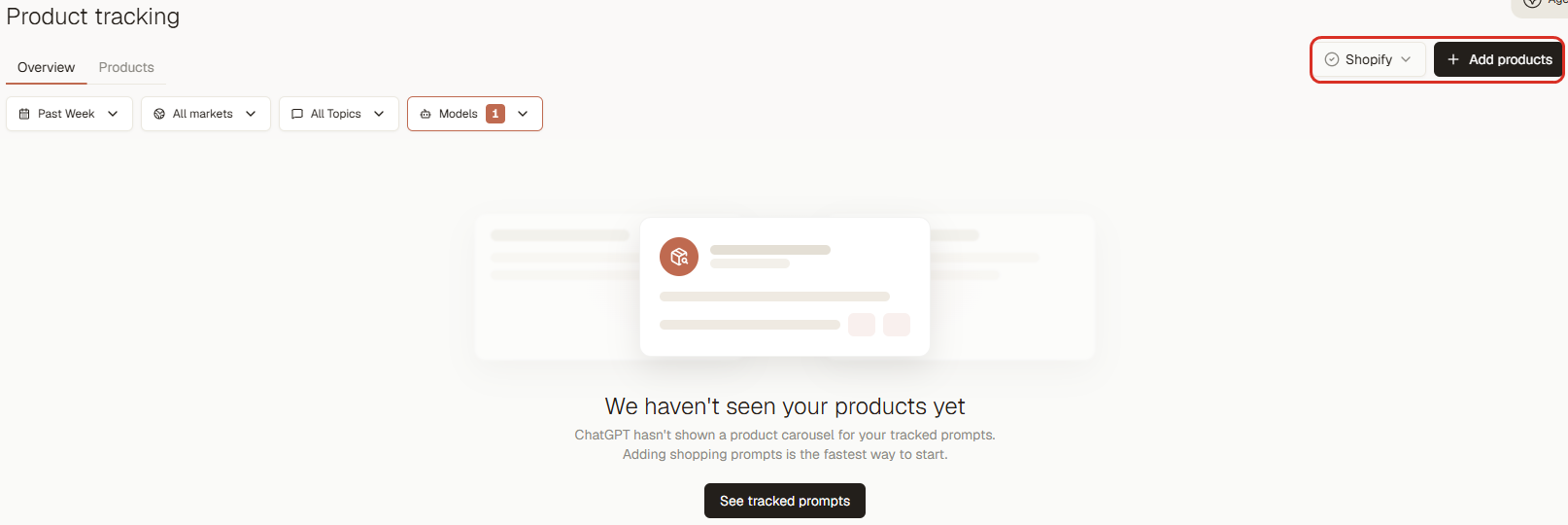
Brand visibility tells you whether you're on the shortlist. It doesn't tell you which of your products AI shows, at which price, or which shop it sends the shopper to. That is what product tracking is for.
In 3RD, Product tracking reads ChatGPT's shopping answers for your prompts and records every product card: the product, its maker, its position, the price and rating shown, the shop it links to and the market. You can switch between a Shops view (which shops AI sends shoppers to) and a Brands view (whose products it names). Upload your catalog as a CSV and 3RD matches it against what AI recommends, which also shows the gaps: products AI keeps recommending that you have no equivalent for.
Product tracking in our own workspace. It's empty because 3RD sells software, not products. For a shop, this is where the product cards from ChatGPT's shopping answers show up.
Two honest limits. Product tracking is in closed beta and switched on per organization. And it reads ChatGPT's shopping answers only, because that is where product carousels are captured today.
What to do first: the order matters
Small teams fail at this by trying everything at once. The order below is the one we recommended to Boë Beauté (more on the case below), and it's the order I'd use for any challenger brand.
Step 1: A foundation AI can understand
Fix the facts. Consistent company and category information, Organization and Product structured data, and a Wikidata entry if you qualify. If AI can't tell who you are, nothing else sticks.
Step 2: Pages AI can read
Check crawl access, page structure, readability and structured data. Tie each fix to something you saw AI get wrong. In our data, technical access is rarely the bottleneck: across 60 brands, the median crawlability score in 3RD was 99 out of 100. Check it, fix what's broken, then move on.
Step 3: Questions you have a right to win
Choose the needs where your product is genuinely different and demand is real. Build or improve the pages that answer those questions. Leave head-to-head comparisons with the category leaders for later, when you have some authority.
Step 4: Outside proof
Find the third-party pages AI cites for those questions, and earn a place on them. This is usually where the real lever is. Across 54 brands with all five drivers measured in 3RD, authority or content quality was the weakest driver for 42. Crawlability was the weakest for none.
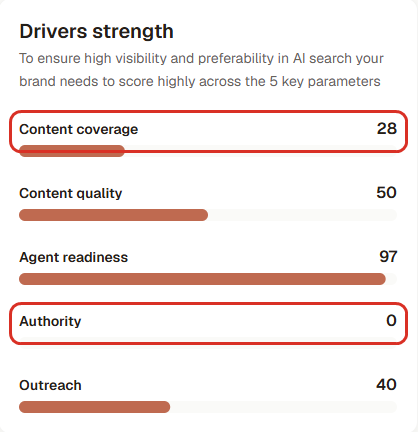
Our own drivers. Agent readiness is fine. Authority (0) and content coverage (28) are what hold us back, which is the most common pattern we see.
Step 5: Widen
Once you're named for your strongest needs, extend to adjacent categories, more markets and the comparison questions.
Decision table: which fix for which problem
|
Problem you see |
Use it when |
What to do |
Who usually does it |
|---|---|---|---|
|
AI describes you wrong or confuses you with another brand |
Branded prompts show wrong facts |
Fix entity facts, structured data, Wikidata |
Marketing + developer |
|
You're missing from category answers |
Competitors named, you're not |
Build pages for the needs you can win |
Content / e-commerce |
|
You have pages but AI cites others |
Your page exists, third parties get cited |
Earn mentions on the cited pages |
PR / partnerships |
|
AI names your brand but not your products |
Brand visibility OK, product cards show rivals |
Product data, retailer distribution, catalog upload |
E-commerce / sales |
|
You're mentioned but never recommended |
Visibility up, Recommended rate near 0 |
Sharpen the "best for" claim with proof |
Marketing / product marketing |
|
A market lags |
One country–language pair far behind |
Local pages and local sources, not translations alone |
Local team |
Five ways e-commerce teams get this wrong
- Tracking only branded prompts. You'll look visible and learn nothing about discovery.
- Reading one answer as the truth. Answers change from run to run. Read weekly trends per category.
- Translating instead of localizing. A Danish shopper's question isn't a translated English one, and the sources AI cites in Denmark are Danish.
- Starting with the category leader's home turf. Head-to-head with the biggest brand on its strongest need is the slowest way in.
- Treating it as an on-site project. With about 93% of citations coming from third parties, a plan that only changes your own pages misses most of the answer.
A real case: from zero to the top five in one quarter
Boë Beauté is a Danish biotech skincare brand specializing in self-tanning for sensitive skin. When it started with 3RD, it didn't appear once across thousands of prompt runs in its markets and languages, not even at a low rank. Larger competitors had years of coverage, big content libraries and bigger teams. Boë Beauté had no GEO or SEO specialist.
What it did. 3RD recommended a US-first challenger plan: put limited resources where demand, real differentiation and ChatGPT adoption gave the best chance to win. Then the work followed the order above:
- A foundation AI could understand, including a Wikidata entry.
- Pages AI could read, with each fix tied to an observed failure.
- Content focused where the brand is genuinely different: self-tanning for sensitive skin. Head-to-head comparison content waited.
- Outreach aimed at the sources that shape AI answers in the category.
One in-house marketer did the work in a few hours a week, alongside other responsibilities.
The result. After one quarter, Boë Beauté's weekly visibility was 22.2%, up from 0.0%. It ranked in the top five of seven competitors, ahead of Malin+Goetz and closing in on CeraVe and La Roche-Posay. All 77 measured mentions were positive, and 9,000+ tracked citations now link the brand to AI answers in its category.
The lessons that transfer to any shop:
- A brand has to be understood before it can be recommended.
- Start where demand and your real difference overlap, not everywhere at once.
- Tie each fix to something you can observe, so you know what worked.
- With a clear plan, one marketer can do this in a few hours a week.
Read the full Boë Beauté case.
How we approach this in 3RD
I'll be honest about where 3RD helps and where it doesn't.
Where it helps:
- Tracking per category and market. Topics, markets as country–language pairs, and the assistants your shoppers use, with Visibility and Recommended rate separated.
- Diagnostics. Five drivers (content coverage, content quality, agent readiness, authority and outreach) scored, with a plain-language explanation of why AI picks your competitors.
- Playbooks and tasks. A goal in your own words becomes ranked tasks, each tied to a driver.
- Outreach. The third-party pages AI cites for your prompts, ranked by how many of your prompts they influence, with a suggested angle for each.
- Product tracking (closed beta): which products and shops ChatGPT's shopping answers name.
- Content Agent, where your plan includes it: it drafts pages from a brief and your brand context. You review and publish. Nothing goes live without you.
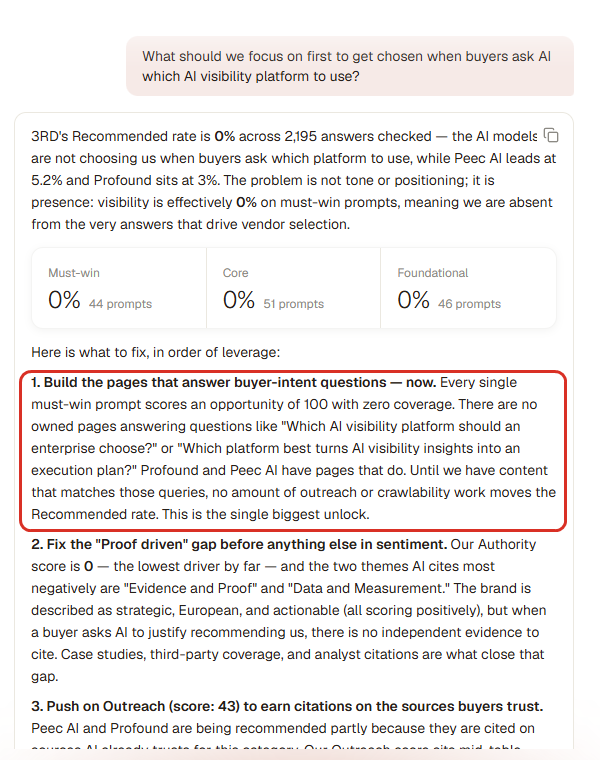
In our own workspace we asked 3RD Agent what to fix first. The answer, "build the pages that answer buyer-intent questions", is the same advice we give e-commerce brands.
Where it doesn't:
- 3RD doesn't manage your product feeds or merchant accounts. That stays in your commerce platform and feed tools.
- It doesn't publish for you or contact publishers in your name.
- Product tracking covers ChatGPT's shopping answers only, and it's in closed beta.
- No tool can guarantee AI will recommend you. What it can do is show you why it doesn't, and measure whether your work moves the number.
About the data
The aggregate figures in this guide come from 3RD's own research: brands tracked in 3RD between September 19 and October 18, 2026, covering 732,000 AI answers for the variance figures, 5.9 million citations for the source figures, and 60 brands for the driver and recommendation figures. The sample leans Nordic. The data is anonymised and aggregated, and no brand is named. These are observational data, not controlled experiments. The Boë Beauté figures are from the published case.
FAQ
Which GEO tool helps an e-commerce brand win AI-driven product discovery? Pick one that tracks your category questions per market, separates being mentioned from being recommended, shows which third-party sources AI cites, and tracks products in shopping answers. 3RD does all four (product tracking is in closed beta). Our buyer's checklist covers how to compare tools.
Does 3RD work for e-commerce brands? Yes. Boë Beauté, a Danish skincare brand, went from 0.0% to 22.2% weekly visibility and a top-five rank in one quarter, with one in-house marketer. 3RD tracks brand visibility per category and market, and product tracking shows which products ChatGPT's shopping answers name.
Is AI product discovery the same as Google Shopping? No. Product data still matters, but AI also writes a text shortlist from third-party sources such as review sites, comparison articles and specialist blogs. Most of what AI cites is not your own site: a median 6.8% of citations in our data.
How many prompts should an e-commerce brand track? Start with 20–40 per category per market, mostly problem and "best X for Y" questions. Smaller prompt sets give noisier scores; in our data they swung about twice as much from day to day.
How long before results show? Expect weeks, not days. Read the weekly trend per category. Boë Beauté reached the top five within a quarter, and single-day readings can move by more than 10 points with no change on your side.