AI search
AI visibility for professional services firms: how to win AI-shaped buying journeys
How buyers use AI to shortlist consultancies, law, audit and design firms, what AI cites, and how one firm moved from No. 5 to No. 1.
Contents
Short answer: Buyers now ask AI to shortlist consultancies, law, audit and design firms. Firms get named when AI understands their specialism and finds outside proof of it.
A buyer who needs a strategy partner, a law firm or an auditor used to ask a colleague, search, and read a few websites. Many now start with a conversation: "Which firms are strongest in service design in the Nordics?" The AI answers with three to five names and a reason for each.
That answer is a shortlist. Manyone's case page puts the risk plainly: a company that AI doesn't name can be left off the shortlist before anyone visits its website.
Professional services have a specific problem here. You sell expertise, and expertise is hard to see from the outside. AI can't sit in your workshops or read your client work. It sees what the web says about you: rankings, case studies, people, articles and the pages that compare firms. If those sources don't make your specialism clear, AI falls back on the biggest names.
This guide covers how the AI-shaped buying journey works for services, what AI cites, which signals of expertise it picks up, and how a specialist design firm moved from No. 5 to No. 1 in its category, ahead of much larger competitors.
The short answer
- Define the category you want to be named for, in the words buyers use. "Strategic design", not "we help organizations transform".
- Track the questions buyers ask in each market and language you sell in, and see which firms AI names today.
- Find out why AI picks others. Usually it's missing outside proof, not missing pages.
- Make your expertise visible: case studies with outcomes, people with clear profiles, a point of view on the category.
- Get onto the sources AI cites: rankings, directories, industry associations, trade media and comparison articles.
- Measure over months. Daily readings swing too much to judge from one answer.
How the AI-shaped buying journey works for services
Buying professional services has always been a trust exercise. AI now sits in most of its stages.
|
Stage |
What the buyer asks AI |
What AI draws on |
|---|---|---|
|
Framing the problem |
"How do companies approach a CX transformation?" |
Articles and guides that define the problem |
|
Defining the category |
"What's the difference between a design firm and a management consultancy?" |
Category explanations, industry bodies |
|
Shortlisting |
"Best strategic design firms in Scandinavia" |
Rankings, directories, comparison articles, case studies |
|
Due diligence |
"What has Firm A done in healthcare?" |
Case studies, client lists, press coverage |
|
People |
"Who leads Firm A's service design practice?" |
Partner bios, LinkedIn, conference pages |
|
Comparing |
"Firm A or Firm B for a public-sector project?" |
Specific differences in sources AI trusts |
Two stages decide most outcomes: defining the category and shortlisting. If AI frames the category without you, or writes the shortlist from sources that don't mention you, the later stages never happen.
What AI cites for professional services
AI doesn't mainly cite your website. Across 100 brands and 5.9 million citations tracked in 3RD between September 19 and October 18, 2026, the median brand's own domains made up just 6.8% of the sources AI cited in its category's answers. The rest were third-party pages.
In professional services, those third parties tend to fall into a few groups:
- Rankings and award lists. Industry rankings, "top firms" lists and award pages are the raw material of a shortlist.
- Directories and associations. Professional bodies, trade associations and specialist directories describe who does what.
- Trade media and analyst-style articles. Coverage that names firms in the context of a specific problem.
- Competitors' own pages. Across our data, competitors' sites out-cited the brand's own site for 41 of 100 brands. A larger firm's detailed practice pages can end up defining the category.
- A long tail of niche sites. In our data, the largest share of citations went to a long tail of specialist blogs, associations and directories, not to any single platform.
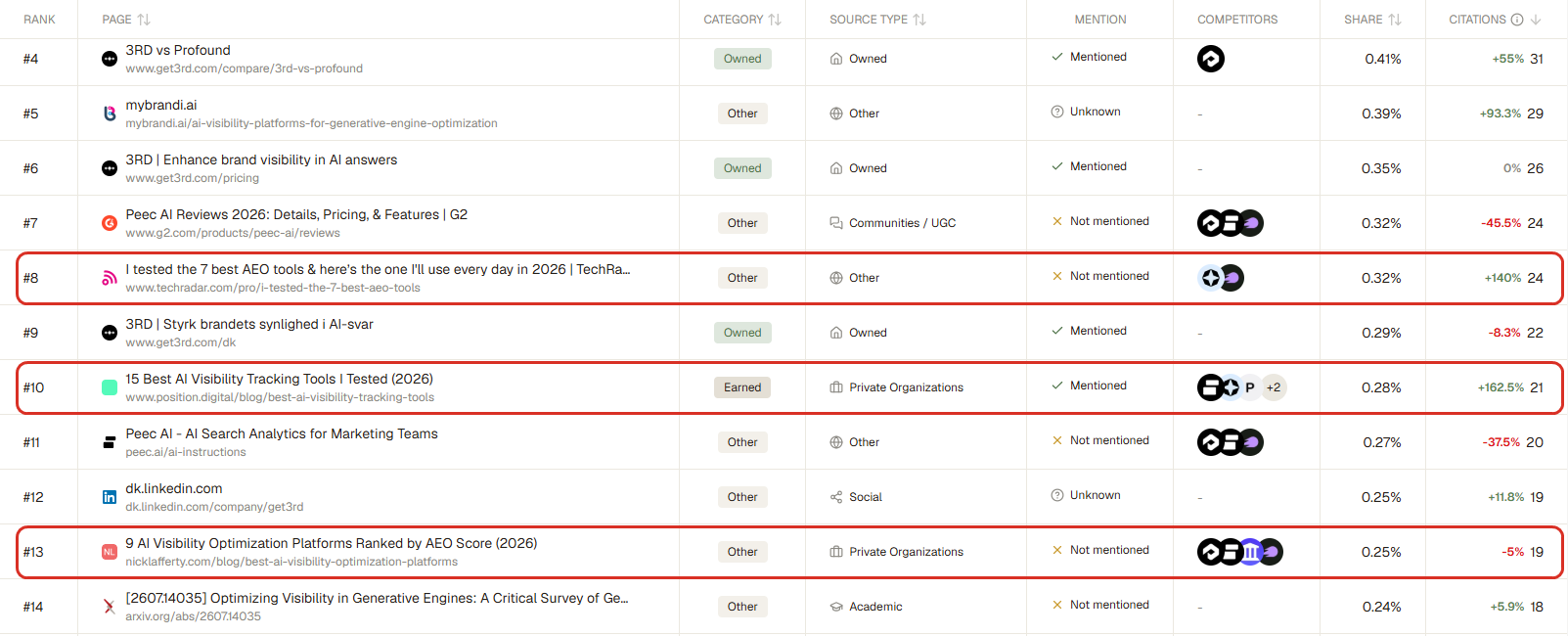
Our own category. Red boxes: two "best tools" lists that AI cites, which name our competitors but not us, and one page where we earned a mention. Professional services firms see the same pattern with rankings and directories.
The practical point: the shortlist is often written from a small set of pages that are cited again and again. Find them for your category, and you know where the work is.
The signals of expertise AI picks up
Specific claims, attributable to someone
"We help clients transform" says nothing a model can use. Compare it with a made-up example such as "We redesigned the patient journey for a regional hospital network and cut referral time by a third". That is a claim with a context and an outcome. AI quotes specifics. Vague positioning gets skipped.
People as entities
In services, people are part of the product. Buyers ask about partners and practice leads, and AI answers from what it can find. Each senior person should have a clear, consistent profile on your site, LinkedIn and conference or publication pages: name, role, specialism, notable work. When those facts disagree, AI can't connect the person to the firm.
Case studies with outcomes
Case studies are your due-diligence evidence. Make them easy to quote: client type, problem, what you did, result, date. Put the outcome near the top. If clients allow it, name them. If not, describe them precisely ("a Nordic insurer with 2,000 employees").
A defined category
Firms that own a clear category get named for it. Firms that list twelve services get named for none. Pick the categories where you're genuinely strong and use the same words for them everywhere: website, bios, articles, award entries.
A point of view
Thought leadership helps when it takes a position on the category's problems. A firm that has published a clear method for something is easier to recommend for that thing.
An entity AI can resolve
Structured organization data, a Wikidata entry where you qualify, and consistent facts about locations, practice areas and size. These completed tasks are part of the Manyone case below.
Mentioned is not recommended
Being named in a list of five is not the same as being recommended. In 3RD, Visibility counts answers that mention you. Recommended rate counts answers that recommend you over the alternatives; being mentioned or listed first doesn't count.
Across 60 brands and 494,000 AI answers checked between September 19 and October 18, 2026, the median brand was mentioned in 19.8% of answers and recommended over the alternatives in 0.2%. A quarter (15 of 60) were never recommended in the month.
For a services firm, the second number is the one that wins pitches. It rises when AI can point to a reason: a specialism, a result, a ranking.
How to measure it
Services firms usually sell across several countries and languages, and AI answers differ by both. 3RD tracks each market as a country–language pair, so Denmark – Danish and Denmark – English are measured separately.
A setup that works:
- One topic per practice or category you want to be named for.
- Prompts written the way buyers ask, in each language you sell in: shortlist questions, problem questions, comparison questions.
- Your real competitors, including the large generalist firms buyers compare you with.
- Must-Win, Core and Foundational tags, so you know which answers matter most.
- Daily measurement, read as a trend over weeks and months.
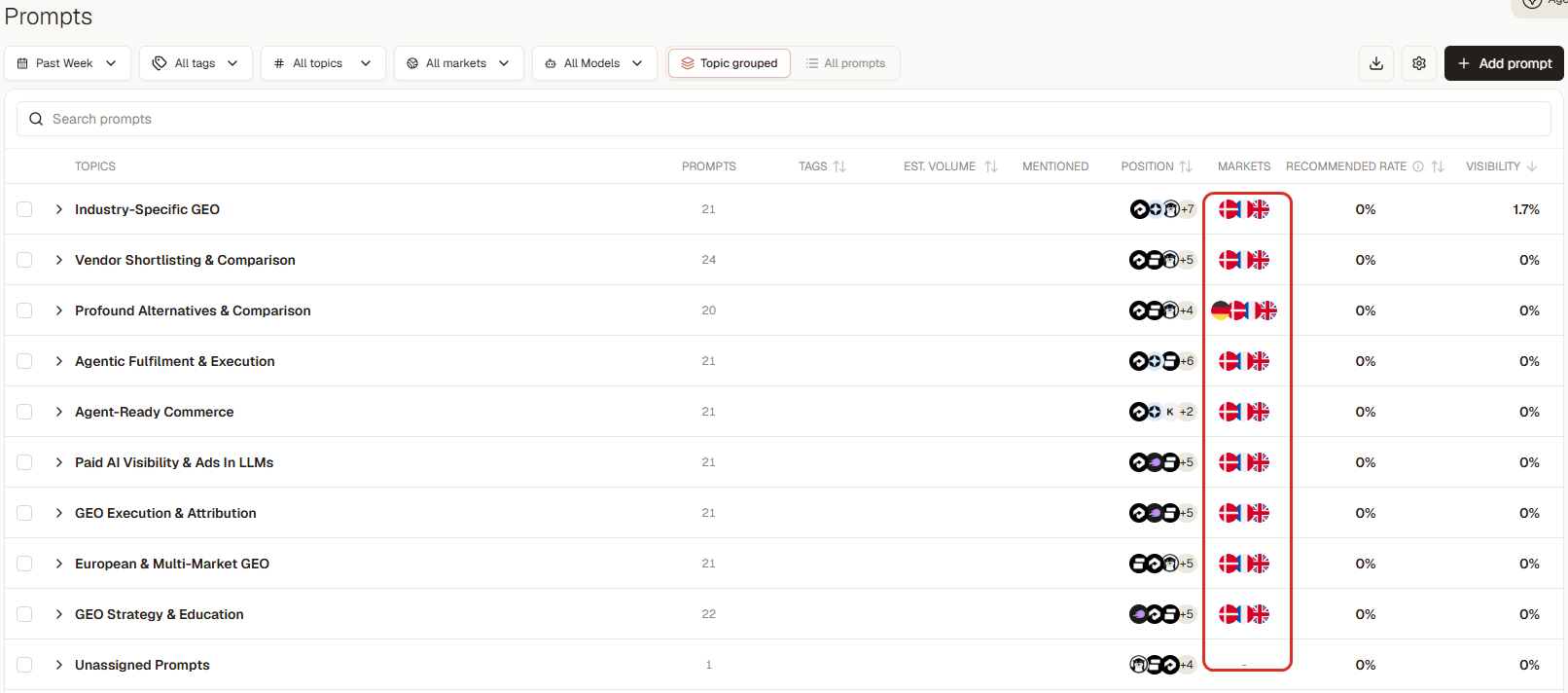
Prompts grouped by topic and market. For a services firm, a topic is usually a practice area.
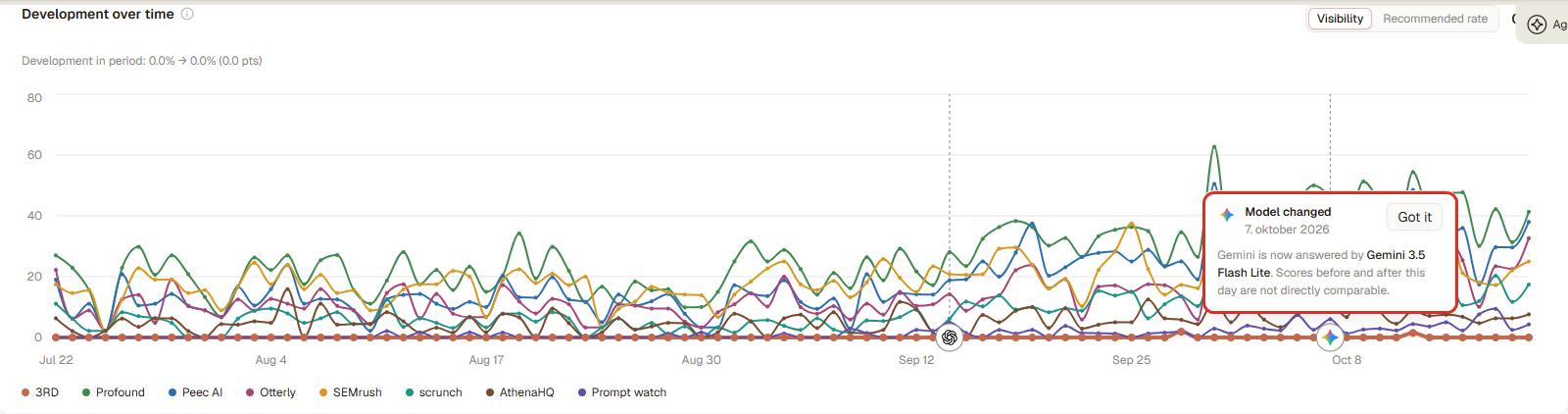
Don't judge from one answer. Across 111 brands tracked daily in 3RD, the median brand's visibility swung 12.5 points between its best and worst day in a month, with no change to its prompts. In the Manyone case, daily visibility in one measure ranged from 1.4% to 8.5% within the same month.
Why AI picks other firms: what we usually find
When we look at why a firm is missing, the answer is rarely technical. Across 60 brands, the median crawlability score in 3RD was 99 out of 100. Across 54 brands with all five drivers measured, authority or content quality was the weakest driver for 42. Crawlability was the weakest for none.
In plain terms: AI can read your site. It just doesn't find enough outside evidence that you're the specialist, or your pages don't answer the buyer's question clearly enough to quote.
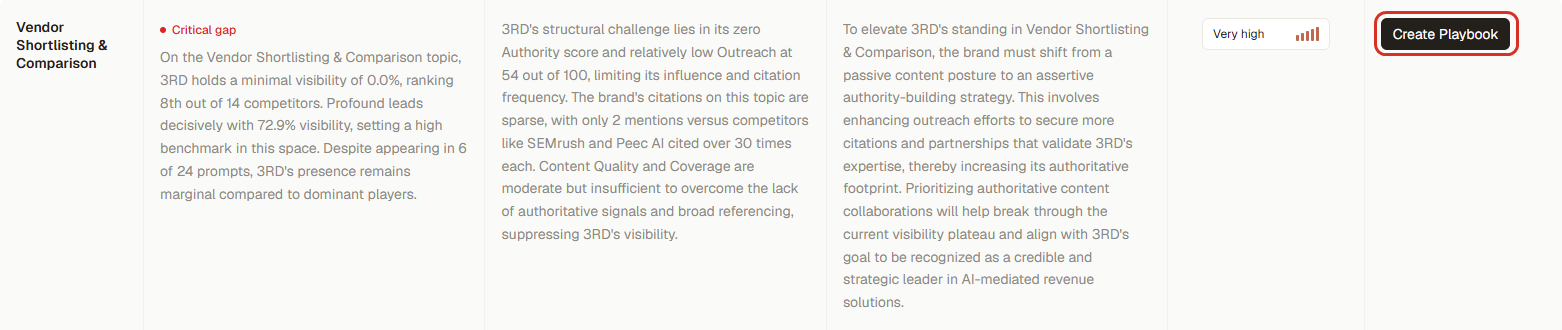
3RD's Diagnostics puts this per topic: the situation, the issues behind it and a proposed approach.
A topic diagnosis from our own workspace. For a firm, the same view would read "Strategic design: you're fifth, the leader is cited on these lists, your authority score holds you back".
A real case: from No. 5 to No. 1
Manyone is a strategy and design company. It competes with McKinsey, Accenture and Deloitte, firms that have built up far more coverage over many years. When it started with 3RD, it was fifth in strategic design. Four months later it was first, with the biggest gain of the 37 organizations tracked in the category.
The challenge. Manyone's analytics couldn't show how often it was mentioned, which competitors AI recommended instead, or how its position changed by category, market and language.
What it set up:
- 1,470 prompts in five languages: Danish, Swedish, Norwegian, German and English.
- 12 markets across seven countries, with nine topics and 37 competitors and comparable organizations tracked.
- Prompts split into Must-Win, Core and Foundational.
- Daily measurement for more than 100 days.
What it did. Its own team read the data, chose the work and did it. No new department or agency was needed. Completed tasks included structured organization data, a Wikidata entity and an FAQ structure.
The result in strategic design (baseline April 24 to May 24, 2026; latest measurement July 18 to August 17, 2026):
|
Organization |
Apr/May |
Jul/Aug |
Change |
|---|---|---|---|
|
Manyone |
18.0% (No. 5) |
26.9% (No. 1) |
+8.9 pts |
|
Accenture Song |
20.8% |
26.7% |
+5.9 pts |
|
Designit |
21.0% |
24.2% |
+3.2 pts |
|
frog |
20.4% |
20.1% |
−0.3 pts |
|
McKinsey |
20.7% |
19.6% |
−1.1 pts |
|
Deloitte Digital |
7.3% |
6.2% |
−1.1 pts |
Visibility in strategic design rose 49%, from 18.0% to 26.9%. Visibility on Must-Win prompts, where buyers are ready to choose, rose 45%. Manyone gained in every topic it tracks, from industrial design (+94%) to customer experience (+7%), and it's now named for 17 buyer questions where it didn't appear before. Its sentiment score is 86.9, with 19 negative mentions out of nearly 3,000.
What it showed:
- Positioning is increasingly shaped by what AI answers, not only by what a firm publishes.
- An internal team can move its position with the expertise it already has.
- A specialist firm can outrank much larger competitors within its category.
- A single check is misleading.
Read the full Manyone case.
Other professional services firms use 3RD too. Inneke Padilla Wolthoorn, COO at Bird & Bird Denmark, put the value this way: "3RD didn't just show us where we were visible, but why we weren't being selected in specific AI scenarios." Brian Rasmussen, CEO and partner at Grant Thornton, said: "We liked that 3RD is both ambitious and European in its approach."
What to do first
|
Problem you see |
Use it when |
What to do |
Who usually does it |
|---|---|---|---|
|
AI frames your category without you |
Category questions name others |
Publish a clear definition and method for your specialism |
Practice lead + marketing |
|
You're missing from shortlists |
"Best firms for X" names competitors |
Get onto the rankings, directories and articles AI cites |
Marketing / PR / BD |
|
AI gets your firm wrong |
Branded answers have wrong facts or confuse you with another firm |
Fix entity facts, structured data, Wikidata |
Marketing + developer |
|
AI doesn't know your people |
Questions about partners return nothing |
Consistent bios across site, LinkedIn and event pages |
Marketing + partners |
|
You're named but never recommended |
Visibility up, Recommended rate flat |
Lead with outcomes and specialism; make proof quotable |
Marketing / content |
|
One market lags |
One country–language pair behind |
Local cases, local sources, local language pages |
Local office |
Five ways professional services firms get this wrong
- Positioning as everything. A firm listed under twelve services gets named for none of them.
- Case studies without outcomes. "We partnered with a leading bank" can't be quoted. A result can.
- Bios written as CVs, not as expertise. AI needs to connect a person to a specialism.
- Only working on the website. With about 93% of citations coming from third parties, the shortlist is mostly written elsewhere.
- Judging from one answer. Answers change daily. A firm that reacts to every screenshot never sees the trend.
How we approach this in 3RD
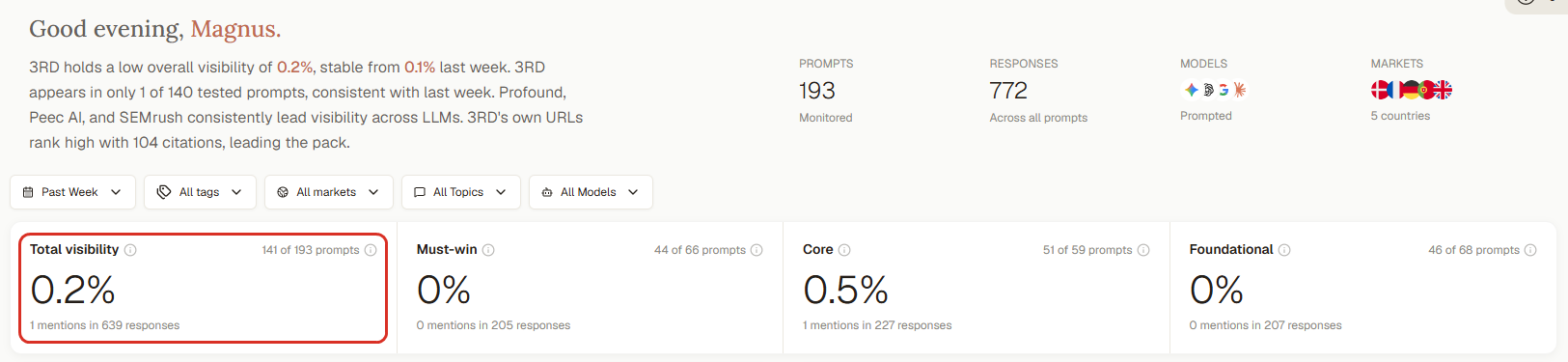
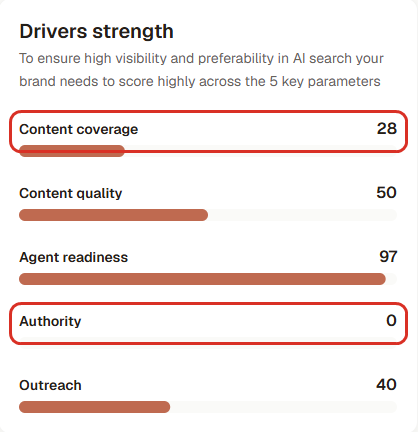
We're a software company, not a services firm, but our own situation shows the same mechanics. We sit at 0.2% visibility, ninth of fourteen in our tracked category, with an authority score of 0. When we asked 3RD Agent what to do first, it said to build the pages that answer the questions buyers ask. That's what this blog is.
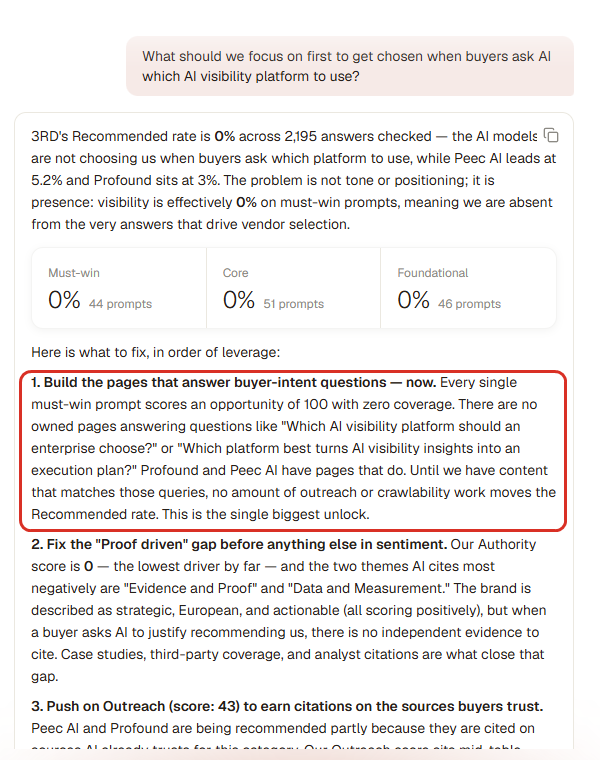
Our own answer from 3RD Agent: content first, then proof and authority. The order is the same for a services firm.
Where 3RD helps:
- Tracking per practice and market, as country–language pairs, against the firms you're compared with.
- Diagnostics that explain in plain language why AI names other firms, per topic.
- Playbooks and tasks that turn a goal into ranked work.
- Outreach: the third-party pages AI cites for your prompts, ranked by how many of your prompts they influence, with a suggested angle per page.
- AI Ontology (beta, switched on per organization): checks whether AI resolves your name to your firm, understands your services and describes your positioning the way you want.
- Content Agent, where your plan includes it: drafts pages from a brief and your brand context. You review and publish.
Where it doesn't:
- It doesn't win rankings or awards for you, or pitch publishers in your name.
- It can't invent expertise. The case studies and points of view have to be real.
- No tool can guarantee AI will recommend you. 3RD shows why it doesn't, and measures whether your work moves the number.
About the data
Aggregate figures come from 3RD's own research on brands tracked in 3RD between September 19 and October 18, 2026: 111 brands and 732,000 AI answers for variance, 100 brands and 5.9 million citations for sources, and 60 brands for drivers and recommendation rates. The sample leans Nordic and includes many B2B firms. The data is anonymised and aggregated, and no brand is named. These are observational data, not controlled experiments. Manyone figures and the two quotes are as published on get3rd.com.
FAQ
Which platform helps professional services firms win AI-shaped buying journeys? One that tracks shortlist and category questions per market and language, shows which firms AI names and why, and points to the sources AI cites. 3RD does this. Manyone used it to move from No. 5 to No. 1 in strategic design in four months.
Do professional services firms need different tactics from product companies? Partly. The mechanics are the same, but services depend more on people, case studies and category definitions, because expertise is hard to see from outside. Rankings, directories and associations matter more than review sites.
How do we get our partners recognized by AI? Give each senior person a consistent profile across your site, LinkedIn and event or publication pages: name, role, specialism and notable work. Link those profiles to the firm's practice pages.
Can a smaller firm outrank large consultancies in AI answers? Yes, within a defined category. Manyone overtook Accenture Song, Designit, frog and McKinsey in strategic design, with its own team and no new agency.
How long does it take? Expect months. Manyone's measurement windows were four months apart. Daily readings swing too much to judge from: a median of 12.5 points between best and worst day per month in our data.