AI search
AI visibility for banks, brokers and financial services: managing what AI recommends under compliance
How financial brands track what AI says about them, catch wrong rates and fees early, and fix the sources AI trusts without breaking compliance.
Contents
Short answer: pick a platform that tracks AI answers per market, flags wrong claims, shows the sources AI trusts, and keeps every draft behind compliance review.
Here is the longer version. When someone asks ChatGPT which bank has the best savings rate, or which broker suits a first-time investor, the answer is built mostly from pages you don't own: regulators, comparison sites, review sites and the press. You can't edit that answer. You can watch it, find the sources behind it, correct what's wrong at the source, and publish clear, current, compliance-approved facts that AI can cite instead.
This guide shows how to do that in a regulated business. It covers what AI does differently with money questions, how to catch wrong rates and fees before a customer does, a workflow that keeps compliance in control, and how to choose a platform. Where it helps, I show how we run the same steps in 3RD, including the places where 3RD falls short for a regulated buyer.
Why AI treats money questions differently
Search engines have long treated finance as "Your Money or Your Life" territory: topics where bad information can hurt people, so the bar for trust is higher. AI assistants behave the same way in practice. On finance prompts they tend to:
- Lean on institutions. Regulators, central banks, consumer bodies and well-known comparison and review sites carry a lot of weight in the sources they cite.
- Hedge. Answers often add "check with a licensed adviser" or "rates change frequently", and avoid naming one winner.
- Compare. "Which bank…" and "which broker…" questions usually get a shortlist, and the shortlist often mirrors a comparison site's table.
- Go stale. Rates, fees and offers change faster than many of the pages AI cites are updated.
Across the brands we track, the pattern behind all four is the same: AI answers are built from other people's pages. Across 100 brands and 5.9 million citations, the median brand's own website made up just 6.8% of the sources AI cited in its category. Review and comparison sites were cited for 82 of 100 brands, and government and public bodies for 61 of 100. For 11 of 100 brands, the single most-cited outside source was a government or health body. Sector mix drives that last number, so read it as directional, but it matches what finance teams see: the regulator's page and the comparison site often outrank the bank's own.
The practical consequence: in finance, "AI visibility" is as much about accuracy and framing as about being mentioned.
What you can and can't influence
Be clear about this before you start. It saves arguments with compliance later.
|
You can |
You can't |
|---|---|
|
Track which questions name you, in which markets and assistants |
Edit or delete an AI answer |
|
Read the exact answers and the sources behind them |
Guarantee AI states your rate or fee correctly |
|
Fix wrong facts on your own pages and keep them dated |
Make AI recommend you for a product you're not licensed to offer in that market |
|
Ask comparison and review sites to correct outdated tables |
Pay for organic mentions in AI answers |
|
Publish clear, compliance-approved answers to the questions buyers ask |
Stop an assistant from citing a forum thread or an old article |
|
Measure whether the answers change after you fix the sources |
Prove that one change caused a shift (see how to prove a GEO change moved your AI visibility) |
Step 1: Track the questions customers ask, per market
Start with the questions, not the keywords. A useful finance prompt set has three layers:
- Must-win: "Which bank in Denmark has the best savings account for a family?", "Which broker is cheapest for ETFs in the UK?"
- Core: "Is it safe to keep more than €100,000 in one bank?", "What fees should I look for in a stock trading app?"
- Branded: "Is [your bank] a good choice for a first mortgage?", "What does [your broker] charge for foreign stocks?"
Branded prompts matter more in finance than in most categories, because they are where wrong facts about you show up. Track them, even if your visibility score leaves them out by default.
Track each market separately. In 3RD a market is one country in one language, so Denmark in Danish and Denmark in English are two markets with two sets of answers. That matters for finance: product availability, regulators and comparison sites are national.
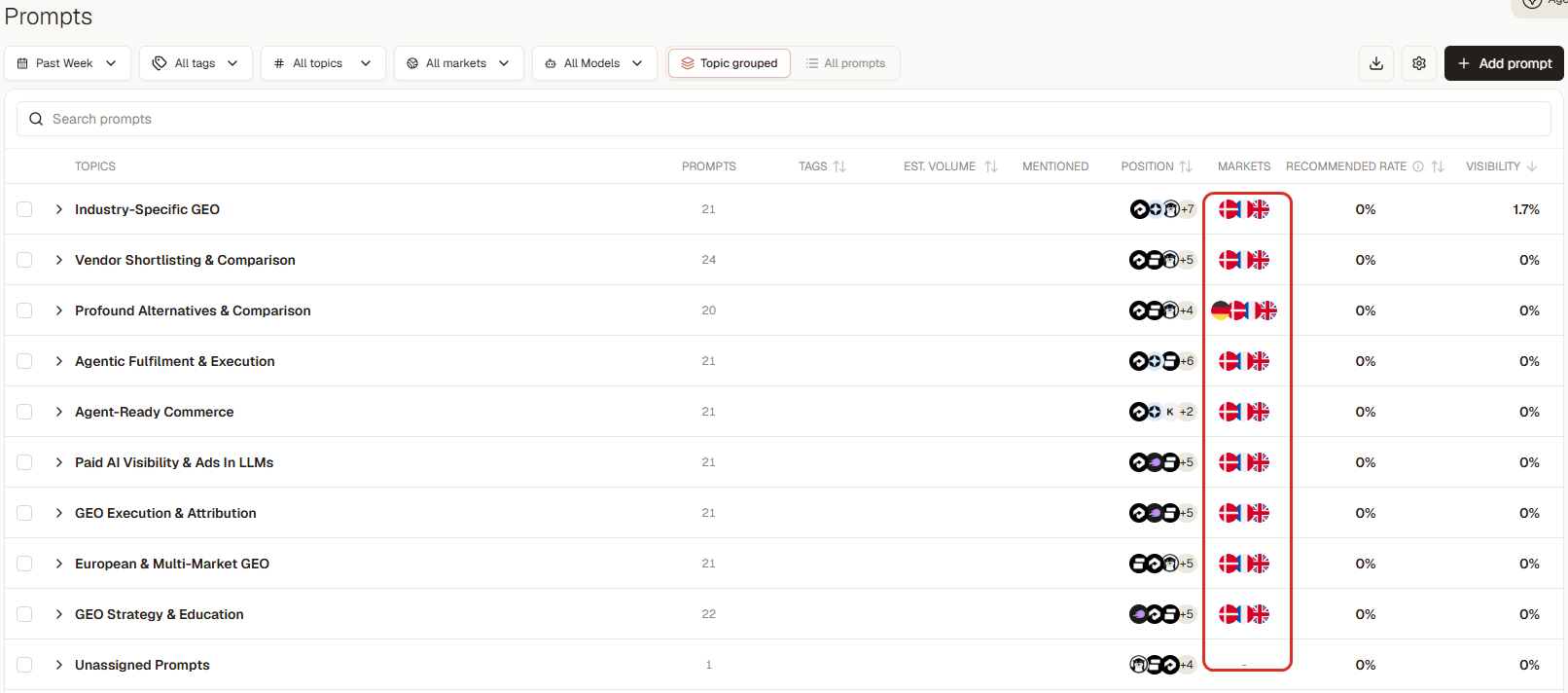
Prompts grouped into topics and tracked per market. In finance, build one topic per product line (savings, mortgages, investing) so compliance can review one product at a time.
Rule of thumb: start with 20 to 40 prompts per market you care about, including at least five branded ones per product line. Smaller sets are noisier. Across the 111 brands in our data, brands with fewer than about 100 answers a day swung twice as much from day to day as brands with 230 or more.
Step 2: Read the answers, not just the score
A visibility score tells you whether you were named. It doesn't tell you whether the answer said your mortgage rate is 2.1% when it is 3.4%. In finance, you have to read the answers.
In 3RD, the Conversations explorer shows each prompt, every assistant's answer, whether you were mentioned, how you were described, which competitors appeared and every source cited. You can switch between assistants to compare how ChatGPT, Gemini and Perplexity answered the same question. They often differ. Across 83 brands in our data, the gap between a brand's best and worst assistant was a median 16 points of visibility, and for 62% of brands (37 of 60) a different competitor led on different assistants.
What to look for, in order of risk:
- Wrong numbers: rates, fees, minimums, limits.
- Wrong eligibility: "available to non-residents", "no credit check", products you don't offer in that market.
- Wrong entity: your product credited to a competitor, or a sister company's product credited to you.
- Outdated framing: an old fee scandal, a discontinued product, a past rating.
- Missing safeguards: AI suggesting your product for a use you would never market it for.
3RD Agent also has a skill called "Is what they say true", which checks the claims the models make about you against the facts. Use it as a first pass, then have a person read the answers that matter. For a regulated product, a human reads before anyone acts.
Step 3: Watch sentiment and the themes behind it
Sentiment shows how AI describes you when it does mention you. In finance, the themes matter more than the score. A recurring "high fees" or "slow customer service" claim is a brief for your content team and a question for your product team.
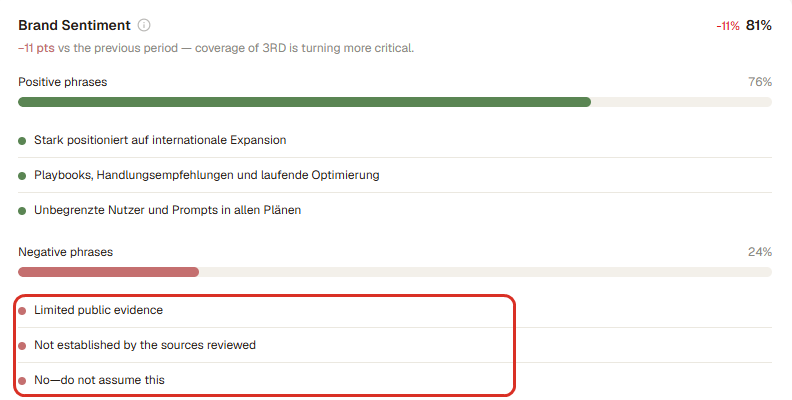
Here is our own example. When AI describes 3RD, the most common negative phrases are "limited public evidence" and "not established by the sources reviewed".
Our own sentiment page. The negatives aren't about the product. AI is saying the sources it trusts don't vouch for us yet. Financial brands see the same mechanism with "fees" or "complaints" themes.
That is the same mechanism a bank faces: AI repeats what its sources say. If the comparison site still lists last year's fee, AI will too.
Two practical limits to know about 3RD's sentiment scoring:
- Sentiment is only scored on answers that mention you, so it never mixes non-mentions into the picture.
- Sentence-level scoring works in English, Danish, Swedish, Norwegian and German. If you sell in other languages, read those answers directly.
Step 4: Find the sources behind the answers
To change an answer, change what it is built from. Start with the sources AI cites most for your must-win prompts, and check which of them mention you and which only mention competitors.
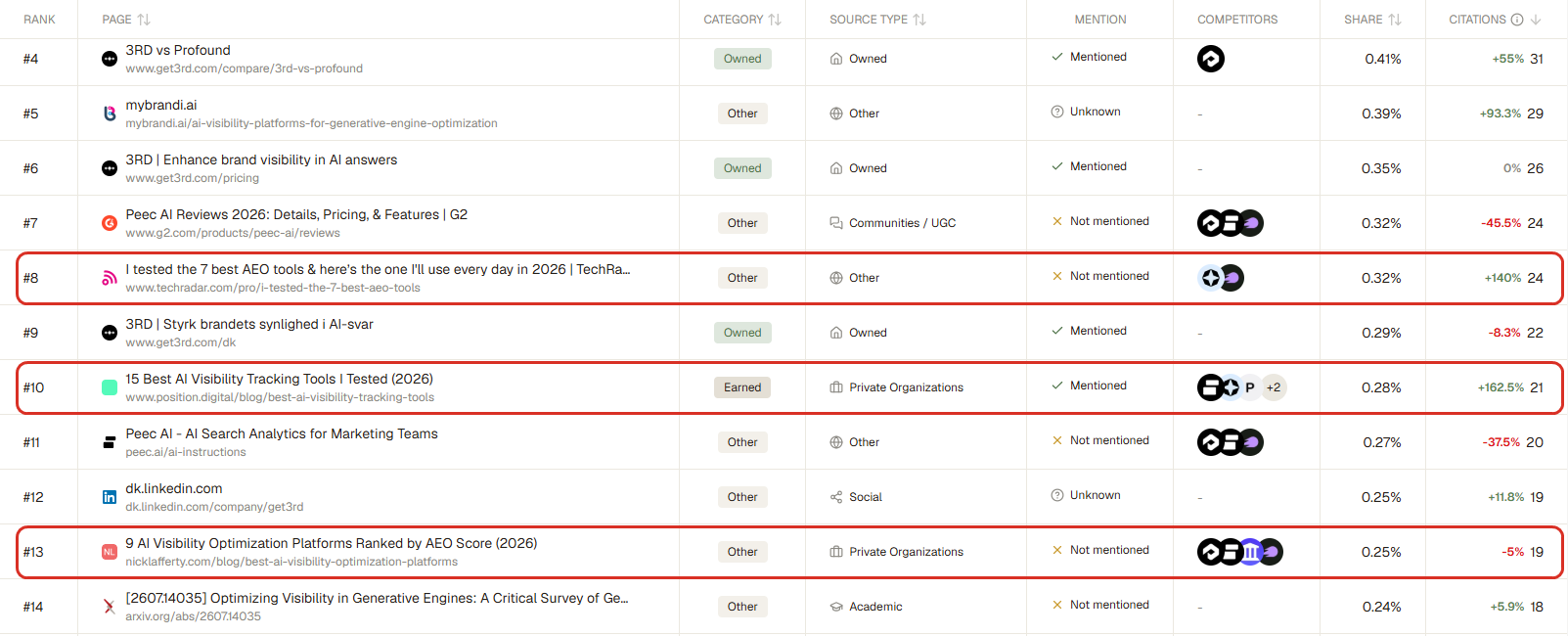
The sources AI cites for our own category, with mention status. The red boxes mark pages that name our competitors but not us. In finance, the same view shows which comparison tables and review pages shape your answers.
For a financial brand, the sources usually fall into five groups. Each needs a different owner:
|
Source type |
What to check |
Who usually owns the fix |
|---|---|---|
|
Your own product pages and price lists |
Current rates and fees, dated, easy to find and crawl |
Product marketing, with compliance sign-off |
|
Regulator and public registers |
Your licence, entity name and permissions are current |
Legal and compliance |
|
Comparison sites |
Your product is listed, with today's rates and fees |
Partnerships or affiliate team |
|
Review sites |
Recent reviews exist; replies are on brand and compliant |
Customer service with compliance |
|
Press and expert content |
Recent, accurate coverage of your products |
PR and communications |
Rule of thumb: fix the source AI cites most for your must-win prompts first. One earned page that feeds dozens of answers moves more than ten new pages on your own site.
Owned pages still matter, though. Across 100 brands, competitors' own sites out-cited the brand's own site for 41 of 100. If a competitor publishes a clear page answering "what does it cost to trade US stocks?" and you don't, AI will quote theirs.
Step 5: Draft, get compliance approval, then publish
This is where a compliance team gets nervous about AI tools, and rightly so. The safe pattern is simple: nothing goes live without a human approving it.
Here is the workflow we recommend, and how each step maps to 3RD:
|
Step |
What happens |
Who |
In 3RD |
|---|---|---|---|
|
1. Pick the gap |
The question you lose, and the source that wins it |
Marketing |
Diagnostics and Task Management |
|
2. Brief |
What the page must answer, structure, sources to cite |
Marketing |
The content brief on each task |
|
3. Draft |
A first version in your brand voice |
Marketing, with AI help |
Content Agent (paid add-on) |
|
4. Review |
Facts, risk warnings, required disclosures, fair and balanced wording |
Compliance and legal |
Outside 3RD, in your normal review process |
|
5. Publish |
On your own site, with a review date |
Web team |
HubSpot push creates a draft only; you publish |
|
6. Measure |
Did the answers change on the target prompts |
Marketing |
Measured effect on the completed task |
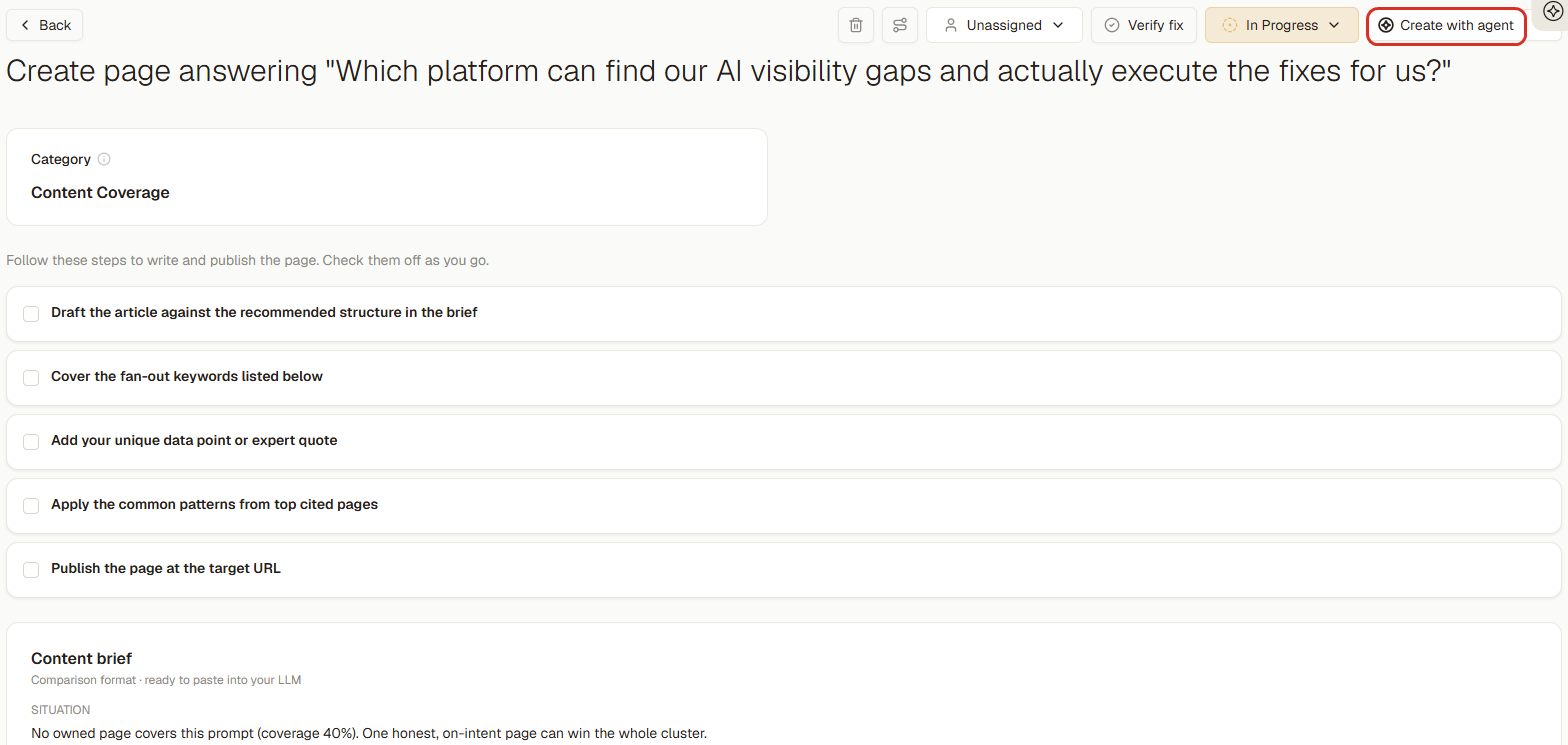
Each content task carries a brief and a checklist. "Create with agent" hands the draft to Content Agent. For a financial brand, add your compliance review as an extra step before "Publish".
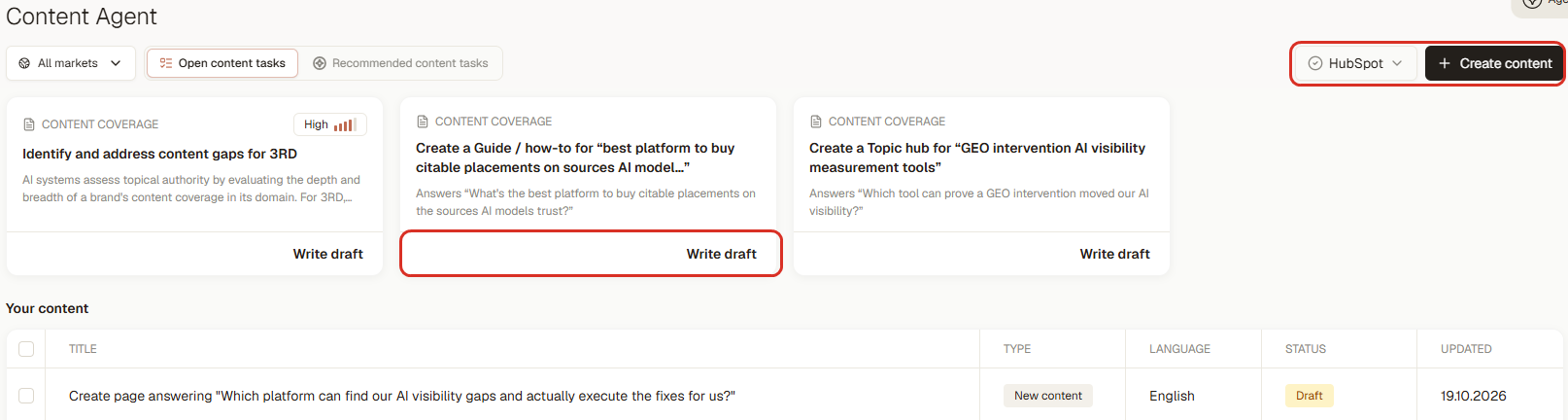
Content Agent drafts each page from its brief. The HubSpot connection only ever creates or updates a draft. Your team reviews and publishes it in HubSpot.
Three properties make this workable under compliance:
- 3RD Agent asks before it changes anything. Every change it proposes (a new prompt, a task, a draft) arrives as a card you approve, edit or reject.
- 3RD never publishes to your site. Content Agent drafts, and the HubSpot integration only creates drafts. Publishing stays your move.
- The draft is a starting point, not approved copy. Treat it like an agency draft: compliance reviews it against your rules for financial promotions in each market.
In the UK, financial promotions must be fair, clear and not misleading, and the same standard applies to marketing communications under MiFID II across the EU. Your compliance team knows the local rules. The point here is that an AI-visibility workflow fits inside them. It doesn't need an exception.
Step 6: Correct wrong facts at the source
When an answer is wrong, work backwards from it:
- Find the source. In the answer, check which pages were cited. The wrong rate usually comes from one of them.
- Fix your own page first, if it is the source. Put the current figure, the date it was last checked and the conditions in plain text, not only in an image or a PDF.
- Ask third parties to update. Send the comparison or review site the correct figure, with a link to your official page.
- Make the right answer easy to quote. A short, dated table of current rates and fees on a crawlable page is easier for AI to cite than a brochure.
- Re-check the answers after the next runs, and expect days to weeks, because assistants re-crawl on their own schedule.
Failure mode: the "rates" image. Rates shown only in an image or a calculator widget are invisible to most AI crawlers. Keep a text version on the page.
Failure mode: one page per country, same URL. If your Danish and Swedish products share one page that switches by IP, AI may cite the wrong country's terms. Give each market its own crawlable URL.
Failure mode: unknown aliases. If customers call you by an old name or an abbreviation, add it as an alias in your brand profile. Missing aliases make answers that clearly recommend you count as non-mentions.
Step 7: Measure, against noise
AI answers move on their own. Across 111 brands and 732,000 answers, the median brand's visibility swung 12.5 points between its best and worst day in a single month, with no change to its prompts. So judge a fix on equal windows and against prompts you didn't touch, not on a single day. 3RD shows this on each completed task: the targeted prompts' change next to the change on the brand's other prompts. Our own method is in how to prove a GEO change moved your AI visibility. The revenue side is in how to connect AI recommendations and citations to revenue.
Paid placements in AI answers: check the rules first
Paid placements are possible in some assistants, but finance is a restricted category almost everywhere:
- OpenAI reviews finance, health and legal advertisers case by case, and keeps ads away from sensitive conversations. We cover the policy in OpenAI has opened advertising in Europe.
- Google requires financial services verification before finance ads can run in a growing list of countries. Since mid-2026 that list has expanded across most of the EEA. Check Google's policy page for your market before planning spend.
For the full picture of what can be bought, see paid AI visibility in 2026.
How to choose a platform for a regulated financial brand
Most of the checklist in how to choose an AI visibility platform applies. Regulated buyers should add these:
|
Criterion |
Why it matters in finance |
What to ask in the demo |
|---|---|---|
|
Per-market tracking |
Products, regulators and comparison sites are national |
"Is Denmark in Danish a separate market from Denmark in English?" |
|
Reading the answers |
Wrong figures hide behind a good score |
"Show me every answer for one prompt, with sources, across assistants." |
|
Accuracy checks |
Wrong rates and eligibility are a compliance risk |
"How do you flag claims that are wrong about us?" |
|
No auto-publishing |
Every promotion needs approval |
"Can anything go live on our site without a person approving it?" |
|
Security evidence |
Vendor risk reviews ask for certificates |
"Which certifications do you hold today?" |
|
Data location |
Many banks require EU hosting |
"Where is our data stored?" |
How the options compare on the last three, from vendors' public pages as of October 2026:
- Profound offers SSO, SOC 2 and an API on Enterprise. Its agents publish to your CMS after an approval step. If your vendor-risk process requires a SOC 2 report today, Profound meets that bar and 3RD doesn't yet.
- KIME runs agents that carry out tasks for you. Check carefully which of those actions touch your site or outreach before you enable them in a regulated business.
- 3RD stores data in EU regions and follows ISO 27001 and SOC 2 controls, but is not yet certified for either. SAML single sign-on is available on Enterprise by agreement. 3RD never publishes to your site; drafts go to HubSpot as drafts or stay in 3RD. See Security.
Our honest summary: if a certificate is a hard requirement this quarter, put a certified vendor on the shortlist. If your main problem is that nobody has time to find and fix what AI gets wrong in each market, 3RD is built for that workflow, with compliance kept in the loop.
Worked example: what this looks like in 3RD
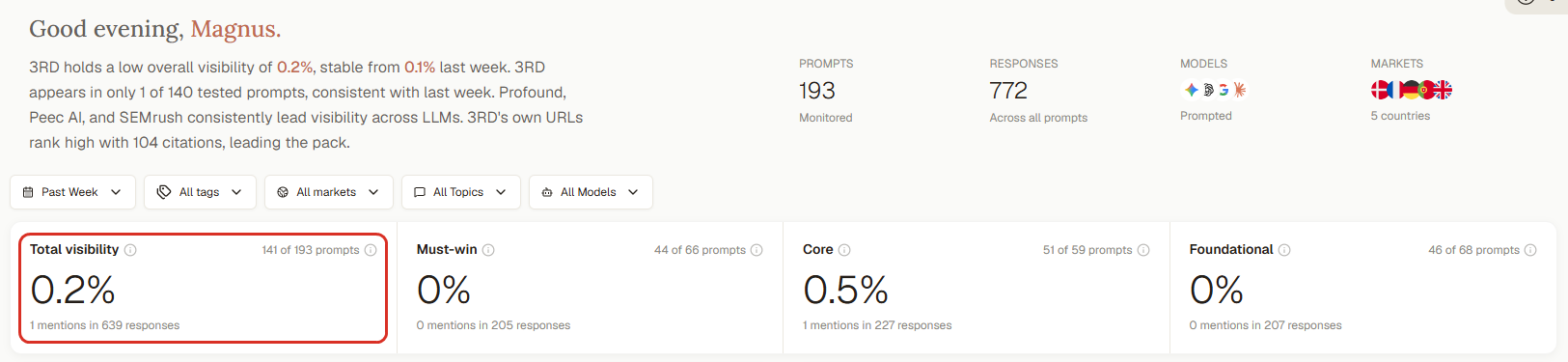
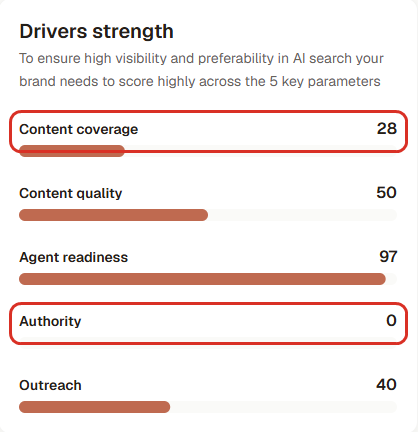
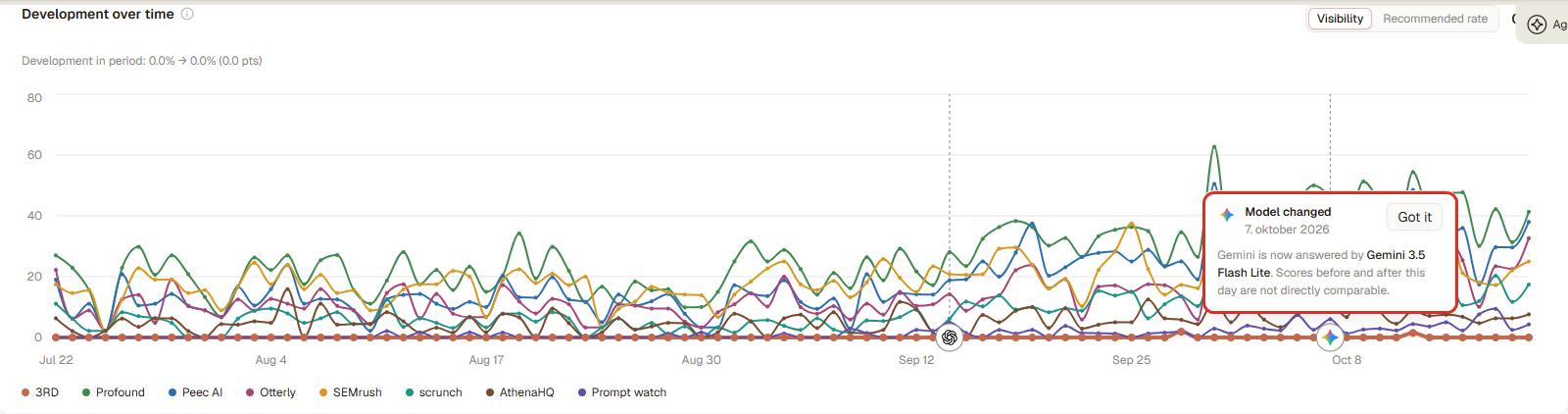
We run this loop on our own brand. 3RD sits at 0.2% visibility on our tracked buyer questions, ninth of fourteen, and Authority is our weakest driver at 0. So we asked 3RD Agent what to fix first.
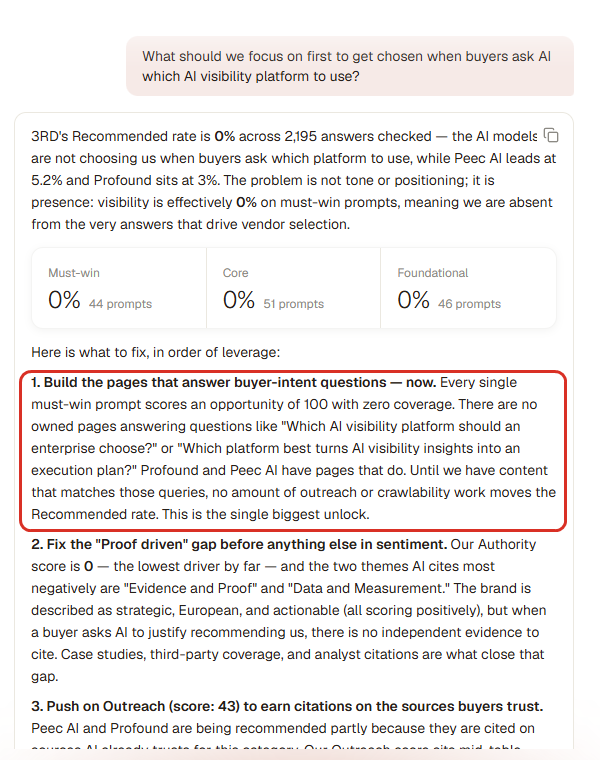
We asked 3RD Agent what to fix first. Its answer: build the pages that answer the questions buyers ask. This article is one of them.
For a bank or broker, the same loop looks like this:
- Diagnostics names the reason you lose a topic, for example "comparison sites list competitors but not you" or "your pages don't answer the fee question".
- Task Management turns each reason into a task with a brief: a page to write, a source to contact, a technical fix.
- Content Agent drafts the page. Compliance reviews it outside 3RD. You publish.
- Outreach tasks list the comparison and review pages that feed your must-win answers, with an angle for each.
- The measured effect on each completed task shows whether the target prompts moved more than your other prompts.
About the data
The aggregate figures come from 3RD's own research: 111 brands tracked in 3RD between 19 September and 18 October 2026, covering 732,000 AI answers, plus 5.9 million source citations for 100 of them. The sample leans Nordic. Brands are anonymised and figures are medians across brands. These are observational data, not controlled experiments.
FAQ
Which platform helps a bank or broker manage what AI assistants recommend about it? One that tracks your questions per market, lets you read each answer and its sources, flags wrong claims and sentiment, and keeps a human approval step before anything is published. 3RD does all of these; certified vendors such as Profound may fit better if a SOC 2 report is a hard requirement today.
Can we correct a wrong rate or fee in ChatGPT? Not directly. You correct the sources the answer is built from: your own pages first, then the comparison and review sites it cites. Then you re-check the answers over the following weeks.
Is an AI visibility tool compatible with our compliance process? Yes, if it never publishes on its own. In 3RD, every change needs your approval, Content Agent only drafts, and the HubSpot integration only creates drafts. Compliance reviews the copy in your normal process.
Should we track branded prompts? Yes. Branded questions such as "what does [your bank] charge for…" are where wrong facts about you appear. Track them per product line and per market.
How long before fixes show up in AI answers? Usually days to weeks, because assistants re-crawl on their own schedule. Judge it on equal windows against prompts you didn't touch, because answers swing on their own: a median 12.5 points a month in our data.