AI search
How to connect AI recommendations and citations to revenue (and what no tool can measure yet)
No tool traces AI answers to revenue end to end. Here's a 9-step method to measure the links you can: visibility, citations, AI visits, pipeline.
Contents
No tool traces AI recommendations to revenue from start to finish. You can measure four links: being named, being cited, AI-referred visits, and pipeline.
Here's the direct answer. Most AI influence happens inside the answer, before anyone clicks. So no analytics stack sees all of it. What you can do is measure each link you can see, and tie your own actions to the numbers that moved.
- 3RD tracks whether AI names and recommends you on the questions closest to a purchase. It also shows which sources the answers cite, and puts AI-referred traffic from your analytics next to your visibility.
- Profound measures AI crawler visits and AI-referred human visits from your server logs.
- Revenue attribution tools such as Attrifast join AI-referred sessions to payments.
- GA4 (Google Analytics 4) on its own can count the visits that do click through, once you set it up.
None of them closes the loop on its own. Anyone who says otherwise is overclaiming.
This guide shows how to build the measurement anyway: the version you can defend in front of a CFO. I've spent most of my career in demand generation, where every channel has to earn its budget with a number. AI is the first channel I've worked with where the honest answer starts with "partly". I'll show you our own numbers along the way, including the odd ones.
Our own numbers don't add up, and that's the lesson
Here's something we found in our own account that explains this whole topic better than any diagram.
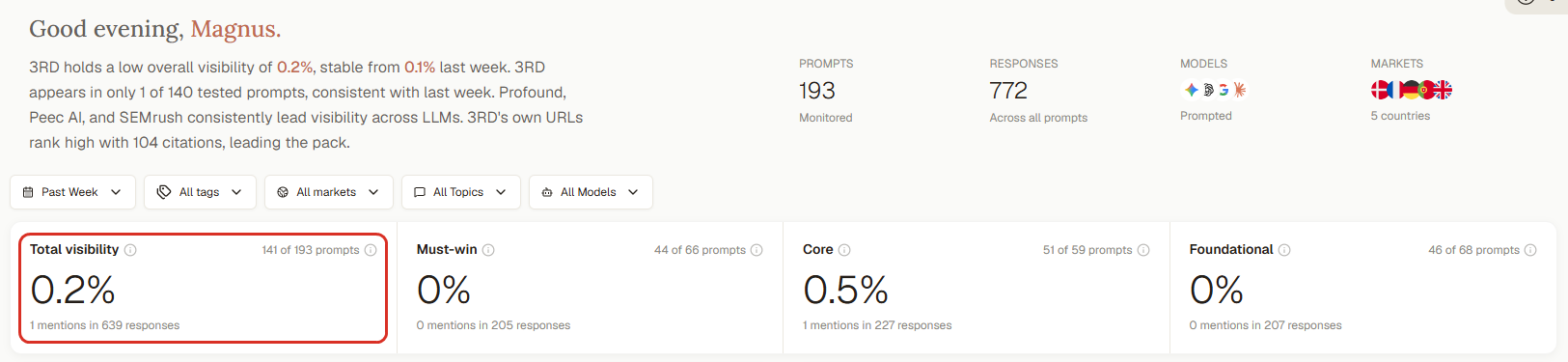
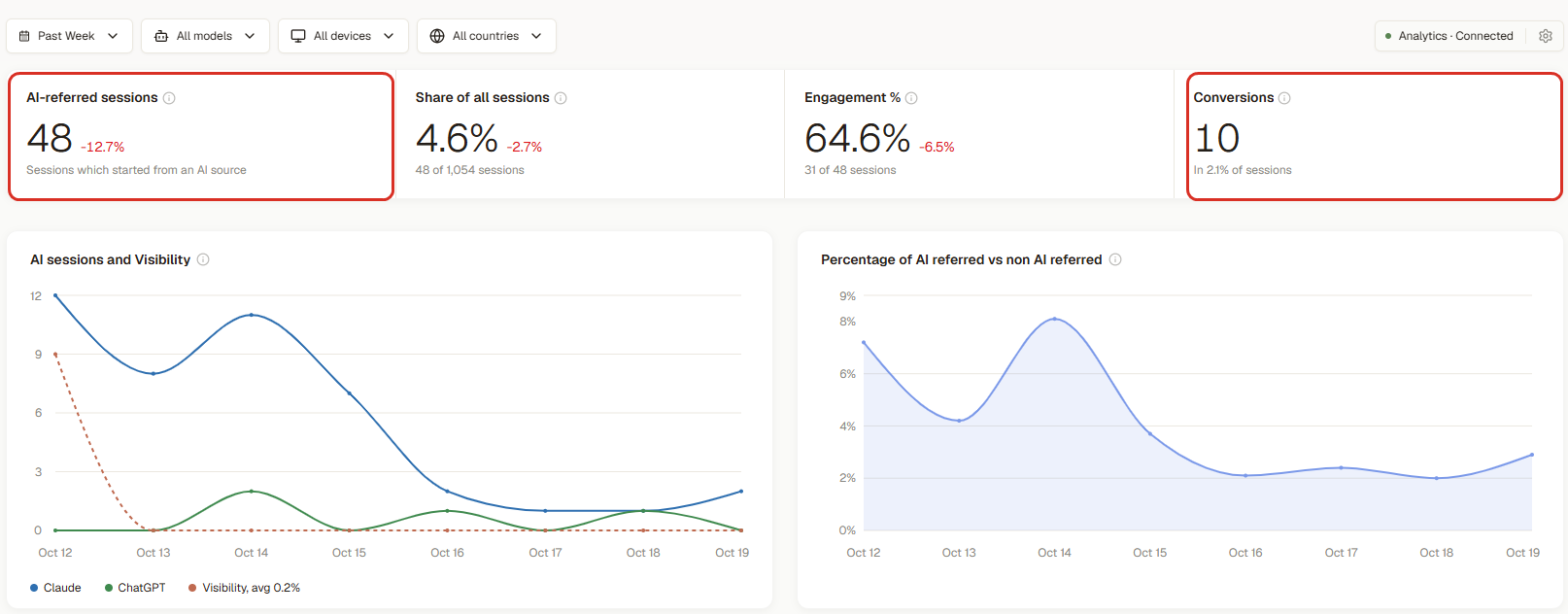
Last week, 3RD was named in 0.2% of the AI answers to the buyer questions we track. By that number, AI barely knows we exist. In the same week, AI assistants sent 48 sessions to our website, 4.6% of all our traffic, and those sessions produced 10 conversions.
Our AI-referred traffic last week: 48 sessions and 10 conversions, while our visibility averaged 0.2%. The clicks came from citations, not from AI naming us.
How can both be true? Because being named and being cited are different links in the chain. AI rarely names 3RD in its answer. But it often cites our pages as a source, and some readers click the source.

AI cited our pages 422 times in a week, even while it almost never named us. Each of those citations is a possible click.
If we judged AI on mentions alone, we'd call it worthless for us today. If we judged it on clicks alone, we'd miss that our competitors are named in the answers and we aren't. You need every link of the chain, measured separately.
Why your attribution model can't see AI
A buyer asks ChatGPT which platforms to shortlist. The answer names three brands. The buyer remembers two of them. A week later, they type one of the names into Google and book a demo.
Your attribution model credits branded search, or "direct". The AI answer that built the shortlist gets nothing.
One consultant described the problem on a sales call with us:
"Similar thinking behind putting up a billboard on a motorway… you cannot connect it to your sales because there's no code on there."
The billboard comparison is right, and it points to the answer. Billboards get measured. Nobody measures them with click IDs. They get measured with reach, recall and lift. AI visibility works the same way, plus one bonus: some AI answers do produce a click you can track.
A Head of Digital at a Nordic marketplace described where most teams stand today:
"What we are currently measuring right now is basically referral traffic from the major AI sites, which is spotty and not as accurate as we might want it to be. And of course it just measures the users who actually do click onto our sites."
That's the gap this guide closes, as far as it can be closed.
Split the question in two
"Can we attribute AI to revenue?" hides two questions.
- Can we connect AI answers to revenue? Partly. You can follow the clicks and the pipeline that come from AI assistants. You can't see the decisions that happened without a click.
- Can we show that our work moved the number? Yes. You can track what you changed, which questions it targeted, and whether AI named or cited you more often afterwards, against prompts you didn't touch.
Most teams get stuck because they try to answer the first question completely. Answer the second one fully, answer the first one honestly, and the budget conversation gets easier. The second question has its own guide: how to prove a GEO change actually moved your AI visibility.
What you can and can't measure today
|
Link in the chain |
Measurable? |
Where the number comes from |
|---|---|---|
|
AI names your brand in the answer |
Yes |
An AI visibility platform (Visibility, Position) |
|
AI recommends you over the alternatives |
Yes |
Recommended rate, per prompt and per competitor |
|
AI cites your pages as sources |
Yes |
Citation tracking, owned vs earned |
|
The buyer clicks through to your site |
Partly |
GA4 or other web analytics, AI referrers. Some assistants strip the referrer |
|
The visit converts |
Partly |
Key events in analytics, CRM source fields |
|
The buyer remembers you and comes back later |
Indirectly |
Self-reported attribution, branded search trends |
|
The answer shaped a decision with no click at all |
No |
No tool sees it. Treat it like brand reach |
|
Paid placement inside the answer converts |
Yes |
Ads reporting: clicks, conversions, CPA (cost per acquisition) |
Read the table from the top. The top rows are the ones you can prove. The bottom rows are the ones you estimate. Keep the two apart in every report.
Three numbers from 100+ brands that change how you measure
Before the method, three findings from the brands we track. Each one changes what you should put in your report.
1. Being mentioned is not being recommended. Across 60 brands and 494,000 checked AI answers, the median brand was mentioned in 19.8% of answers but recommended over the alternatives in just 0.2%. That's about 1 recommendation for every 65 mentions. A quarter of the brands (15 of 60) were never recommended at all in the month, even though AI mentioned them. If your report only shows mentions, it's showing the easy number.
2. AI rarely points to your own website. Across 100 brands and 5.9 million citations, the median brand's own domains made up just 6.8% of the sources AI cited in its category. The other 93% were third-party pages. Only 3 of 100 brands had more than 20% owned citations.
3. Your competitors' websites often out-cite yours. For 41 of 100 brands, AI cited competitors' sites more often than the brand's own. A citing answer lists a median of 8.6 sources, so being one citation among many is the norm.
The commercial consequence: the pages that shape the answer, and send the clicks, are mostly not yours. Your attribution has to look at third-party sources too, not just your own landing pages.
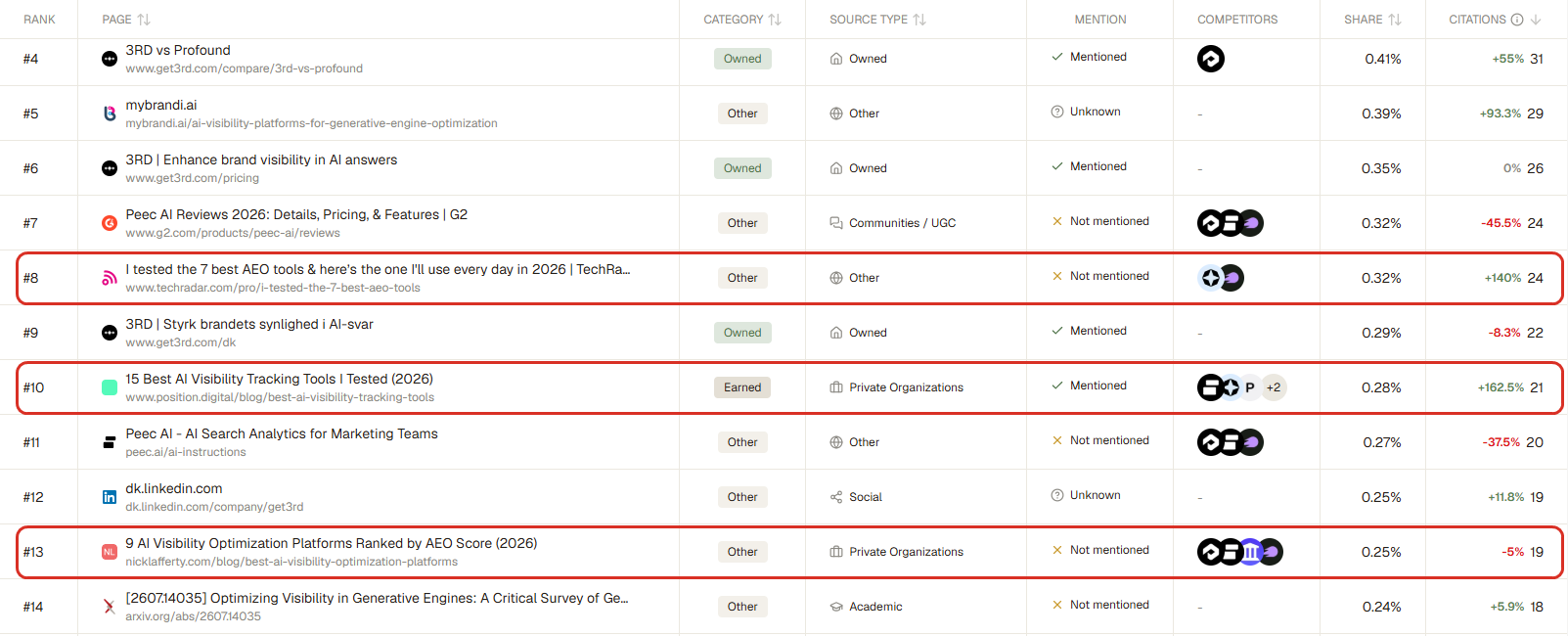
The pages AI cites for our category. Two widely cited lists name our competitors but not us. One list, where we earned a mention, now does.
What you need first
Before you start, line up six things.
- A list of the questions buyers ask AI. Group them by how close they sit to a purchase. 3RD calls these tiers Must-Win (closest to the decision), Core (research and shortlisting) and Foundational (how AI understands your category).
- A baseline. Measure how often AI names you on those questions today, against your nearest competitors. Without a "before", every "after" is a guess.
- Web analytics you control. GA4, Adobe Analytics or Piwik PRO, with permission to edit channel groups and key events.
- A CRM field for source. HubSpot, Salesforce or similar, with a field your forms can write to.
- A "How did you hear about us?" field on your demo or signup form. Make it free text, or add an "AI assistant (ChatGPT, Gemini, etc.)" option.
- A change log. One shared sheet or task board where every content change, outreach win and technical fix gets a date and the questions it targets.
Step-by-step: build the attribution chain
Step 1: Pick the questions that sit closest to revenue
Not every AI answer is worth the same. "What is generative engine optimization?" teaches. "Which AI visibility platform should an enterprise choose?" decides.
Tag every question you track by commercial weight. Report on the decision-stage group first. In 3RD these are the Must-Win prompts, and the recommended visibility target for them is 75%. Core prompts have a 50% target and Foundational prompts 35%.
This is the step that turns "AI visibility" into a number leadership cares about. Visibility on decision questions is a share-of-shortlist metric.
Step 2: Measure presence, not just traffic
For each question, track four numbers against your competitors:
- Visibility: the share of AI answers that name you.
- Position: where you appear inside the answer. First is different from ninth.
- Recommended rate: the share of answers that recommend you over the alternatives. Being listed doesn't count.
- Citation Share: the share of the sources AI cites that are your own pages.
Citation Share deserves extra attention. It often moves before visibility does: when AI starts citing your pages, mentions tend to follow. And as our own account shows, citations are where most of the clicks come from when you're not yet named.
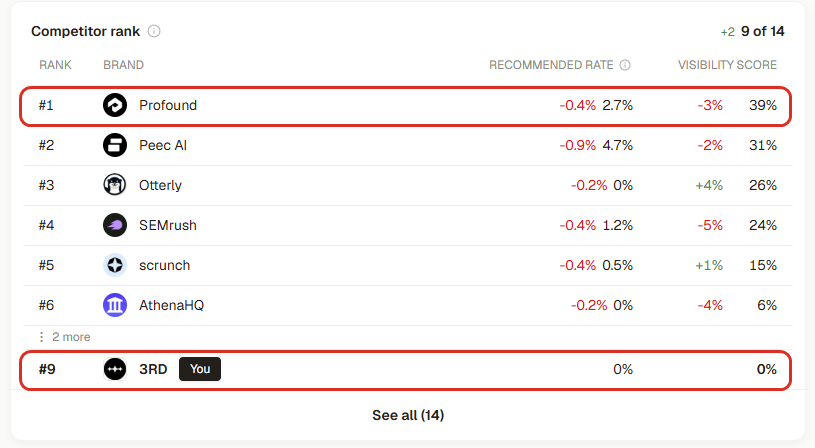
Visibility and recommended rate side by side. Profound is named in 39% of answers but recommended in 2.7%. The gap between the two columns is normal, and it's why you report both.
Step 3: Give AI traffic its own channel in analytics
By default, GA4 mixes AI visits into "Referral" or loses them in "Direct". Fix that with a custom channel group.
- In GA4, go to Admin → Data display → Channel groups and create a new group.
- Add a channel called AI assistants and place it above Referral.
- Set the condition to source matches this regex:
chatgpt\.com|chat\.openai\.com|perplexity\.ai|gemini\.google\.com|copilot\.microsoft\.com|claude\.ai|meta\.ai|deepseek\.com- Check the list every quarter. New assistants appear, and domains change.
Then build two reports on top of it:
- Landing pages from AI assistants. This shows which of your pages AI sends people to. It often differs from your top SEO pages.
- Key events from AI assistants. Demo requests, signups, purchases. This is the conversion rate of AI traffic.
Two limits to know. Some assistants and apps strip the referrer, so part of this traffic still lands in "Direct". And clicks from Google's AI Overviews and AI Mode usually arrive as normal Google organic traffic, so you can't separate them this way.
Break the channel down by assistant, too. In our own data, most AI-referred sessions last week came from Claude, while ChatGPT sent only a few. That's the opposite of what most people assume, and it changes where we look first.
Step 4: Carry the AI source into your CRM
Analytics counts sessions. Revenue lives in the CRM. Connect the two.
- Capture the first-touch source in a hidden form field, and write it to the contact record.
- Keep any `utm_source` value the assistant adds. ChatGPT often adds `utm_source=chatgpt.com` to the links it shows.
- Build a CRM view of contacts and deals whose first or any touch came from an AI assistant.
Now you can report pipeline and closed revenue that started with an AI click. It's a floor, not the full number. Keep calling it that.
Step 5: Ask buyers where they heard about you
Self-reported attribution catches what analytics misses. That includes the buyer who saw you in ChatGPT and typed your name into Google a week later.
- Add the question to every demo form and signup.
- Tag the answers weekly: "ChatGPT", "AI", "asked Perplexity" and similar all count.
- Ask on sales calls too, and log it in the CRM.
Self-reported data is noisy. It is also the only direct evidence of zero-click influence you'll get. Track the trend, not single answers.
Step 6: Log every action you take
This is the step most teams skip. It's the one that makes the rest work.
For every change, record:
- what you did (new page, rewrite, earned mention, technical fix),
- the date it went live,
- the questions it targets.
Without the log, a rising number is a coincidence. With it, it's evidence.
Step 7: Read the trend against your publish dates, and against a control
AI models re-crawl and re-learn on their own schedules. Expect days to weeks between shipping a fix and seeing it in the answers.
So don't read daily numbers. Read the trend for the questions an action targeted, starting from its publish date. Then compare it with questions you didn't touch in the same period. If the targeted questions moved and the untouched ones didn't, you have a much stronger case than "visibility went up". If they didn't, say so. See the worked example below for one of ours that didn't.
Step 8: Use paid placement to calibrate
Ads inside AI answers are the one place where the path from answer to sale is fully trackable today. In ChatGPT, OpenAI Ads report impressions, clicks, conversions and CPA.
Run a small campaign on a decision-stage question where you're weak organically. The conversion rate and CPA tell you what a visit from that question is worth. That gives you a fair proxy for the organic answer on the same question. It's not proof, but it's a number with a source.
Step 9: Report it as a ladder
Give leadership one page with four rungs. Each rung is harder to prove than the one before.
- Did we ship it? Tasks completed, by date.
- Did the number move? Visibility, citations and Recommended rate on the targeted questions, against the untouched ones.
- Did it move where money is? The Must-Win group, against your nearest competitors.
- Did clicks and pipeline follow? AI-referred sessions, conversions, self-reported mentions and AI-sourced pipeline.
Then say the fifth rung out loud: the decisions made with no click at all. You can't measure those, and saying so is what makes the first four rungs credible.
A sentence that works in a board deck:
"We're now named in X% of the AI answers closest to a purchase, up from Y%, against Z% for our nearest competitor. AI-referred visits converted at A%, and B deals in pipeline started there. Here's what we did to move it, and what we're doing next."
The KPIs a CMO should track for AI visibility
|
KPI |
What it answers |
Report it |
|---|---|---|
|
Visibility on decision-stage questions |
Are we on the AI shortlist when buyers decide? |
Monthly trend, against competitors |
|
Recommended rate |
Does AI tell buyers to pick us? |
Monthly, per competitor |
|
Position |
Are we named first or last? |
Monthly |
|
Citation Share |
Does AI use our own pages as sources? |
Monthly, as the early signal |
|
Sentiment |
Is AI describing us accurately and well? |
Monthly, flag changes |
|
AI-referred sessions and conversions |
Do the clicks that happen convert? |
Monthly, from analytics |
|
Self-reported AI mentions |
How many buyers say AI sent them? |
Monthly count and share |
|
AI-sourced pipeline |
What revenue started with an AI click? |
Quarterly, labeled as a floor |
|
Paid CPA on AI questions |
What does a buyer from this question cost? |
Per campaign |
Report the first five as the AI visibility story. Report the last four as the commercial story. Never blend them into a single "AI ROI" score. A blended score hides which part is measured and which part is estimated. For exact definitions of each metric, see the 3RD glossary: 15 metrics behind your dashboard.
Common pitfalls
|
Failure mode |
What it looks like |
Fix |
|---|---|---|
|
The revenue promise |
"This will drive X in revenue." The most experienced buyers ask about ROI to test whether you'll overclaim. |
Concede the limit first, then show the ladder. |
|
Clicks only |
AI is judged on referral traffic alone, so the zero-click answers get no budget. |
Report visibility and recommended rate next to traffic. |
|
Mentions only |
Visibility looks fine, but AI never recommends you. Across 60 brands, the median was 19.8% mentioned and 0.2% recommended. |
Always report recommended rate beside visibility. |
|
Own pages only |
You track your landing pages, but 93% of what AI cites is third-party. |
Track earned citations and the lists that name your competitors. |
|
Daily numbers |
A single day's jump gets reported as a win. |
Judge the trend over weeks, against a control. |
|
Forecast as result |
An "expected lift" gets reported as achieved. |
Keep estimates and measurements in separate columns. |
|
Every question equal |
A rise on a teaching question is weighted like a rise on a buying question. |
Report Must-Win prompts on their own. |
Worked example: the attribution chain in 3RD
Here's the chain as we run it on our own brand, with GA4 connected.
- Set the goal. Pick the Must-Win prompts in one market and set a goal in a Playbook, for example "raise visibility on Must-Win prompts in the UK on ChatGPT".
- See where you stand. The dashboard shows Visibility, Position, Recommended rate and Sentiment for the brand and each tracked competitor. Citations show which pages AI cites, split into owned and earned.
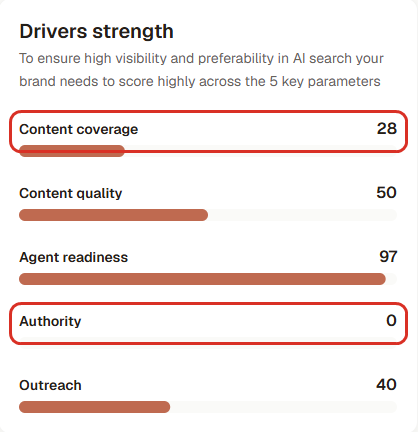
- Find out why. Diagnostics explains why AI picks competitors, across five drivers: content coverage, content quality, crawlability, authority and outreach. Ours says authority is 0: AI finds almost no third-party evidence about us.
- Do the work. The Playbook turns the diagnosis into prioritized tasks. We ask 3RD Agent what to focus on, and the Content Agent drafts the pages in our voice. We review and publish them. Publishing is still our move.
- Track it. When a task is completed, 3RD measures what moved: whether the target page is cited by more AI models, its citations, and visibility on the prompts it touches, compared with the brand's other prompts.
- Add the traffic. On Growth and Enterprise plans, AI-referred traffic from GA4 or Adobe Analytics sits next to the visibility numbers, as in the screenshot at the top of this guide.
- Calibrate with paid. On a Must-Win prompt where organic visibility is still low, run an OpenAI Ads campaign from 3RD. The campaign reports spend, clicks, conversions and CPA.
- Report it. Reports Studio turns the month into a branded report for the CMO. The Looker Studio connector or the Export API puts the same data next to CRM pipeline in your own dashboard.
What 3RD doesn't do: it doesn't tie a specific deal to a specific AI answer. That step happens in your CRM, with the source fields and self-reported data from steps 4 and 5.
A data point from our own account: one action, measured honestly
In September, 3RD earned a mention on a third-party "best AI visibility tracking tools" page that AI assistants already cite in our category. 3RD detected the mention and measured what happened next.
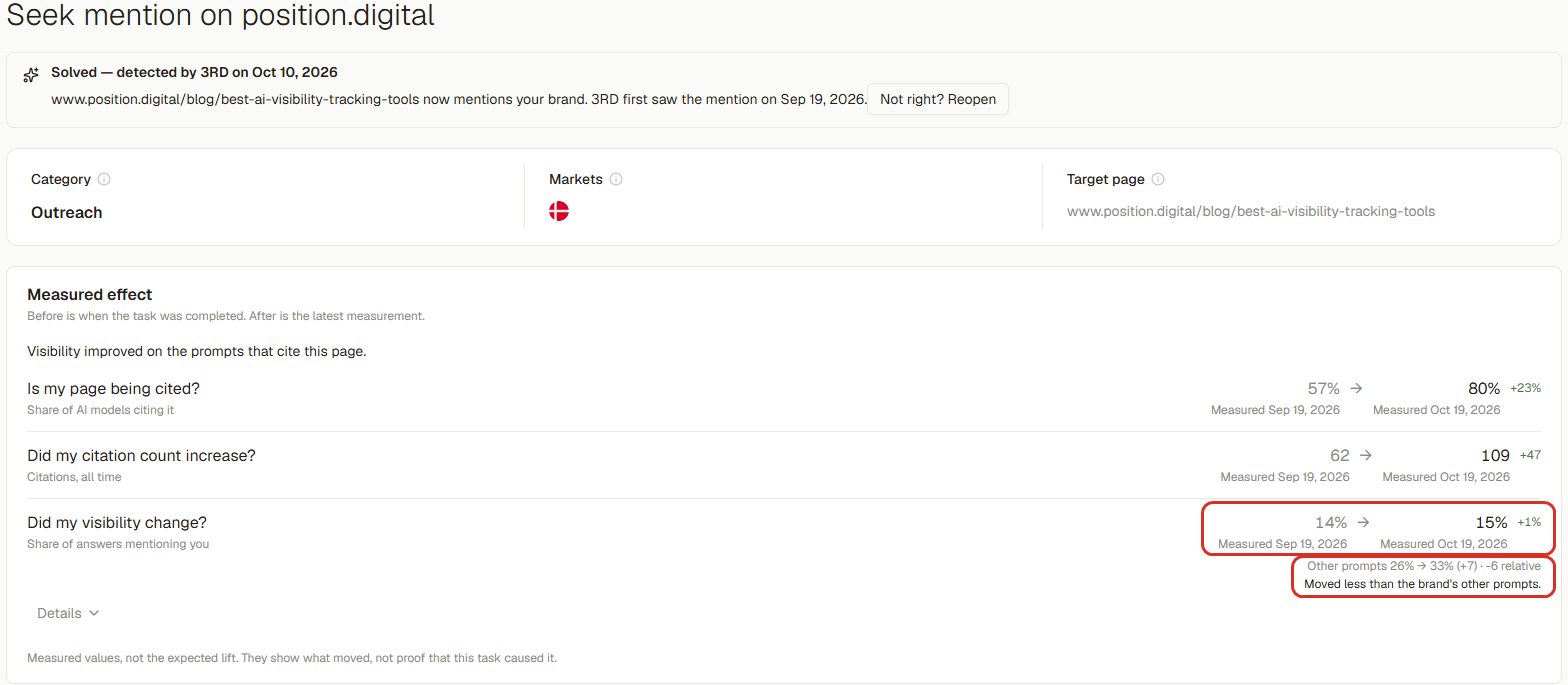
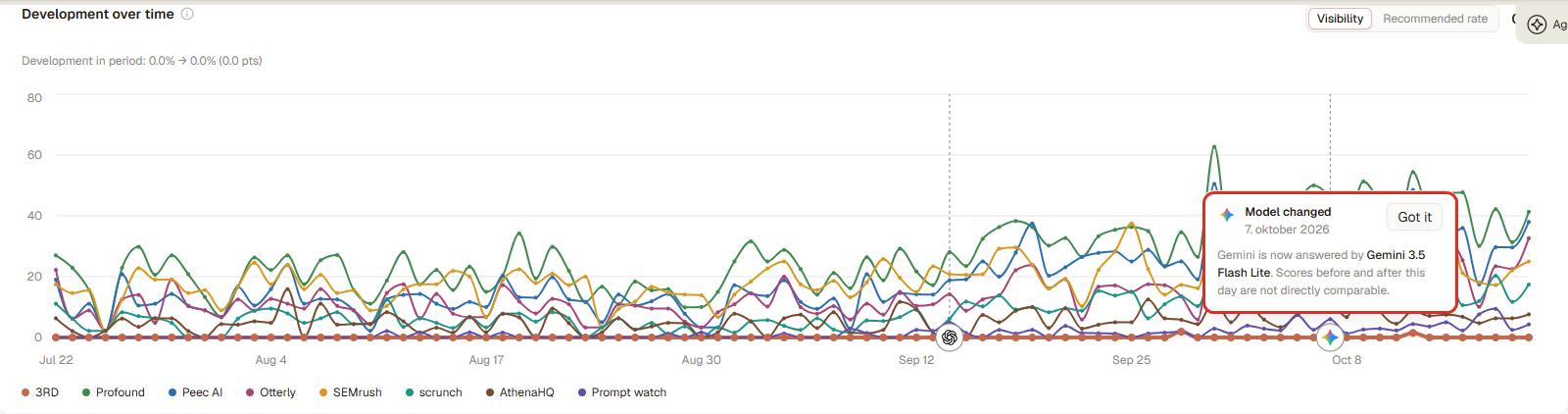
One outreach win, measured. The page is now cited by more AI models. Visibility on its prompts moved 6 points less than our other prompts.
- The share of AI models citing that page rose from 57% to 80%.
- Its all-time citation count went from 62 to 109. That counter only goes up, so we read it as "still in use", not as a lift.
- Visibility on the prompts that cite the page went from 14% to 15%. Our other prompts went from 26% to 33% in the same period. So this action did not lift visibility more than the rest of our work did.
That's what "attribute to decisions" looks like in practice: one action, one dated page, one measured change in what AI reads, and an honest "no lift" on mentions. We don't put a revenue figure on it, because nobody can measure that link honestly. What it told us is more useful: one mention isn't enough. We need many more third-party sources before AI names us in the answer.
Which platforms help with attribution?
|
What you need |
GA4 on its own |
3RD |
Profound |
Revenue attribution tools (e.g. Attrifast) |
|---|---|---|---|---|
|
Visibility and Recommended rate on buying questions |
No |
Yes |
Yes (visibility) |
No |
|
Which sources AI cites, owned vs earned |
No |
Yes |
Yes |
No |
|
AI-referred visits and conversions |
Yes, with a channel group |
From GA4 or Adobe Analytics, on Growth and Enterprise |
From server logs (Agent Analytics) |
Yes, with server-side detection |
|
AI crawler activity on your site |
No |
Crawlability checks in Diagnostics |
Yes, from server logs |
No |
|
Join AI visits to payments |
No |
No |
Not stated |
Yes (Stripe, Shopify) |
|
Measured effect of a completed action against a control |
No |
Yes, on completed tasks |
Not stated |
No |
|
Prioritized plan to move the numbers |
No |
Yes, Playbooks and 3RD Agent |
Yes, agents with an approval step |
No |
|
Paid placement in AI answers with CPA |
No |
Yes, OpenAI Ads |
Yes, Ads Studio |
No |
Competitor facts are from each vendor's public pages, as of October 2026.
Where each one wins:
- Choose Profound if you want AI crawler and referral data straight from server logs, and have engineers to connect your CDN.
- Choose a revenue attribution tool if you're an online business and want AI visits joined to payments.
- Choose 3RD if you need to know whether AI puts you on the shortlist, why it picks competitors, and what to do next, with AI-referred traffic beside it. You don't need an AI visibility specialist to run it.
About the data
The cross-brand figures come from customer brands tracked in 3RD between September 19 and October 18, 2026: 494,000 checked answers across 60 brands for recommended vs mentioned, and 5.9 million citations across 100 brands for owned vs earned. The data is anonymized and aggregated, mostly from Nordic markets. 3RD's definition of "recommended" is strict: AI must recommend the brand over the alternatives, and being listed first doesn't count. Our own account figures are from the week to October 19, 2026.
FAQ
Can any tool attribute AI recommendations to revenue? Not end to end. Tools can count the clicks and payments that follow an AI answer. No tool sees the decisions buyers make inside the answer without clicking.
How do I track ChatGPT traffic in GA4? Create a custom channel group with an "AI assistants" channel that matches chatgpt.com, perplexity.ai, gemini.google.com and similar sources. Place it above Referral, then report landing pages and key events for that channel, broken down by assistant.
Can AI send traffic even if it rarely mentions my brand? Yes. AI cites sources, and readers click them. In our own account, AI named 3RD in 0.2% of answers last week but still sent 48 sessions and 10 conversions, because it cites our pages. Track citations and AI-referred traffic, not only mentions.
How long before AI visibility work shows results? Expect days to weeks between publishing a change and seeing it in AI answers. Models re-crawl on their own schedules. Judge the trend over several weeks against prompts you didn't touch, not the daily number.
What should I show my CFO? A four-rung ladder: what you shipped, how visibility and citations moved on the targeted questions, how it moved on decision-stage questions against competitors, and the AI-referred pipeline. Then say clearly what can't be measured.
Start with your baseline
You can't show what moved without a "before". Start a free 3RD trial to see how often AI names, recommends and cites you on the questions closest to a purchase, against your competitors, today. Or book a meeting and we'll walk through your numbers with you.