AI search
How to turn AI visibility data into a prioritized weekly task plan
A step-by-step method to rank AI visibility gaps, route each fix to the team that owns it, and ship 3–5 tasks a week against one goal.
Contents
Pick one goal, list every prompt where you're missing, find the cause of each gap, and rank the fixes by commercial value against effort. Then ship three to five tasks a week.
Most teams that track AI visibility have the data. What they lack is the step between the dashboard and the work. A visibility score tells you that you're missing. It doesn't tell you what to do on Monday, who should do it, or what comes first.
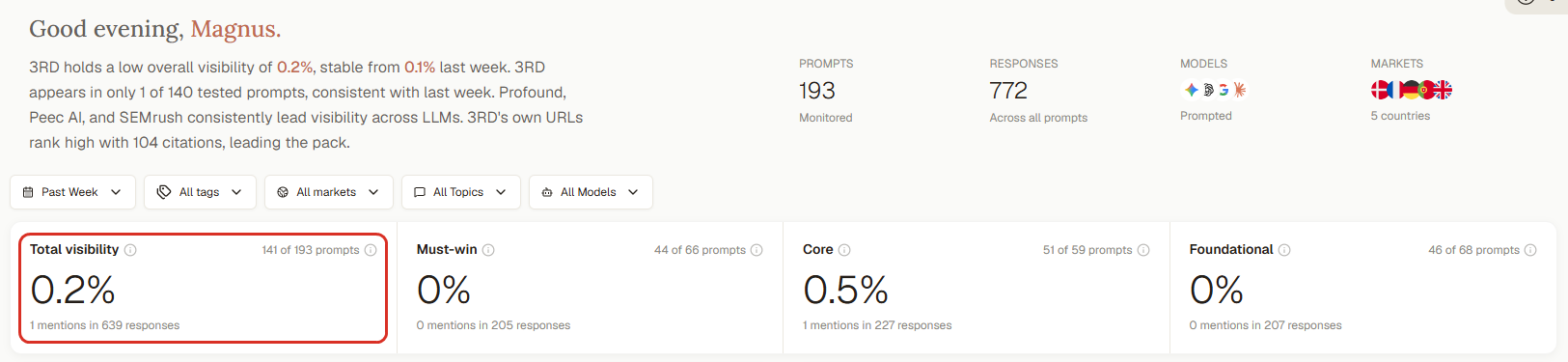
I know this from the inside. At 3RD we track 193 buyer questions about our own category, in five markets. In the week to October 19, 2026, AI named us in 1 of 639 answers. Our board holds more than 60 tasks. Without a method for choosing the next three, that board would be noise.
This guide is that method. You can run it in a spreadsheet. At each step I'll show how we run it on our own account in 3RD, including the parts the software doesn't do.
The short answer
A useful AI visibility plan has five parts:
- One goal. A number to reach, for a named group of prompts, in one market, by a date.
- A gap list. Every prompt in that group where you're missing, and who appears instead.
- A cause for each gap. Missing page, weak page, blocked crawler, no third-party proof, or confused identity.
- A ranked task list. Each task has an owner, a definition of done and a score.
- A weekly rhythm. A small batch shipped every week, measured on the trend.
Here's the alternative most teams run today. Someone checks ChatGPT by hand, screenshots an answer and adds "write more content about X" to a list of tips. A list of tips isn't a plan. It has no order, no owner and no way to tell whether it worked.
One founder described the feeling on our product page:
"It feels a bit intimidating for me because I need to work on it and I don't know where to start."
Grant Feller, EveryRung
The rest of this guide is the place to start.
What you need first
Have these five things in place before you build the plan.
|
You need |
Why |
Minimum |
|---|---|---|
|
A tracked prompt set |
The plan can only fix what you measure |
10–15 prompts you care about, written the way buyers ask |
|
Prompts tiered by value |
A gap on a buying question matters more than one on a definition |
Must-Win, Core and Foundational |
|
A baseline over time |
One check is noise |
At least two weeks of daily or near-daily answers |
|
Citation data |
It tells you which sources AI trusts, and which team fixes the gap |
Cited URLs, split into owned and earned |
|
One accountable owner |
Shared ownership means nobody ships |
One named person, plus helpers in content, web and PR |
Two of these get skipped most often.
The tiering. In 3RD's methodology, a Must-Win prompt is a question asked close to a decision, like "Which platform should a mid-size bank use for X?". A Core prompt shapes the shortlist. A Foundational prompt builds the AI's understanding of your category. The recommended visibility targets are 75%, 50% and 35%. Without tiers, every gap looks equally urgent, and the plan fills up with easy, low-value work.
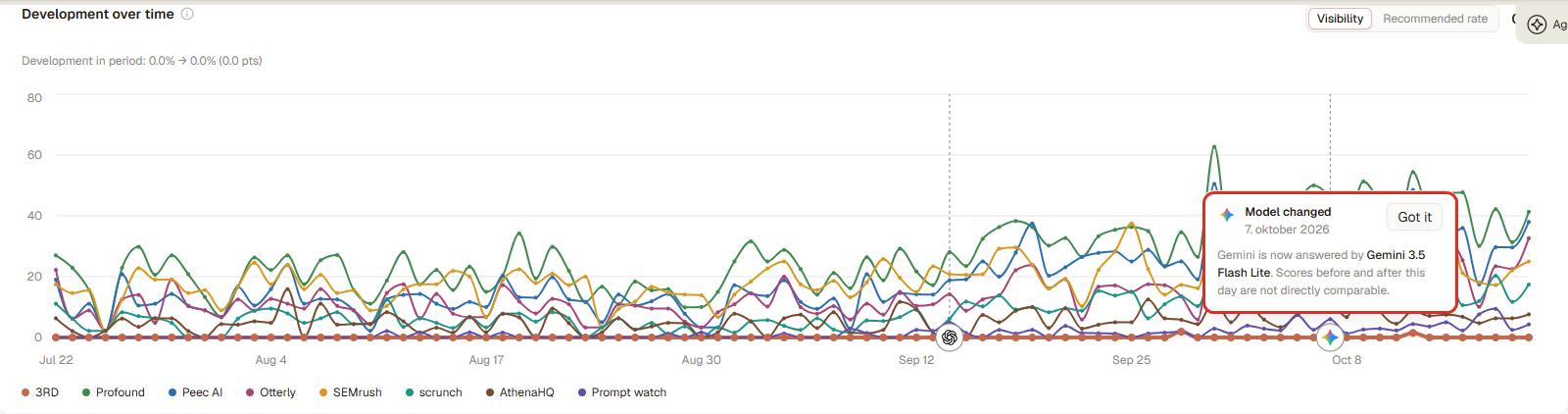
The baseline. AI answers vary from day to day, far more than most teams expect. Across 111 brands we track, with 732,000 AI answers between September 19 and October 18, 2026, the median brand's visibility moved 12.5 points between its best and worst day of the month, with no change to its prompts. For 7 in 10 brands, at least one single-day reading sat more than 5 points away from the brand's 30-day average. A plan built on one screenshot chases noise.
Smaller prompt sets swing more. Brands with fewer than about 100 answers a day swung roughly twice as much as brands with 230 or more. Our rule: the fewer prompts you track, the longer the baseline you need.
Step 1: Set one goal
Write the goal as one sentence with five parts: a metric, a prompt group, a market, the AI models and a date.
Raise visibility from 11% to 27% on Must-Win prompts about payroll software, in the US, on ChatGPT and Gemini, by the end of Q1.
Keep it narrow. A goal like "improve AI visibility" can't be ranked against, and it hides progress. A narrow goal on commercial prompts shows movement sooner, and it teaches you what works for your brand.
Good first goals:
- The Must-Win prompts in your biggest market
- One topic where a single competitor dominates
- One AI model that your buyers use most
In 3RD, a Playbook starts from that one sentence.
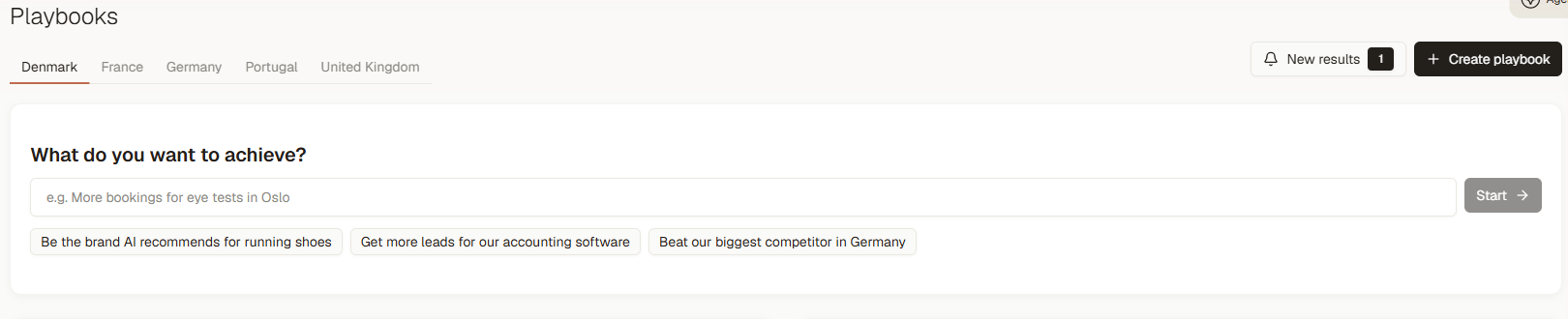
A Playbook starts with one goal, written in your own words.
Our own first goal is the topic where we're weakest and the buying intent is highest: vendor shortlisting and comparison questions, in Denmark and the UK. In Denmark we sat at 0.0% on that topic, eighth of fourteen, while Profound led at 72.9%.
Step 2: Build the gap list
For every prompt in the goal, record what the AI answers say today. Use one row per prompt.
|
Prompt |
Tier |
You mentioned? |
Who is mentioned |
Top cited sources |
Your matching page |
|---|---|---|---|---|---|
|
Best payroll software for a 50-person company |
Must-Win |
0 of 4 models |
Competitor A, Competitor B |
g2.com list, competitor A blog |
None |
|
Payroll software with EU data hosting |
Must-Win |
1 of 4 models |
Competitor B |
Competitor B pricing page |
/security, thin |
|
What is embedded payroll |
Foundational |
2 of 4 models |
Competitor A |
Wikipedia, industry blog |
/blog/embedded-payroll |
Read the answers, not only the score. The answer text tells you how the AI describes you and your competitors. The cited sources tell you where it learned that.
Step 3: Find the cause of each gap
Every gap has a cause. The cause decides the task and the team. Five causes cover almost every case.
|
What you see |
Likely cause |
Task type |
Who fixes it |
|---|---|---|---|
|
You have no page that answers the prompt |
Content coverage |
Write a new page |
Content |
|
You have a page, but it's never cited |
Content quality |
Restructure the page |
Content |
|
Your pages are never cited, even good ones |
Crawlability |
Unblock AI crawlers, fix the rendering, add structured data |
Web or SEO |
|
Answers cite third-party lists you're missing from |
Authority and outreach |
Pitch the source, update a review profile |
PR or comms |
|
The AI mixes you up with another company |
Identity (entity) |
Add organization data and a consistent description everywhere |
Web, plus content |
Expect the cause to sit in content or authority, not in the technical layer. Across 60 brands we track, the median crawlability score was 99 out of 100. Authority or content quality was the weakest of the five drivers for 42 of the 54 brands where all five were measured. Crawlability was the weakest for none of them.
Ours fits the pattern exactly.
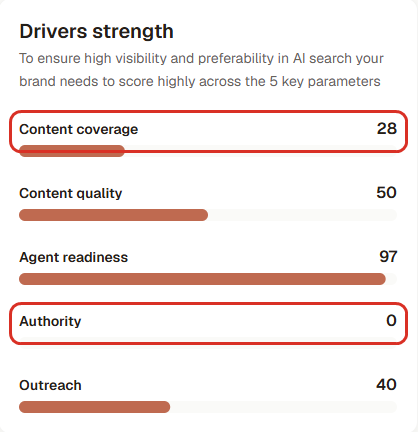
Our five drivers. Agent readiness is fine. Authority (0) and content coverage (28) hold us back.
The citation split is your shortcut. If the cited sources are on your own domain (owned), the fix is content. If they're on someone else's site (earned), the fix is outreach. Owned and earned citations work as an org chart: they tell you which team owns each gap.
Plan for a lot of outreach. Across 100 brands and 5.9 million citations, the median brand's own website made up just 6.8% of the sources AI cited in its category. For 41 of those brands, AI cited competitors' websites more often than the brand's own. If your plan is only content, it leaves most of the gap untouched.
In 3RD, Diagnostics does this write-up per topic.
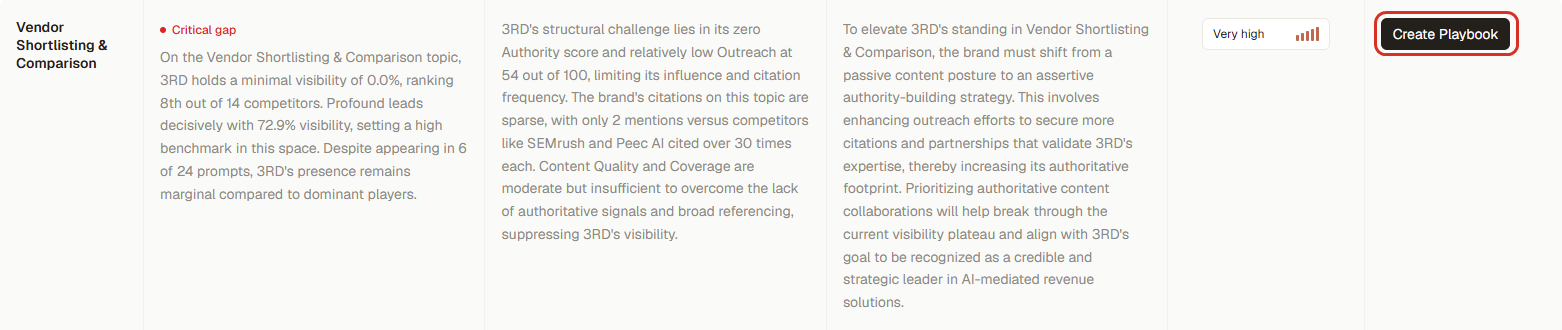
Each topic gets a situation, the issues behind it, a proposed approach and a one-click Playbook.
Step 4: Turn each cause into a task with a definition of done
"Improve our comparison content" isn't a task. A task names the prompt, the cause, the steps and the finish line. Use the same card for every task:
|
Field |
Example |
|---|---|
|
Title |
Publish a comparison page for "Best payroll software for a 50-person company" |
|
Prompts it targets |
3 Must-Win prompts in the payroll topic |
|
Cause |
Content coverage: no page answers the question |
|
Evidence |
Competitor A's comparison page is cited in most answers |
|
Steps |
1. Brief 2. Draft 3. Expert review 4. Publish 5. Add to the sitemap |
|
Owner |
Content marketer |
|
Effort |
M (one to two days) |
|
Done when |
The page is live, crawlable and linked from the pricing page |
|
Measure from |
The publish date |
The "Done when" line matters most. It turns a vague intention into something you can tick off on Friday.
Here is a real task card from our own board: the task that produced a sister article to this one.
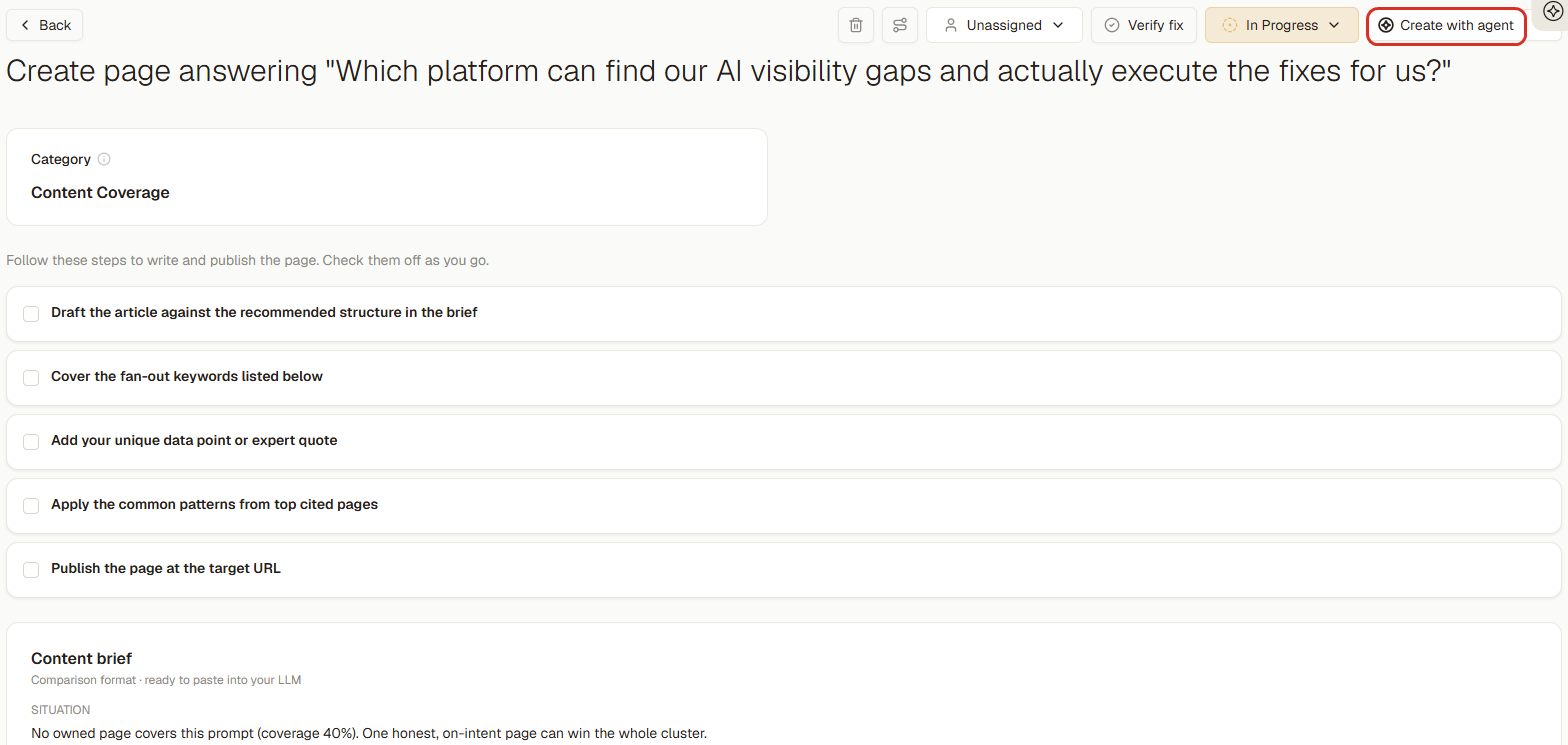
A content task with its checklist. The last step, "Publish the page at the target URL", is the definition of done.
A good task also carries the brief. Ours lists the structure that the pages AI already cites for this question have in common.
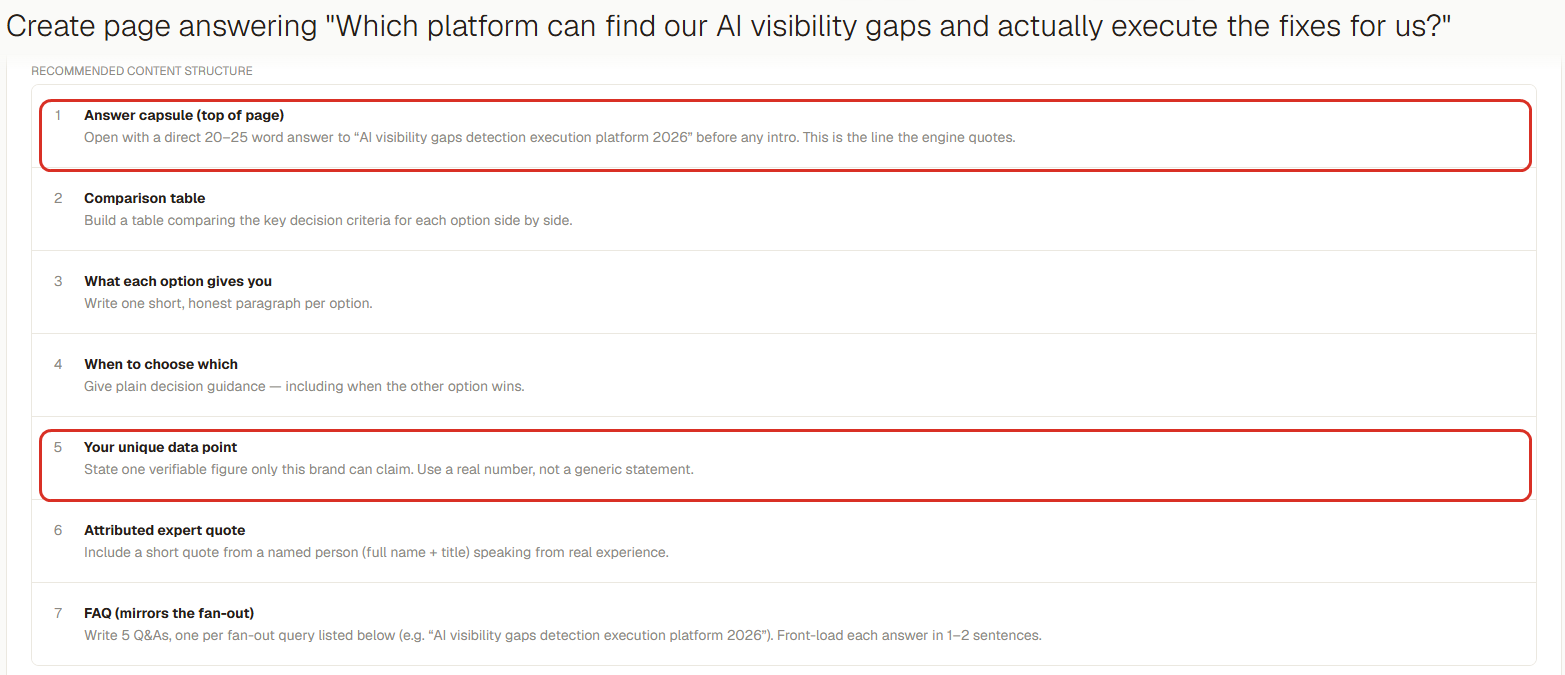
The brief behind the task: the structure the pages AI already cites have in common.
Step 5: Score and rank the tasks
Rank tasks by expected value, not by ease. A simple score works:
Priority = tier weight × prompts influenced × gap size ÷ effort
- Tier weight: Must-Win 3, Core 2, Foundational 1
- Prompts influenced: how many prompts in the goal the task touches
- Gap size: 3 if you're absent, 2 if you're mentioned but behind, 1 if you're close
- Effort: S = 1, M = 2, L = 3
|
Task |
Tier |
Prompts |
Gap |
Effort |
Score |
|---|---|---|---|---|---|
|
Unblock AI crawlers on /pricing |
3 |
8 |
2 |
S (1) |
48 |
|
Get added to the list cited in 6 Must-Win answers |
3 |
6 |
3 |
M (2) |
27 |
|
New comparison page |
3 |
3 |
3 |
M (2) |
13.5 |
|
Rewrite the glossary page |
1 |
2 |
1 |
S (1) |
2 |
Two patterns show up in almost every plan.
- A real technical fix ranks first when it exists. It's small and touches many prompts at once. But check that it's real. As the driver data above shows, the technical layer is rarely the bottleneck.
- Outreach to one heavily cited page often beats a new page. Many answers are built from the same few sources.
The formula is our method, not a law. Adjust the weights if your business values a market or a model differently. What matters is that the team ranks against the same rule every week.
Step 6: Sequence the work
The ranking says what's worth most. The sequence says what has to come first. Some tasks only pay off once others are done.
Use this order:
- Be identifiable. If the AI confuses you with another company, nothing else lands. Fix the organization data and the description first.
- Be readable. If AI crawlers can't reach or parse your pages, new content is wasted. Fix the access and the structure next.
- Be the answer on your own pages. Publish and restructure pages for the prompts where you have a real right to win.
- Be backed by others. Earn mentions on the sources AI already cites.
- Go head to head last. Comparison content against big competitors works better once you have some authority.
The Boë Beauté case followed this order. The brand fixed its identity and crawl access first, focused its content on where it was different, and held head-to-head comparison content back until it had built authority.
We're breaking rule 5 on purpose, and I'll say why. Our must-win questions are comparison questions ("Which AI visibility platform should we choose?"), and our authority is 0. Waiting for authority before publishing comparisons would mean never answering the questions buyers actually ask. So we run steps 3, 4 and 5 in parallel, and the comparison pages concede what competitors do well. Sequence is a default, not a rule to follow when your best questions say otherwise.
Step 7: Plan the week
Now fit the ranked, sequenced list into the hours you have. Most in-house teams can ship three to five tasks a week alongside other work.
|
When |
What happens |
Time |
|---|---|---|
|
Monday |
The owner reviews the trend and last week's shipped tasks, and pulls the next tasks from the top of the list |
30 minutes |
|
Monday |
Tasks go to their teams: content, web or PR |
15 minutes |
|
Tuesday to Thursday |
Draft, review, publish, pitch |
A few hours in total |
|
Friday |
Mark tasks done, log the publish dates, note anything blocked |
15 minutes |
|
Monthly |
Re-rank the list against the latest answers, and retire tasks that no longer matter |
1 hour |
Pull from the top. Don't cherry-pick the easy tasks lower down. The ranking exists so that the week's effort goes where it's worth most.
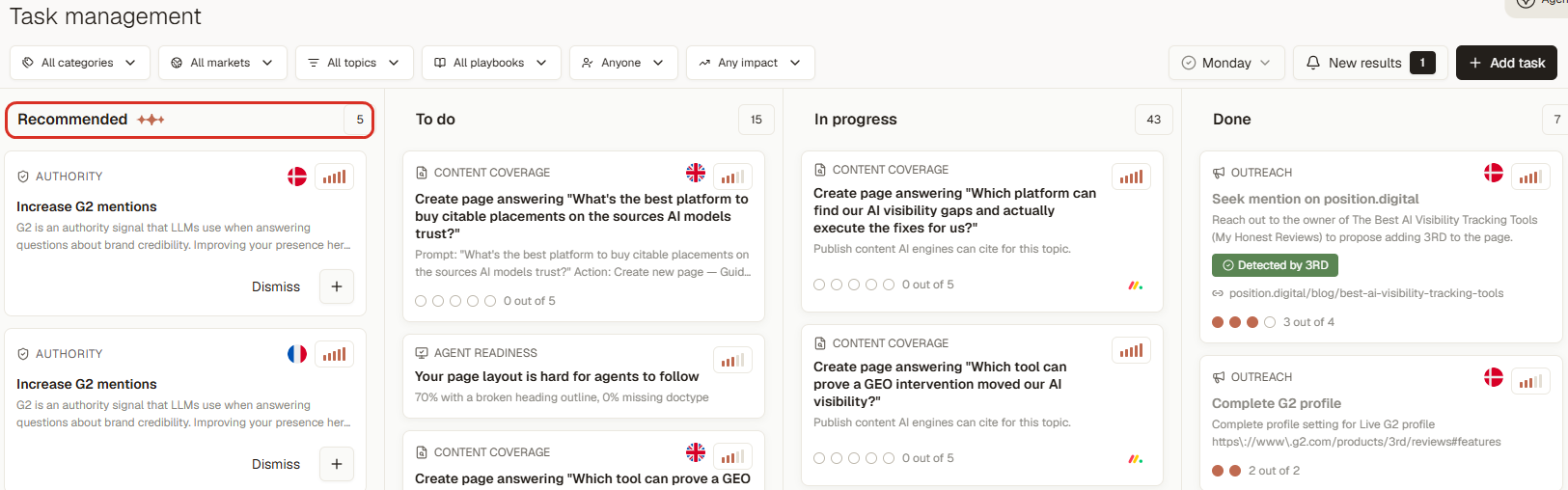
This is our board on a normal Monday.
Recommended next, to do, in progress and done. Each card shows the driver it moves.
One honest note on that board: 43 tasks in progress is too many. That's the pitfall this guide warns about, and it's ours. The fix is to pull fewer tasks at a time and close them.
Step 8: Measure on the trend, not the day
AI models re-crawl and re-learn on their own schedule. Expect days to weeks between shipping a fix and seeing it in answers.
So measure like this:
- Log the ship date for every task.
- Compare windows, such as the two weeks before against the two to six weeks after, not one day against another.
- Compare against a control: prompts the plan didn't touch. If they rose just as much, the market moved, not your work.
- Read the answers. Check whether your wording and pages now show up in them.
The control is not optional. We looked at 117 completed tasks across the brands we track where the targeted prompts could be compared with a control group of the same brand's untouched prompts. 29% moved up by more than 5 points relative to the control, 26% moved down by more than 5 points, and 44% stayed within that band. The median relative change was zero. A single before-and-after reading can't separate a real lift from normal variance.
Here's what that looks like on one of our own tasks: an outreach win on a "best AI visibility tracking tools" list.
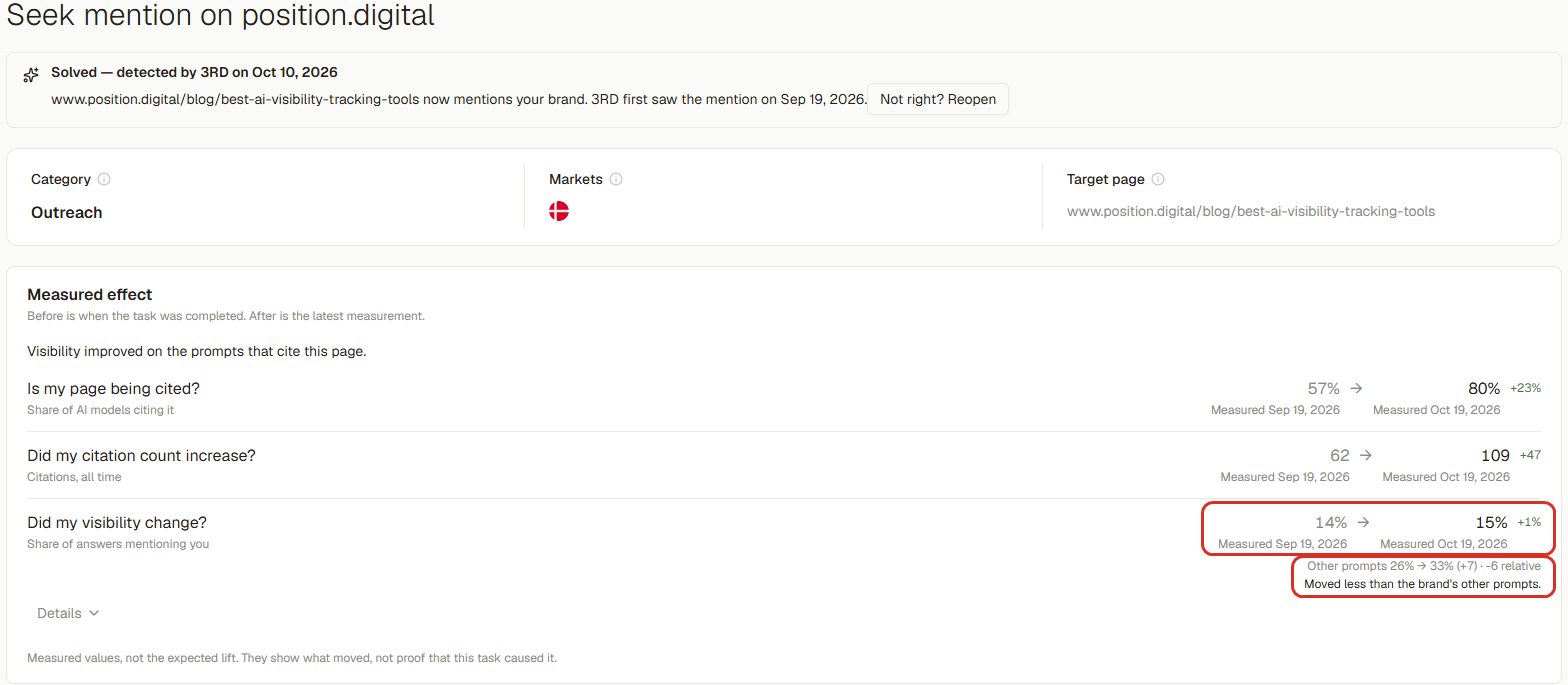
More AI models cite the page after the mention. But visibility on its prompts moved less than our other prompts did. That's the honest reading.
The page got cited by more AI models, which is what outreach can directly change. The visibility number didn't beat the control. So we log it as "source won, no visibility lift yet" and keep going. We don't call it a win.
Be honest about what this proves. Competitors publish too. Models change. Seasons shift demand. A rising trend next to shipped work is a strong signal. It isn't proof that the work caused the rise.
Common pitfalls
- Planning from one screenshot. Daily answers vary widely. Plan from a baseline.
- Ten goals at once. The effort spreads thin, and nothing moves enough to see.
- Easy tasks first. The list fills with Foundational rewrites while Must-Win gaps stay open.
- Only owned content. Most citations point to third-party pages. Ignoring outreach leaves most of the gap untouched.
- Fixing the wrong layer. Teams reach for technical fixes because they feel concrete. Check the drivers first.
- Too much in progress. Forty open tasks means none of them are getting finished. Cap work in progress.
- No owner. When the work is spread across teams with nobody accountable, nothing ships.
- No definition of done. Tasks stay "in progress" forever.
- Judging a task after three days. Wait for the measurement window, and compare against a control.
Worked example: the same method in 3RD
Everything above works in a spreadsheet. It takes hours a week to keep up to date. Here's where 3RD takes that work over, and where it doesn't.
Steps 2 and 3: the gap list and its causes. 3RD asks the AI models your tracked prompts on a schedule, in each market and language, and reads every answer. Diagnostics scores the five drivers (content coverage, content quality, crawlability, authority and outreach). For each topic, it writes up the situation, the issues, a proposed approach and the size of the opportunity. Each finding links to the answers and citations behind it, so you can check the story before acting on it.
Steps 1, 4 and 5: the goal and the ranked tasks. From any topic, Create Playbook starts a Playbook. You set the goal, for example "Increase visibility to 70% for Employer Branding in ChatGPT." 3RD generates the tasks to reach it. Each task has an impact rating from very low to very high, a source-type label (content, outreach, crawlability and more) and a checklist of steps. The highest-impact work sorts to the top.
Step 7: the week. Every task from every Playbook lands on one Task Management board: To do, In progress, Done. You assign tasks to colleagues. Technical tasks go to your SEO or web team.
Doing the tasks. 3RD Agent is the assistant built into every page. Ask it what to focus on and it answers from your data. We asked it exactly that for our own brand.
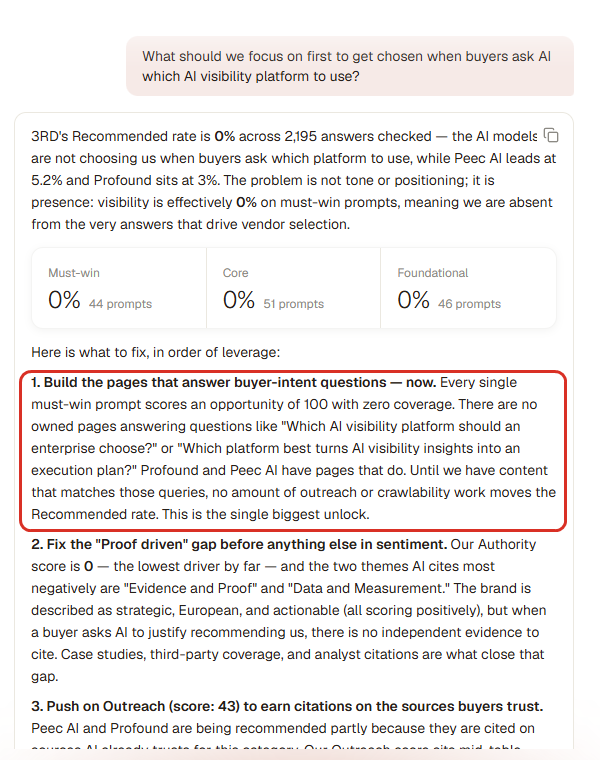
We asked 3RD Agent what to fix first. Its first answer: build the pages that answer buyer questions.
Ask it to do the work and it drafts the page, the brief or the outreach angle. A few of its skills match this guide step by step:
|
Agent skill |
What it does in the plan |
|---|---|
|
Build a playbook |
Agrees what to influence, then plans the actions |
|
Argue against my plan |
Makes the case against what you're about to commit to |
|
Is my plan still right |
Checks the Playbook against what the data says now |
|
Turn a gap into a brief |
Writes a brief from a gap worth closing |
|
Turn this into a task |
Sends an answer to your Playbook as work to do |
Every change the agent proposes arrives as a card. Nothing is written until you approve it. Content Agent drafts full pages from a task brief in your brand voice.
Step 8: measuring. 3RD keeps measuring each Playbook against new AI answers. Completed tasks show a measured effect next to the brand's other prompts, as in the screenshot above. The screen says plainly that the values show what moved, not proof that the task caused it.
What 3RD doesn't do. It doesn't publish to your site. You review the draft and publish it. It doesn't fix your technical tasks, either. It hands them to your web team with the steps. And it doesn't claim that a task caused a rise.
You can also ask from Slack. Mention @3RD in a channel, and it answers from the same data.
What this looks like in practice
One in-house marketer at Boë Beauté, with no GEO or SEO background, followed a 3RD plan in a few hours a week. The Danish skincare brand had not appeared once in thousands of AI answers. Within one quarter, it reached 22.2% weekly visibility and a top-five rank among seven competitors.
The method didn't need a new hire or an agency. It needed a plan in the right order, and a person who shipped it every week.
We're running the same method on 3RD now, from 0.2%, and we judge it the same way: on the trend, against the control.
About the data
The aggregate figures come from brands tracked in 3RD between September 19 and October 18, 2026: 111 brands and 732,000 AI answers for variance, 100 brands and 5.9 million citations for sources, and 60 brands for driver scores. Task outcomes come from 117 completed tasks with a control group, finished between February and October 2026. The sample leans toward Nordic brands, the data is anonymised and aggregated, and it shows correlation, not cause.
FAQ
Which platform turns AI visibility insights into an execution plan? 3RD turns its diagnosis into goal-based Playbooks with impact-ranked, assignable tasks on one board, and 3RD Agent drafts the work for you to review and publish. Other platforms take different approaches, as of October 2026. Profound's agents can publish to your CMS after an approval step. KIME's agents run tasks automatically. Peec AI suggests content optimizations. Choose based on how much control your team wants over what goes live.
How many AI visibility tasks should a team ship each week? Three to five is realistic for most in-house teams alongside other work. Fewer, finished tasks beat many half-done ones. Pull from the top of the ranked list each Monday, and cap how many tasks are in progress at once.
Who should own AI visibility work? One accountable person, usually in marketing. Content owns the gaps on your own pages, PR or comms owns the gaps on third-party sources, and the web or SEO team owns the technical fixes. Without one owner, the work stalls between the teams.
How long before a task shows up in AI answers? Expect days to weeks. AI models re-crawl and re-learn on their own schedule. Log each publish date, and judge the result on a two-to-six-week trend against a control group of untouched prompts, not the next day's number.
Can I run this plan in a spreadsheet? Yes. Every step in this guide works in a spreadsheet. The cost is time: checking answers across models and markets, tracing causes and re-ranking every month takes hours each week. A platform does that part, so your hours go into shipping.