AI search
How brands build the trust and authority that make AI recommend them
AI recommends brands that others vouch for. A practical playbook for identity, reviews, lists, proof and outreach, written from authority 0.
Contents
AI recommends brands that other sources vouch for. Build authority by fixing your identity, earning reviews and list placements, publishing proof, and showing up where AI already looks.
I'm writing this from the bottom of the table.
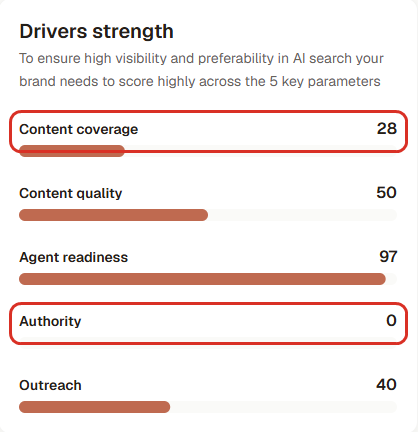
3RD scores 0 out of 100 on authority in our own platform. When AI assistants describe us at all, the negative phrases they use are "limited public evidence" and "not established by the sources reviewed." And when buyers ask which AI visibility platform to use, the lists AI cites name our competitors and leave us out.
Our own drivers. Agent readiness is fine. Authority is 0, and that is what holds us back.
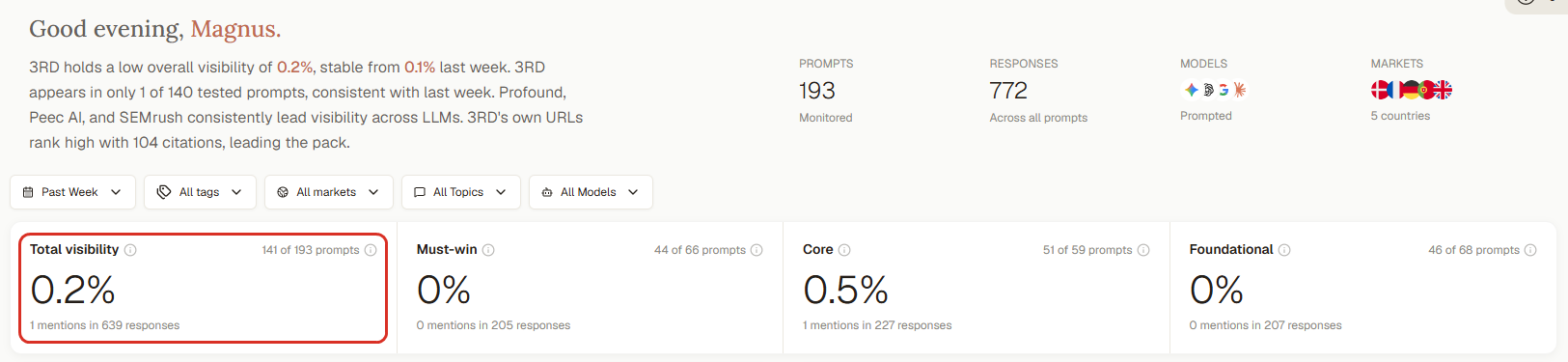
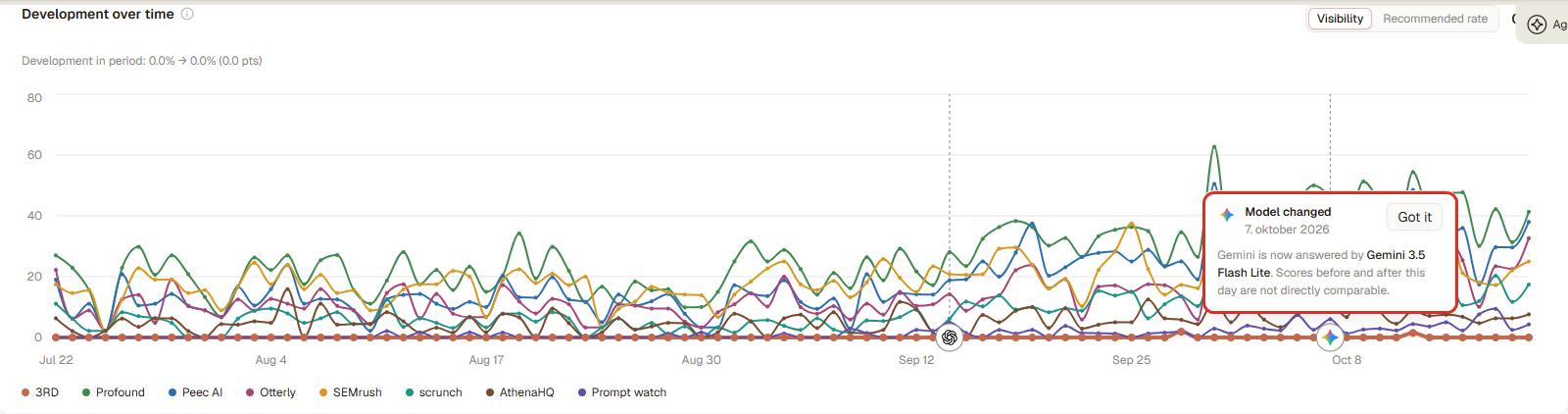
So this is not a guide from a brand that already won. It is the playbook we are running on ourselves, built on what we see across the brands we track. Below are our own starting numbers.
The short answer
Authority, for an AI assistant, is the evidence it can find that someone other than you backs what you say. Brands build it in five layers:
- Identity. Make sure models know exactly who you are, and don't confuse you with anyone else.
- Corroboration. Get other sources to say what you say about yourself.
- Proof. Publish numbers, cases and reviews that a model can quote.
- Presence. Get onto the specific pages AI already cites for your buying questions.
- Consistency. Say the same thing everywhere, so every source agrees.
Content on your own site still matters, but it can't do this job alone. Your own site is one voice. Authority is what the other voices say.
Why your own website isn't enough
AI answers rarely rely on the brand's own site. In our research across 100 customer brands and 5.9 million citations, the median brand's own domains made up just 6.8% of the sources AI cited in its category's answers. The other 93% were third-party pages.
It gets worse. For 41 of those 100 brands, AI cited competitors' websites more often than the brand's own.
|
What AI cites (across 100 brands) |
Finding |
|---|---|
|
The brand's own site |
Median 6.8% of citations |
|
Competitors' sites |
Cited more than the brand's own site for 41 of 100 brands |
|
Review and comparison sites |
Cited for 82 of 100 brands |
|
|
Cited for 85 of 100 brands, but a median of only about 1% of citations |
|
Most-cited third-party domain per brand |
A review or comparison site for 22 brands, Reddit for 15, a government or health body for 11, a niche site for 47 |
Source: 3RD customer data, 100 brands, Sep 19 – Oct 18, 2026. Source categories are classified by domain pattern, so treat the split as directional.
The pattern holds outside our data too. Ahrefs' study of 75,000 brands found that brand mentions across the web had the strongest correlation with visibility in Google's AI Overviews.
And being mentioned is still not being recommended. Across 60 brands and 494,000 checked answers, the median brand was mentioned in 19.8% of answers but recommended over alternatives in just 0.2%. That gap is where authority does its work: a model mentions brands it knows about, and it recommends brands it can justify.
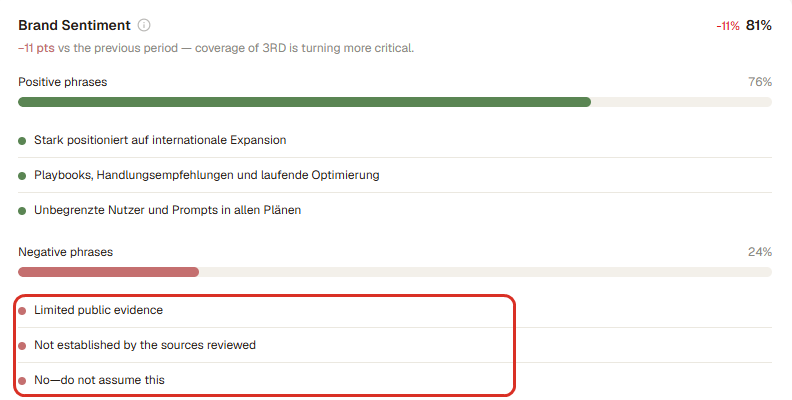
When AI does describe us, the negatives are about missing evidence. That is an authority problem, not a product problem.
What "authority" means to an AI assistant
Strip away the jargon and an assistant needs to answer four questions about you before it puts you forward.
|
Question the model needs answered |
What it reads |
What weak authority looks like |
|---|---|---|
|
Who is this? |
Your site, structured data, Wikipedia and Wikidata where they exist, business directories, LinkedIn, review profiles |
The model confuses you with a similarly named company, or doesn't know what you sell |
|
Does anyone else say so? |
Independent articles, lists, comparisons, analyst notes, partner pages |
Your claims appear only on your own site |
|
Is there proof? |
Reviews, ratings, case studies with numbers, original data |
"Limited public evidence" |
|
Is it current and consistent? |
Dates, recent coverage, matching descriptions across sources |
Old or conflicting descriptions |
3RD's documentation puts the core idea well: a claim you make that no model repeats, backed by nothing but your own site, doesn't need more copy on your own pages. It needs someone else to say it.
The playbook
Here is the order we work in. Each step makes the next one cheaper.
Step 1: Fix your identity
Before anyone vouches for you, models need to resolve your name to you.
This was a real issue for us. "3RD" is also an ordinary word. Our own event feed picks up pages about a clothing boutique and a military training battalion with "3rd" in the name. If a person can mix that up, a model can too.
What to do:
- Add Organization schema to your site, with your legal name, logo, URL and `sameAs` links to your official profiles. Our own site didn't have it. Our agent-readiness report flagged it.
- Use one description everywhere. The same one-line description of what you do on your site, LinkedIn, G2, Crunchbase and partner pages.
- Claim your profiles on the review and directory sites that matter in your category.
- Wikipedia and Wikidata: only if you meet their notability rules. Don't write your own article. A rejected or deleted article does more harm than none.
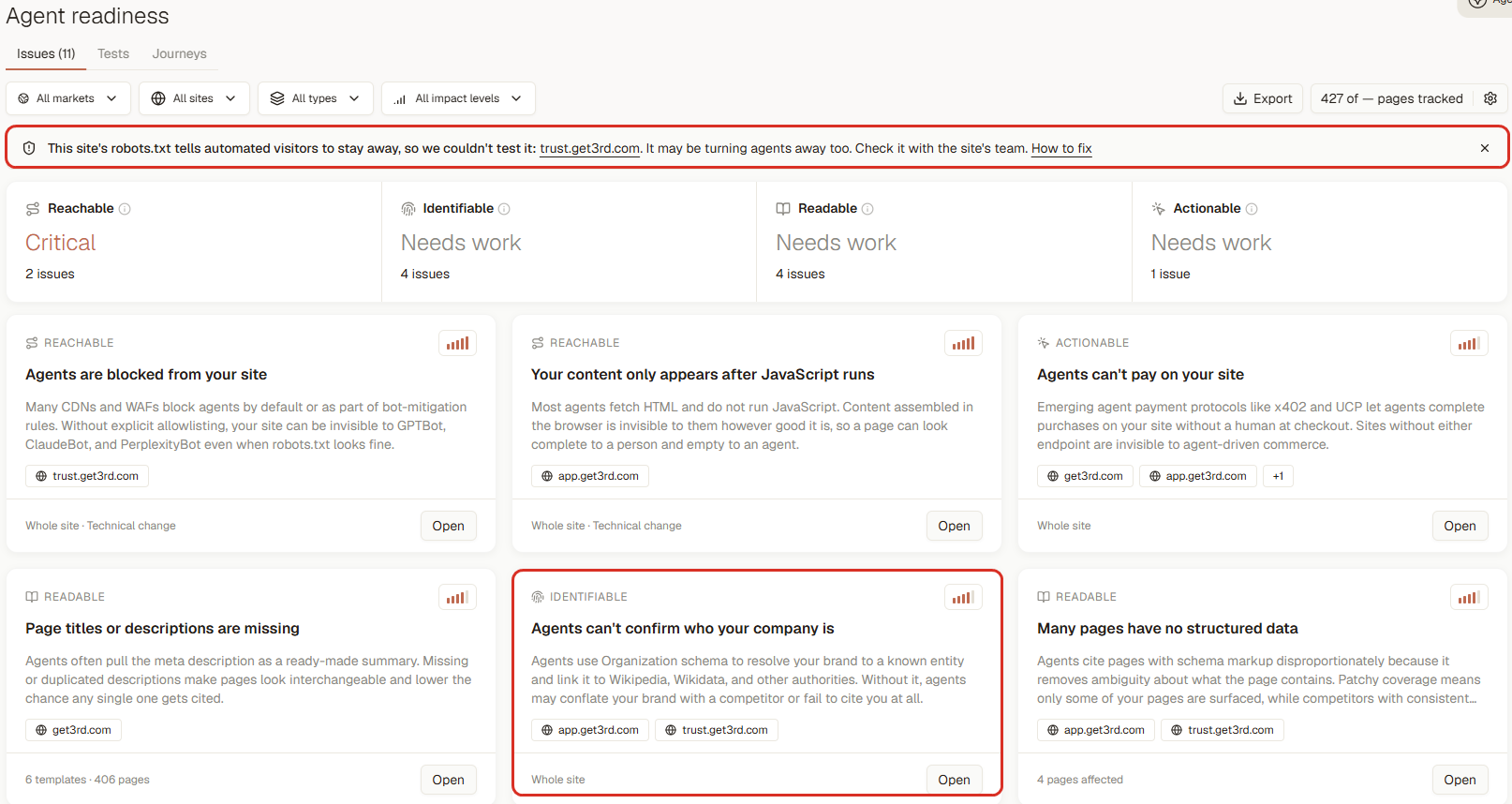
Our own agent-readiness report. Even an AI visibility company had identity fixes to make: no Organization schema, and a robots.txt that turned automated visitors away.
Step 2: Find the pages AI already cites for your buying questions
Don't start with a PR wish list. Start with the pages that already feed the answers you want to be in.
For each Must-Win question, list the third-party pages AI cites. Mark which ones mention competitors but not you. Those are your priority targets. 3RD's documentation calls this the definition of a high-priority outreach target: a source that heavily features competitors but not you, on prompts you care about.
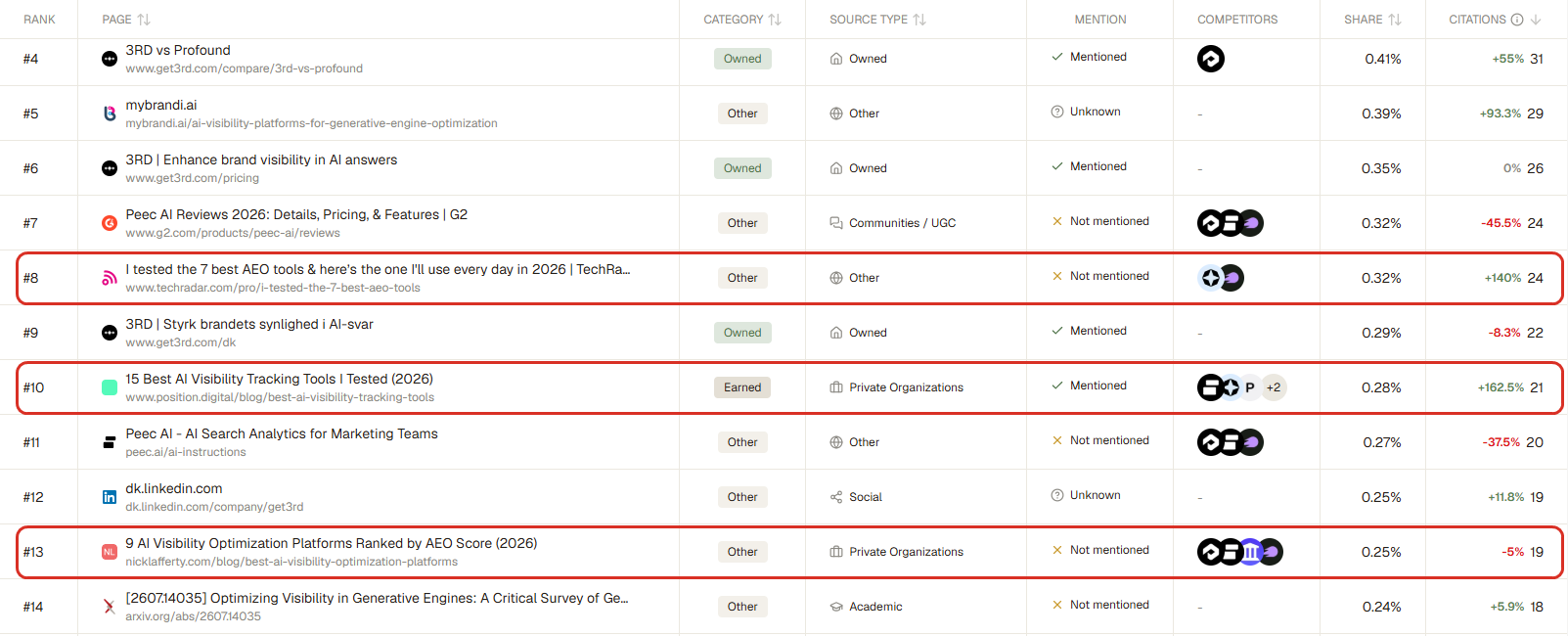
The pages AI cites for our category. Two lists name our competitors but not us. One, position.digital, is where we earned a mention.
In our own category, the pattern is clear. G2 was the most-cited third-party domain in both Denmark and the UK in the last month. Of the 83 G2 pages cited in Danish answers, 6 mentioned us. Of the 117 cited in UK answers, 5 did. Most cited G2 pages featured competitors.
One earned placement can move many answers, because AI draws on a concentrated set of sources per category. That's why we rank targets by how many of our prompts they influence, not by their traffic.
Step 3: Earn a place on the lists
"Best X tools" lists dominate software answers. In our category, the top cited pages for most buyer questions are lists and comparisons.
How we approach a list:
- Read it. Understand the author's criteria and audience.
- Check fit. Pitch only lists where you genuinely belong.
- Make it easy. Send a short, factual entry in the list's own format: what you do, who it's for, pricing, one proof point, and a demo or trial login if they test tools.
- Offer something useful. Data the author doesn't have, a correction, a screenshot.
- Follow up once. Then move on.
Here is an honest result from our own account. We pitched position.digital's "15 Best AI Visibility Tracking Tools" and got added. 3RD detected the new mention and measured what happened next.
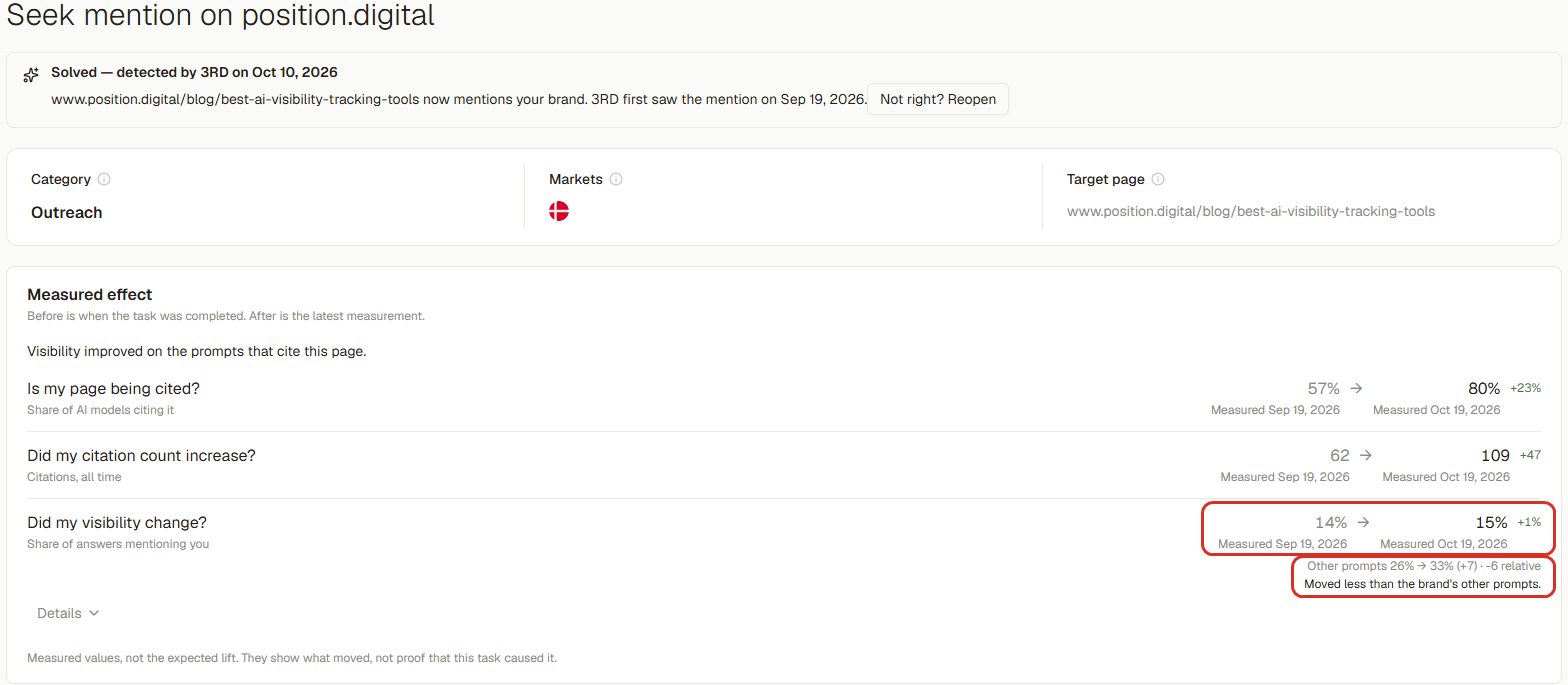
More AI models now cite the page that mentions us. Our visibility on the prompts that cite it rose only 1 point, less than our other prompts. That's the honest reading.
The page became a stronger source: cited by 80% of AI models, up from 57%, and 109 citations, up from 62. But our visibility on the prompts that cite it rose 1 point, while our other prompts rose 7. One placement made the page we're on more influential. It did not yet make AI recommend us. That takes more than one source.
This matches what we see across customers. Of 117 completed tasks that 3RD measured against a control group, 29% moved up by more than 5 points relative to the control, 26% moved down and 44% stayed flat. Single actions rarely move the needle alone. Patterns of corroboration do.
Step 4: Build reviews on the platforms AI reads
Review and comparison sites were cited for 82 of the 100 brands in our research, and they were the most-cited third-party domain for 22 of them.
What to do:
- Pick the two or three review platforms that AI cites in your category. For B2B software that is often G2 or Capterra. For consumer brands it might be Trustpilot or a local comparison site. Check your own citation data rather than guessing.
- Ask every happy customer, every month. A short, polite request after a success moment works better than a quarterly campaign.
- Follow each platform's rules. No fake reviews, no reviews written by staff, no incentives the platform prohibits.
- Answer reviews, including the critical ones. Answers become part of what models read.
- Complete your profile. Categories, pricing, screenshots and integrations all feed comparison pages.
We completed our G2 profile, and "increase G2 mentions" is now a recommended task on our board.
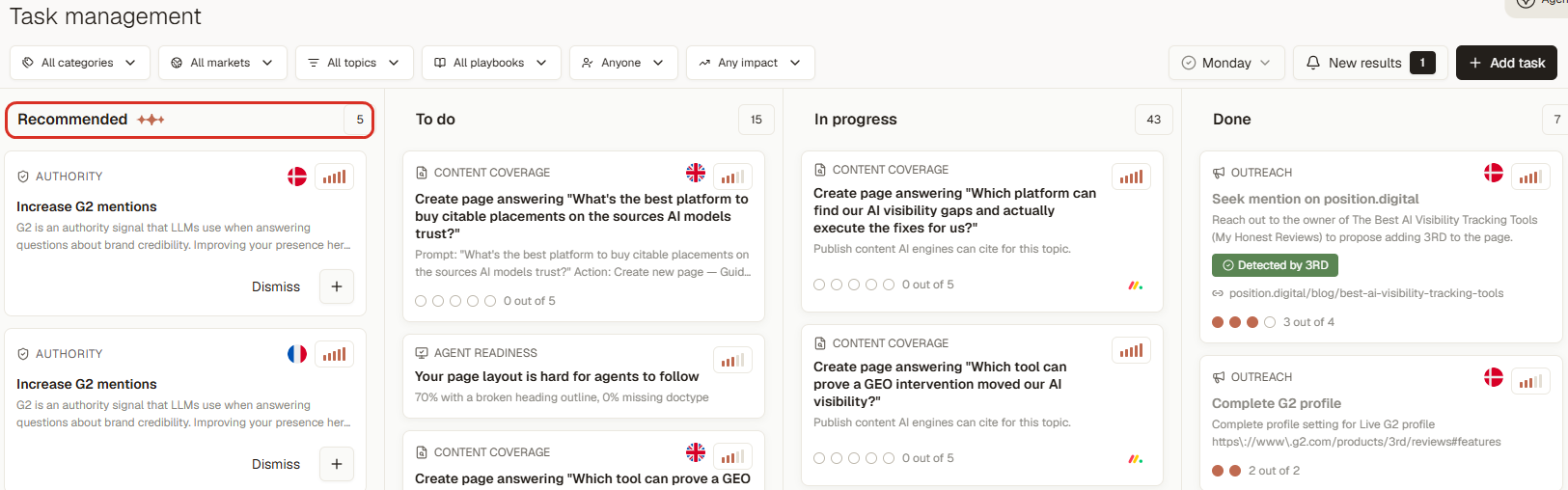
Our own board: "Increase G2 mentions" is recommended next. The G2 profile and the position.digital outreach are done.
Step 5: Publish proof AI can quote
Models prefer definitive, specific statements they can repeat. Give them some.
- Case studies with numbers. A named customer, a starting point, what they did, and the result, with dates. Ours: Manyone, Apollon Studios and Boë Beauté.
- Original data. Studies only you can run. Ours is the research in these articles: 111 brands and 732,000 AI answers. Other publishers cite data like this, and that creates the third-party mentions you need.
- Named experts. A real person with a real role who explains how things work. Bylines and author pages help models connect expertise to your brand.
- Clear facts. Pricing, plans, markets, integrations and security facts, stated plainly on your own site, so third parties copy them correctly.
Step 6: Get covered outside your own channels
Third-party coverage is corroboration that you don't write.
- Trade media and newsletters in your category and your markets.
- Podcasts and webinars hosted by others.
- Conference talks, which create agendas, recaps and recordings.
- Partner and integration pages, which describe what you do in someone else's words.
- Customer posts about results. A customer saying it beats you saying it.
Prioritize by the same rule as step 2: coverage on sources AI already cites for your questions beats coverage that only looks good on a slide.
Step 7: Show up in communities, as a person
Reddit was a cited source for 85 of 100 brands in our research, but it took a median of only about 1% of citations. It matters, but it isn't the whole game. In our own category, Reddit was cited 243 times in Danish answers and 320 times in UK answers last month, and none of those Reddit pages mentioned us.
The rule is simple: participate as a named person, disclose that you work for the company, and answer the question that was asked. Communities punish promotion quickly, and so do the moderators.
Step 8: Keep every source saying the same thing
When your site, your G2 profile, a partner page and a list all describe you differently, a model has to guess. Write one description, one positioning line and one set of facts. Update them everywhere when they change, and correct outdated claims at their source.
Which move to make when
|
Move |
Use it when |
What to do |
Who usually does it |
|---|---|---|---|
|
Identity fixes |
Models confuse you with others, or describe you wrongly |
Organization schema, one description everywhere, claim profiles |
Web or SEO lead with a developer |
|
List outreach |
Lists cited for your Must-Win questions name competitors but not you |
Pitch a factual entry in the list's format |
Marketing or PR |
|
Reviews |
Review sites are among your top cited sources |
Monthly review asks, complete profiles, answer reviews |
Customer success with marketing |
|
Case studies |
AI says there is "limited evidence" |
Publish named results with numbers and dates |
Product marketing |
|
Original data |
You want third parties to cite you |
Run a study only you can run, and publish the method |
Marketing with data or product |
|
Media and partners |
You need independent descriptions of what you do |
Pitch trade media, podcasts, partner pages |
PR, partnerships |
|
Community |
Reddit or forums are cited for your questions |
Answer as a named person, disclose affiliation |
Subject-matter experts |
|
Consistency audit |
Sources describe you differently |
One description and fact sheet, update at the source |
Product marketing |
What doesn't work
- Buying links or placements disguised as editorial. Readers and platforms discount them, and they can damage your search presence.
- Fake or incentivized reviews against platform rules. Platforms remove them and can penalize your profile.
- Self-published "best tools" lists that rank yourself first. Some vendors do it, and AI does cite some of these pages. But a list on your own domain is still your own voice, and it does nothing for the "does anyone else say so?" question.
- Mass-produced AI content. Volume without proof doesn't create authority. It dilutes the pages that do.
- Hidden text or instructions aimed at AI crawlers. It's manipulation, and it tends to be found.
- Promotional posting in communities. It gets removed, and it can follow your brand around.
For buying placements openly, as ads, see paid AI visibility in 2026. That's a separate channel with separate rules.
How long it takes
I won't promise a timeline. Authority is built from many sources, and AI models re-crawl and re-learn on their own schedules. In our customer data, single actions measured against a control group were close to a coin flip in the short term. That's why we treat authority as a programme, not a campaign: steady, specific, and measured on 30-day averages.
What to watch while you build:
- Authority driver score in 3RD's Diagnostics.
- Sentiment phrases. Does "limited evidence" disappear?
- Recommended rate, not just mentions.
- How many AI models cite the pages that mention you.
For a full measurement method, see how to prove a GEO change actually moved your AI visibility.
How we're doing it at 3RD
Our plan, in the open:
- Identity. Add Organization schema and fix the robots.txt on our trust site.
- Reviews. Ask customers for G2 reviews every month.
- Lists. Pitch the lists AI cites for our category in the UK and Denmark, ranked by how many of our prompts they influence.
- Proof. Publish named cases and the research behind these articles.
- Content. Publish the pages that answer our buyers' questions. 3RD Agent told us that was the first fix.
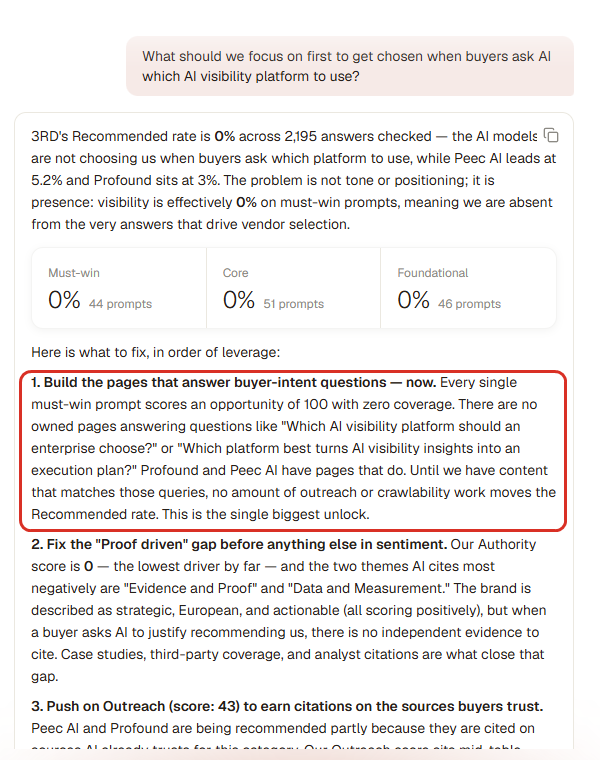
We asked 3RD Agent what to fix first. Build the pages, then close the proof gap, then push outreach. This article is part of step one and step two.
Is 3RD a thought leader in AI visibility? Not yet, by the measure that matters here: AI assistants don't name us when buyers ask. We'd rather say that than claim otherwise. What we can do is publish useful, specific work with our own data, and let other sources decide.
What 3RD does in this work, and what it doesn't. 3RD's Authority and Outreach drivers track brand-mention signals and rank third-party pages AI cites by how many of your prompts they influence. For each source it drafts an outreach strategy: what to pitch and which angle fits. It detects when a target page starts mentioning you and measures what moved afterwards. It does not send the pitch, write your reviews or earn the coverage for you. People still do the outreach.
About the data
The customer findings come from 3RD's own research: we analysed citations from 100 brands (5.9 million citations) and answers for 60 to 111 brands tracked in 3RD between September 19 and October 18, 2026. Completed-task outcomes come from 117 tasks with a control group across 44 brands. The sample leans toward Nordic brands, and the data is anonymised and aggregated. Figures for 3RD itself come from our own workspace.
FAQ
How do brands build the trust and authority that make AI recommend them? By getting other sources to back what they say. Fix your identity so models know who you are, earn reviews and list placements on the pages AI already cites, publish proof such as cases and original data, and keep every source consistent.
Does publishing more content on my own site build authority? Only partly. Across 100 brands we track, the brand's own site made up a median 6.8% of AI citations. Your content answers questions; authority comes from third-party sources that corroborate it.
Do reviews affect whether ChatGPT recommends a brand? Review and comparison sites were cited for 82 of 100 brands in our research, and they were the most-cited third-party domain for 22 of them. Reviews on the platforms AI reads are one of the most direct ways to add proof.
How do I get onto the "best tools" lists AI cites? Find the lists cited for your buying questions, check that you genuinely fit, and send a short factual entry in the list's own format with one proof point. Rank targets by how many of your questions each list influences.
How long until AI starts recommending us? There's no reliable timeline. Models update on their own schedules, and single actions rarely move recommendations alone. Track authority, sentiment and recommended rate on 30-day averages, and expect a programme rather than a quick win.
Start with step 2 this week: list the pages AI cites for your three most important buying questions, and mark the ones that name competitors but not you. That's your outreach list. See how 3RD finds them.