AI search
AI visibility for regulated pharma brands: monitoring what AI says about your medicines
How pharma teams monitor what AI assistants say about their medicines, catch inaccurate answers, and respond with approved content only.
Contents
Short answer: for pharma, choose a platform that monitors AI answers per market, shows the sources behind them, flags inaccurate claims, and never publishes without medical, legal and regulatory review.
Patients and healthcare professionals now ask AI assistants about conditions, treatments and medicines. The answers are built mostly from regulators, medical references and health sites, not from your pages. For a pharma brand, the first job is not "get mentioned more". It is know what AI says, catch what's wrong, and respond only in ways your rules allow.
This guide covers what people ask AI about medicines, why AI leans on authorities, the specific risks for a regulated brand, a monitoring workflow that fits medical-legal-regulatory review, and how to choose a platform. It is not legal or regulatory advice. Your medical, legal, regulatory and pharmacovigilance teams decide what you may do in each market.
What patients and healthcare professionals ask AI
The questions split into two audiences, and you should track them separately.
|
Audience |
Typical questions |
What a good answer relies on |
|---|---|---|
|
Patients and carers |
"What are the side effects of [medicine]?", "Can I take [medicine] with alcohol?", "What are the treatment options for [condition]?" |
Patient leaflets, national health services, patient organizations |
|
Healthcare professionals |
"What do current guidelines recommend for [condition]?", "What is the evidence for [medicine] versus [comparator]?" |
Regulator labels, clinical guidelines, published studies |
|
Both |
"Is [medicine] available in [country]?", "Is there a generic of [medicine]?" |
Regulators, national formularies, pharmacy sources |
In 3RD you can model this with audiences: a user profile for the type of person asking. AI assistants personalize answers, so a patient profile and an HCP profile can get different answers to the same question.
Track each market separately too. A market in 3RD is one country in one language. That matters more in pharma than almost anywhere: approvals, labels, brand names and reimbursement differ by country.
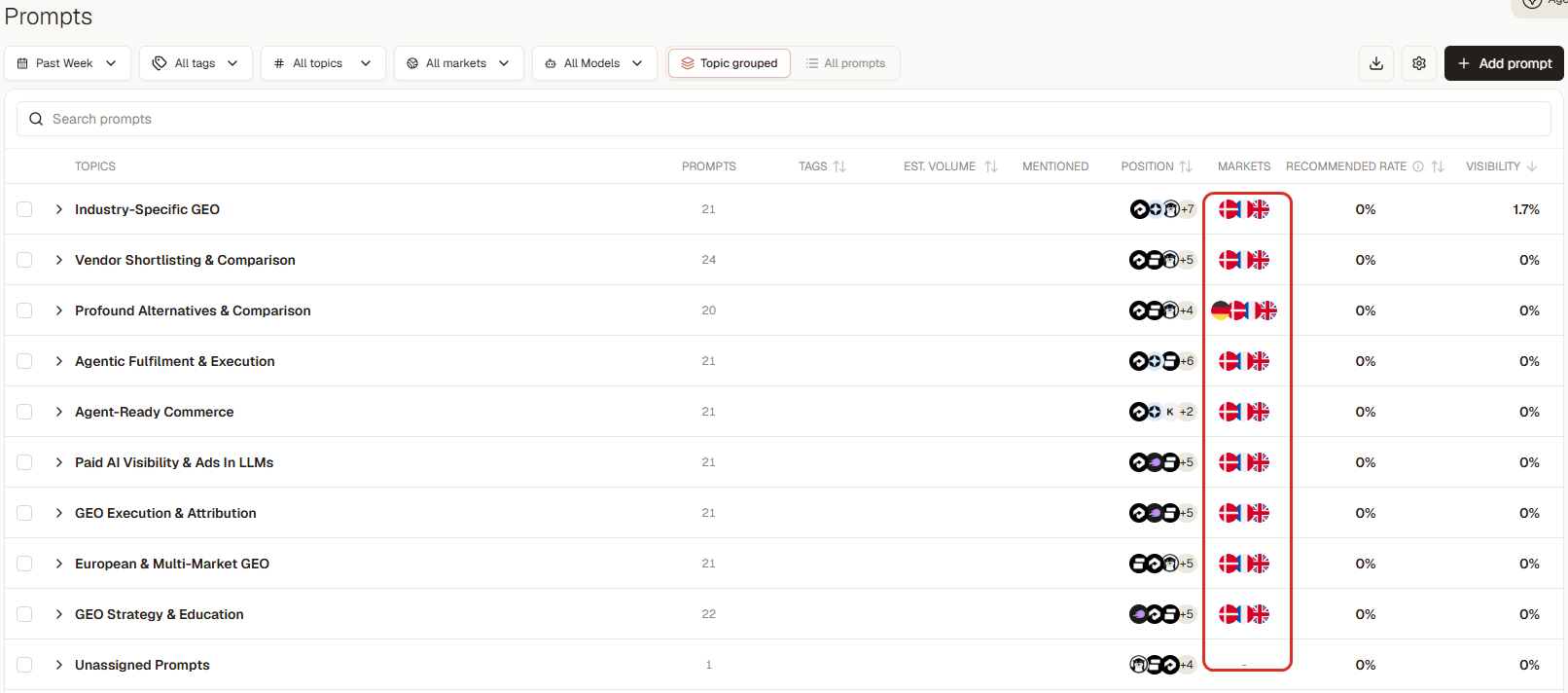
Prompts grouped by topic and tracked per market. For pharma, a sensible structure is one topic per therapy area and one audience each for patients and HCPs.
Why AI leans on authorities for health questions
Health is the clearest case of "Your Money or Your Life" content: topics where bad information can cause harm. AI assistants answer health questions cautiously, add "talk to your doctor", and cite institutions heavily: medicines regulators, national health services, medical references and published research.
Our own data shows the pattern at category level. Across 100 brands and 5.9 million citations, government, health authorities and public bodies were cited for 61 of 100 brands, and for 11 of them a government or health body was the single most-cited outside source. Health and public-sector brands drive most of that share, so treat it as directional. At the same time, the median brand's own website made up only 6.8% of the sources AI cited in its category.
The implication for pharma is direct. Most of what AI says about your medicine comes from sources you don't control, and many of them are sources you shouldn't try to influence commercially.
The risks that matter for a regulated brand
Being mentioned is rarely the problem in pharma. The risk is what the answer says.
- Inaccurate safety information. Side effects, interactions or contraindications that are missing, outdated or wrong.
- Wrong dosing or use. Doses for the wrong indication, age group or formulation.
- Off-label suggestions. AI suggesting a medicine for a use it isn't approved for in that market.
- Wrong market facts. A product described as available, or under a brand name, that doesn't apply in the reader's country.
- Brand and generic confusion. Your brand credited with a competitor's data, or the reverse.
- Outdated framing. An old safety communication, a withdrawn indication or a past supply issue presented as current.
You can't edit an AI answer. You can find these errors early, route them to the right team, and correct what you legitimately can at the source.
A monitoring workflow that fits medical, legal and regulatory review
Step 1: Build a prompt set with your medical team
Write prompts the way patients and HCPs ask, not the way your brand team talks. Include unbranded questions about the condition, branded questions about your medicine, and comparison questions. Agree the list with medical affairs before you track it, so nobody is surprised by what the dashboard shows.
Step 2: Read the answers and the sources
In 3RD, the Conversations explorer shows each prompt, every assistant's answer, whether your brand was mentioned, how it was described, which other brands appeared and every source cited. Compare assistants: they often answer the same question differently. Across 83 brands in our data, the gap between a brand's best and worst assistant was a median 16 points of visibility. Accuracy differs by assistant in the same way, so check every assistant you track.
3RD Agent's "Is what they say true" skill checks the claims the models make about you against the facts. In pharma, use it only as a first pass. A qualified person reviews every answer that touches safety, dosing or indication.
Step 3: Triage what you find
|
What you find |
Route to |
Typical response |
|---|---|---|
|
Possible adverse event or product complaint in an answer or a cited source |
Pharmacovigilance |
Assess under your PV procedures |
|
Inaccurate safety or dosing information |
Medical affairs |
Check whether your own approved materials are the source; fix those first |
|
Off-label suggestion |
Medical, legal and regulatory |
Don't amplify it. Check your approved content isn't feeding it |
|
Wrong market facts (availability, brand name) |
Regulatory and local affiliate |
Make sure each country's approved information is published and crawlable |
|
Outdated framing on a third-party site |
Medical and communications |
Decide whether a factual correction request is appropriate |
A note on pharmacovigilance: in the EU, good pharmacovigilance practice (GVP Module VI) expects marketing authorisation holders to screen the digital media under their management for potential adverse reaction reports, and to assess reports they become aware of elsewhere. Whether monitoring AI answers creates reporting obligations for you is a question for your PV team. Ask it before you start, not after the first finding.
Step 4: Respond only with approved content
The safe pattern is the one you already use: nothing goes out without medical, legal and regulatory (MLR) review. In 3RD that works like this:
- 3RD Agent asks before it changes anything. Every change it proposes arrives as a card you approve, edit or reject.
- Content Agent drafts; you publish. It is a paid add-on that writes a draft from a brief and your brand profile. Treat the draft like any agency draft: it goes into your MLR process like everything else.
- The HubSpot integration only creates drafts. 3RD never publishes a page on your site.
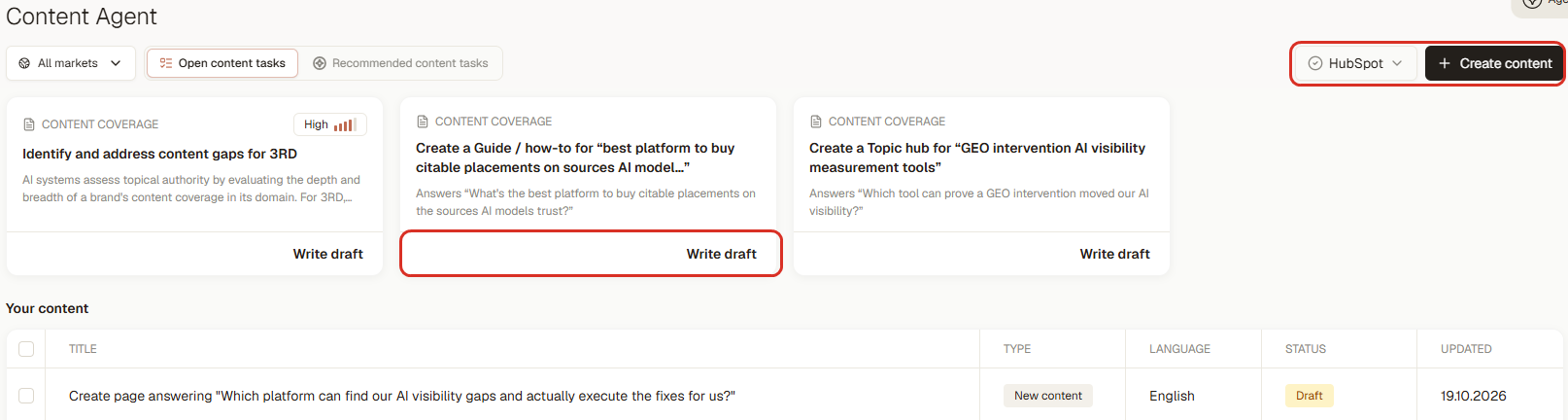
Content Agent drafts each page from its brief. The HubSpot connection only creates drafts. In pharma, nothing reaches a page until it has passed MLR review.
Step 5: Correct at the source, within the rules
What you can usually do, subject to your local rules and codes:
- Keep approved information crawlable. Product information, patient leaflets and safety updates published as text on stable, country-specific URLs, not only as PDFs or images.
- Keep it consistent. The same brand name, generic name and indication wording across your country sites.
- Publish factual, non-promotional resources where your rules allow them, such as approved disease-awareness information or medical information pages for HCPs.
- Request factual corrections from third-party sites that publish wrong information about your product, through the route your medical and legal teams approve.
What you should not do:
- Seed or encourage off-label content, anywhere.
- Pay for, or arrange, undisclosed placements on health sites or forums.
- Publish promotional content about prescription medicines to the general public in markets that prohibit it.
- Treat a draft from any tool, including 3RD, as approved copy.
Step 6: Measure against noise
AI answers move on their own. Across 111 brands and 732,000 answers, the median brand's visibility swung 12.5 points between its best and worst day in a single month, with no change to its prompts. Judge a correction on equal windows, against prompts you didn't touch. Our method is in how to prove a GEO change moved your AI visibility.
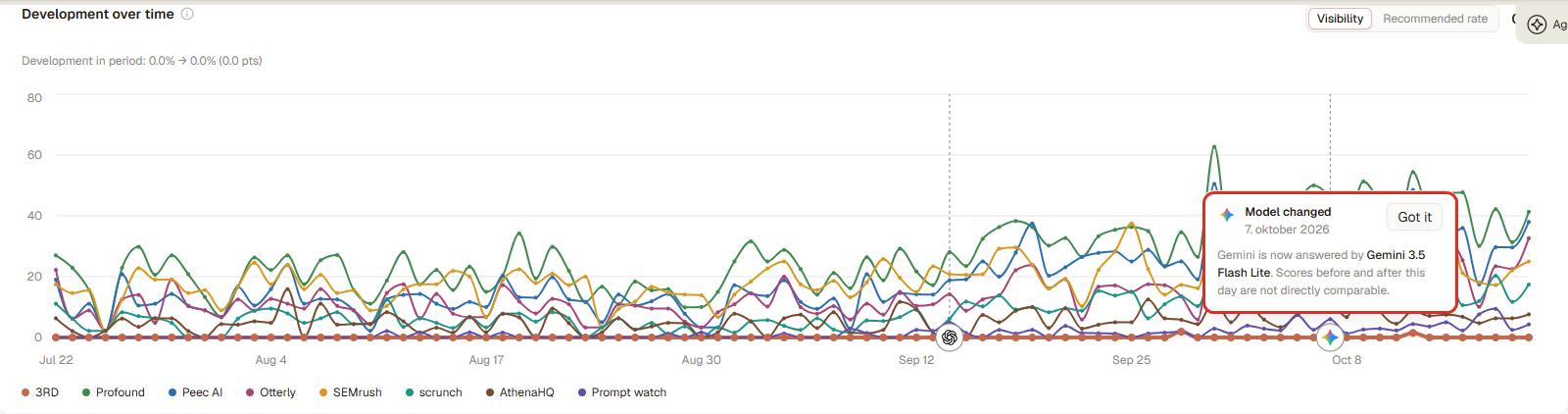
Ninety days of daily visibility from our own account. Scores swing day to day, and a model update on October 7 broke the series. For pharma, a single day's answer is not evidence of a trend.
Market-by-market rules: why one global approach fails
Rules on promoting medicines differ sharply by market, and AI answers are local too. Two examples show the gap:
- EU: advertising prescription-only medicines to the general public is prohibited under the EU medicines directive (Directive 2001/83/EC, Article 88). Disease awareness and factual information are handled under national rules and industry codes.
- US: direct-to-consumer advertising of prescription drugs is allowed under FDA rules, with requirements such as presenting benefits and risks in fair balance.
Paid placements follow the same split. Google lets pharmaceutical manufacturers advertise prescription drugs only in a few countries (the United States, Canada and New Zealand) and only with certification. OpenAI keeps ads away from sensitive conversations such as health, and reviews health advertisers case by case. We cover what can be bought in paid AI visibility in 2026.
So build your tracking per market, and agree per market what responses are allowed. A US playbook will be wrong in Denmark.
How to choose a platform for a regulated pharma brand
Start with the general checklist in how to choose an AI visibility platform, then add these:
|
Criterion |
Why it matters in pharma |
What to ask in the demo |
|---|---|---|
|
Per-market, per-language tracking |
Approvals, labels and brand names are national |
"Is each country–language pair tracked separately?" |
|
Audiences |
Patients and HCPs get different answers |
"Can we compare a patient profile with an HCP profile?" |
|
Full answers with sources |
You need to see exactly what was said and where it came from |
"Show me every answer and citation for one prompt." |
|
No auto-publishing |
Everything needs MLR review |
"Can anything be published or sent without our approval?" |
|
Security evidence |
Vendor qualification asks for certificates |
"Which certifications do you hold today?" |
|
Data location |
Many companies require EU hosting |
"Where is our data stored?" |
How the options compare on the last points, from vendors' public pages as of October 2026:
- Profound offers SSO, SOC 2 and an API on Enterprise, and its agents publish to your CMS after an approval step. If your vendor qualification requires a SOC 2 report today, Profound meets that bar and 3RD doesn't yet.
- KIME runs agents that carry out tasks for you. In a regulated business, check exactly which actions they take on your behalf before switching them on.
- 3RD stores data in EU regions and follows ISO 27001 and SOC 2 controls, but is not yet certified for either. SAML single sign-on is available on Enterprise by agreement. 3RD never publishes to your site. See Security.
Our honest summary: if a certificate is a hard requirement now, include a certified vendor. If the problem is that nobody has time to monitor answers in every market, triage what's wrong and feed MLR-ready drafts into your process, 3RD is built for that loop.
What 3RD shows, and where its limits are
We use the same tools on our own brand. Here is how 3RD's Diagnostics explains in plain words why AI doesn't pick us in Denmark: no content for most buyer questions, and third-party pages that name our competitors instead of us.
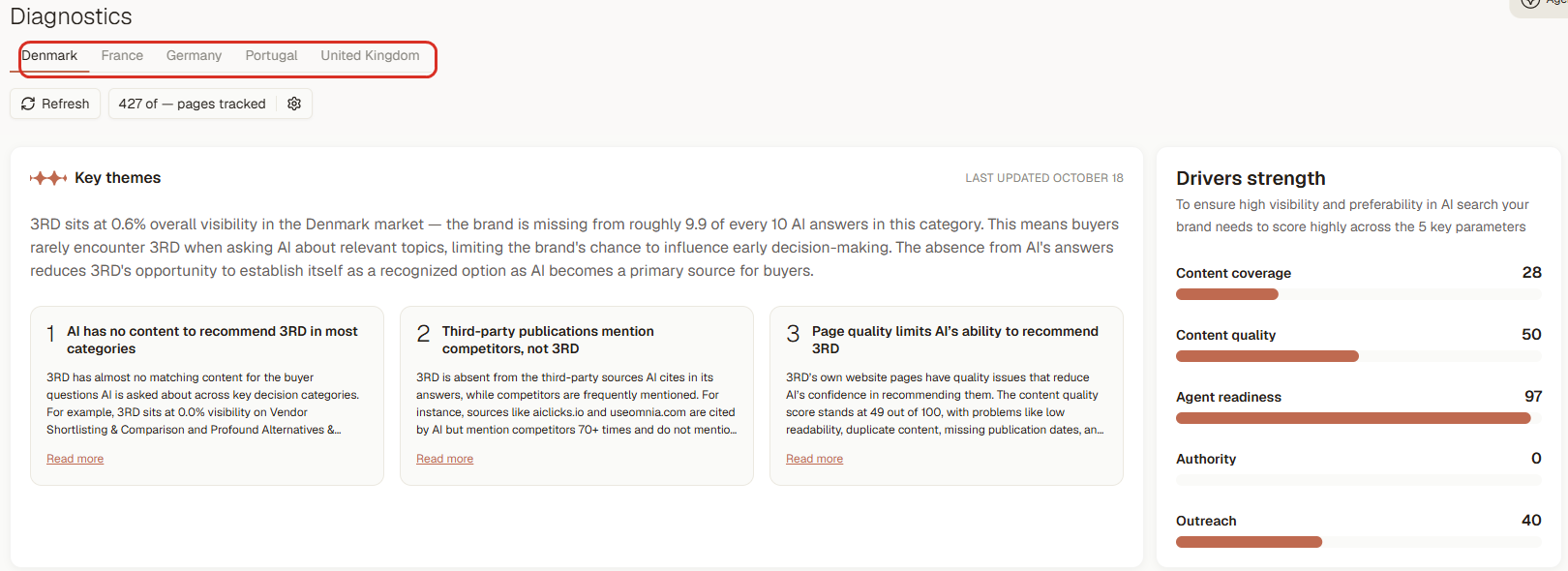
Diagnostics for our own brand in Denmark. For a pharma brand, the same view shows which therapy-area topics you are missing from and which sources fill the gap.
Where the limits are, for pharma specifically:
- Sentiment scoring works at sentence level in English, Danish, Swedish, Norwegian and German. Read answers in other languages directly.
- Accuracy checks are a first pass. Medical review stays with your qualified people.
- 3RD doesn't provide regulatory or pharmacovigilance advice, and its drafts are not approved materials.
- No platform can change an AI answer directly. You influence the sources, then measure.
About the data
The aggregate figures come from 3RD's own research: 111 brands tracked in 3RD between 19 September and 18 October 2026, covering 732,000 AI answers, plus 5.9 million source citations for 100 of them. The sample leans Nordic and isn't pharma-specific. Brands are anonymised and figures are medians across brands. These are observational data, not controlled experiments.
FAQ
What's the best AI visibility platform for a regulated pharma brand? One that tracks answers per market and audience, shows every answer with its sources, flags inaccurate claims, and never publishes without your review. If a SOC 2 report is mandatory today, include a certified vendor such as Profound. 3RD fits teams that need the monitoring and MLR-ready drafting loop, with EU data storage.
Can we change what ChatGPT says about our medicine? Not directly. You can make sure your approved information is accurate, current and crawlable in each market, and request factual corrections from third-party sources through approved routes. Then you measure whether answers change.
Does monitoring AI answers create pharmacovigilance obligations? Possibly. In the EU, GVP Module VI covers digital media under your management and reports you become aware of. Ask your PV team before you start monitoring, and agree how findings are routed.
Should we track patient and HCP questions separately? Yes. They ask different questions, AI answers them differently, and your rules for responding differ. Use separate audiences and topics.
Can we advertise in AI answers? Rarely, for prescription medicines. Google allows prescription drug ads from manufacturers only in a few countries, with certification. The EU prohibits advertising prescription-only medicines to the public. OpenAI keeps ads away from health conversations. Check each market with your regulatory team.