AI search
The best AI visibility platforms for agencies managing many client brands (2026)
Eight AI visibility platforms compared on the jobs an agency has: win the pitch, run many clients, price per brand, report in your brand, deliver the work.
Contents
Short answer: pick the platform that matches how you sell. 3RD, Profound, Peec AI, Otterly, KIME, Scrunch and AthenaHQ all run many client brands; they differ on pitching, per-client pricing and who does the work.
Every agency I talk to has the same client email in its inbox: "Are we showing up in ChatGPT?" The client wants an answer this week. The agency wants something better than a screenshot of one chat.
I've been on the agency side of that email. Before 3RD, I led SEO and CRO for 30+ client brands at an agency. The tool question was never "which dashboard is prettiest". It was: can I win the pitch with it, run every client in it, put my margin on top of it, and show the client what moved, in my own brand?
That's how this guide compares platforms. Not on features in the abstract, but on the seven jobs an agency has when it sells AI visibility.
A note on bias: I work at 3RD, and 3RD is on this list. Every competitor fact below comes from the vendor's own website, checked on October 19, 2026, with sources at the end. Where a vendor doesn't publish something, I say so instead of guessing.
The seven jobs an agency platform has to do
A brand team needs one dashboard. An agency needs a production line. Here's what that line has to handle.
|
# |
Job |
What good looks like |
|---|---|---|
|
1 |
Win the pitch |
Show a prospect where they stand against their competitors, before they sign, without paying for a full seat |
|
2 |
Run many clients in one place |
Every client brand side by side, with its own markets, competitors and prompts, and access set per brand |
|
3 |
Price per client |
A cost per client brand you can mark up, and a bill you can split or pass on |
|
4 |
Diagnose, not just count |
Explain why AI picks a competitor, so your team knows what to do |
|
5 |
Deliver the work |
Briefs, drafts, outreach targets and technical fixes your team can ship |
|
6 |
Report in your brand |
Client reports and live dashboards with your agency's name on them |
|
7 |
Prove it worked |
Before-and-after on the client's prompts, read against a control |
Most platforms handle jobs 1 and 2 well now. The real differences sit in jobs 3 to 7. That's where your margin lives.
The platforms compared
|
Platform |
Pitch |
Many clients |
Agency pricing (public) |
Branded reporting |
Help doing the work |
|---|---|---|---|---|---|
|
3RD |
Free demo brands, 5 days, outside your brand slots; Pitch mode and Assessments |
Client accounts group brands; brand licenses per client; access per brand |
Partner pricing per client brand; agency plans set up with 3RD, not published |
Reports Studio in your branding; Looker Studio connector |
Diagnosis, Playbooks, 3RD Agent and Content Agent drafts you approve; training and a Solution Architect |
|
Profound |
10 pitch workspaces a month, 25 prompts each; 5 more for $199/month |
Agency Mode with a client workspace per client |
Agency Growth: client workspaces as an add-on at $399/month each (100 prompts, 6 articles a month) |
Not described on the agency launch page |
AI-written articles in each client workspace; agents that publish to a CMS after approval |
|
Peec AI |
Free pitch projects (pages differ on limits) |
Projects per client; sub-brand tracking |
Agency plans by credits (Essential, Growth, Scale, Comprehensive); prices not shown on the page |
Data Studio connector and dashboards |
Recommended actions and content optimization |
|
Otterly |
Pitch workspaces |
Unlimited workspaces on Agency Partner status |
Standard or Premium plus Agency Partner status; Standard $189, Premium $489 (higher set on the page) |
Looker Studio reports "with your branding" |
Recommendations and GEO URL audits |
|
KIME |
Unlimited pitch workspaces, 5 prompts each |
Unlimited client workspaces; view-only client access |
Agency pricing on a separate page; not shown on the agency page |
Live client dashboards (view-only) |
AWX agents carry out tasks |
|
Scrunch |
Free prospecting license (partner program) |
Unified workspace for multiple clients |
Agency Core $500/month; Agency Enterprise custom (vendor FAQ) |
Not stated |
Page audits; AXP, an AI-friendly version of the site |
|
AthenaHQ |
Pre-built pitch workspaces |
Several brands, team permissions |
Discounted licenses for agencies; no figure published |
"AI-ready reporting", no detail |
Content optimization agent; GEO certification for your team |
|
Semrush AI Visibility Toolkit |
Not an agency feature |
Priced per domain inside the Semrush suite |
$99/month per domain, billed annually, 25 prompts |
Semrush reporting |
AI search site audit inside the suite |
Facts as published on each vendor's own pages, October 19, 2026. Agency terms change often; confirm before you sign.
Three things stand out from that table.
- Pitching is solved. Almost every platform now gives you a free or cheap way to show a prospect their numbers.
- Per-client pricing is rarely public. Only Profound and Otterly put agency figures on the page. Everyone else, 3RD included, prices agencies in a conversation.
- "Help doing the work" means very different things. It ranges from a recommendation list to agents that publish. That difference decides how many clients one person on your team can carry.
What each platform does for an agency
Every entry follows the same template, so you can compare like with like.
3RD
Best for: agencies making AI visibility a service of its own, with complex clients (several markets, languages or business units) and a content-led team.
What it does well: 3RD is built around one loop: track, diagnose why AI picks a competitor, plan the work, do it, report. For agencies, the organization adds client accounts that group a client's brands, brand licenses so each client brand runs on its own plan, and demo brands that run free for 5 days for a pitch without using a brand slot. When the client signs, you convert the demo and keep its history. You can send a client its own invoice. Reports Studio builds client reports in your agency's branding, and the Looker Studio connector gives every client the same live dashboard from one template.
The partner program is agency-first: 3RD doesn't sell around you, trains your client leads and your specialists on separate tracks, and gives you a Solution Architect while you build the practice. Critical issues on the agency SLA are answered within 2 hours.
Where it falls short: agency pricing isn't published, so you can't model your margin from the website. Agency organizations are set up with 3RD rather than bought self-serve. There's no SOC 2 report yet, which some enterprise clients will ask about. And 3RD Agent drafts the work; your team still checks and publishes it.
Pricing as of October 2026: brand plans are public (Starter €99, Pro €299, Growth €499 a month). Agency plans are a custom deal with partner pricing per client brand. See 3RD for agencies for the partnership itself.
Profound
Best for: agencies whose clients want the deepest dataset and whose team wants to build its own workflows on top.
What it does well: Profound's Agency Growth plan gives each client its own workspace with its own prompts, competitors and models. Each client workspace includes 100 tracked prompts and 6 AEO-optimized articles a month. You get 10 pitch workspaces a month with 25 prompts each, five seats, and one consolidated bill. On Enterprise, Profound tracks up to nine answer engines and offers SSO, SAML and SOC 2.
Where it falls short: at $399 per client workspace per month before your margin, small clients get expensive. The agency launch page doesn't describe white-label reporting. Profound's own pricing page describes the agency plan differently (credits per client workspace), so check which applies to you.
Pricing as of October 2026: client workspaces $399/month each as an add-on; extra pitch workspaces $199/month for 5.
Peec AI
Best for: analytics-first agencies that run the work themselves and want many projects under one account.
What it does well: Peec AI sells agency plans by credits, sized by client count: Growth is described for 3–10 clients and Scale for 11–25+. Pitch projects are free and sit outside your client quota, and a pitch converts into a client project when the prospect signs. There's a Data Studio connector for client dashboards, plus an API and MCP. Peec AI is based in Berlin.
Where it falls short: the agency pricing page lists credits and prompts, not prices, so you need a call to model margin. Peec's pages disagree on pitch limits (unlimited on one page, 7 days on another). Doing the work stays with your team.
Pricing as of October 2026: agency plans Essential (10,000 credits a month), Growth (25,000), Scale (65,000) and Comprehensive (custom). Prices not shown.
Otterly
Best for: small and mid-sized agencies that want a low entry price and published numbers.
What it does well: Otterly is the most transparent on price. Agencies subscribe to Standard or Premium and apply for Agency Partner status. That adds unlimited workspaces for clients, pitch workspaces for prospects, more prompts (150 on Standard, 500 on Premium), Looker Studio reports "with your branding", and one invoice for every workspace. Otterly is an Austrian company.
Where it falls short: prompts are pooled across clients, so 500 prompts spread over ten clients is 50 each. Four engines are included; Gemini, AI Mode and Claude are paid add-ons. The pricing page shows two price sets without labeling which is monthly.
Pricing as of October 2026: Standard $189 and Premium $489 a month (the page also shows $160 and $422, likely the annual rate).
KIME
Best for: agencies that want agents to carry out tasks and want to give clients a live, view-only dashboard.
What it does well: every KIME agency plan includes unlimited client workspaces and unlimited pitch workspaces (5 prompts each). Clients get view-only access to live dashboards, which KIME pitches as a replacement for weekly report emails. KIME's AWX agents execute tasks, and countries and languages are unlimited on every plan. KIME is based in Copenhagen.
Where it falls short: agency prices aren't on the agency page, white label isn't mentioned, and the agency page gives conflicting seat numbers. A 5-prompt pitch workspace is too small to read reliably (more on that below).
Pricing as of October 2026: agency pricing on a separate page. Brand plans: Explorer €99, Core €399 a month.
Scrunch
Best for: agencies serving enterprise brands that care about how AI agents read the site itself.
What it does well: Scrunch's partner program pays up to 20% referral commission, gives partners a free prospecting license and a co-marketing fund, and offers a unified workspace for multiple clients. Its Agent Experience Platform (AXP) builds an AI-friendly version of a client's site.
Where it falls short: agency packages aren't listed on the pricing page; the $500 Agency Core figure comes from Scrunch's FAQ. Branded reporting isn't described.
Pricing as of October 2026: Agency Core $500/month and Agency Enterprise custom (vendor FAQ). Brand plans from $300/month ($250 annual).
AthenaHQ
Best for: agencies that want certification and lead flow from the vendor.
What it does well: AthenaHQ's agency program offers discounted licenses so you can bundle the tool with your services, pre-built pitch workspaces, multi-brand management with team permissions, GEO certification, a dedicated Agency Growth Manager, and client leads routed to certified agencies.
Where it falls short: no discount figure, white label or reporting detail is published. The Starter plan covers one region and language.
Pricing as of October 2026: brand Starter $295/month; agency discount not published.
Semrush AI Visibility Toolkit
Best for: SEO agencies that already run every client in Semrush and want AI visibility next to keyword data.
What it does well: it sits inside a suite your team already knows, priced per domain.
Where it falls short: 25 prompts per domain is a small sample, and it isn't built around agency jobs like pitching or client billing.
Pricing as of October 2026: $99/month per domain, billed annually.
How to price AI visibility as a service
Most agencies get this wrong in the same way: they bolt AI visibility onto an SEO retainer as a line item. The tool cost goes up, the fee doesn't, and margin disappears.
Our partner agencies have the most success when AI visibility is its own initiative with its own budget, goal and owner. Clients pay more for it that way, and they get more from it.
Here's the cost side you need to model per client:
|
Cost line |
What drives it |
Where to find it |
|---|---|---|
|
Platform |
Price per client brand or workspace, plus prompts and models |
Vendor agency pricing (often a call) |
|
Prompts |
Questions × models × markets |
Each vendor counts differently; see how to choose a platform |
|
Delivery hours |
Content, outreach and technical tasks per month |
The platform's plan and how much it drafts for you |
|
Reporting hours |
Monthly report and client call |
Branded reports and live dashboards cut this |
The line that varies most between platforms is delivery hours. A platform that hands you a ranked task list with briefs and drafts lets one specialist carry more clients than one that hands you a score.
Rule of thumb we use: price the platform per client brand, not per agency. If a vendor's cost can't be mapped to a client brand, your margin will drift every time a client adds a market.
Before you pitch: small samples lie
Pitch workspaces are great for opening a conversation. They're dangerous for closing one.
Across 111 brands we track in 3RD, the median brand's daily visibility moved 12.5 points between its best and worst day in a single month, with no change to its prompts. Brands with fewer than about 100 AI answers a day swung twice as much as brands with 230 or more (median standard deviation 4.5 vs 2.1 points). For the smallest third of brands, 30% of days were more than 5 points off their own monthly average.
A pitch workspace with 5 or 25 prompts on one or two models is at the small end of that range. Read it as a direction, not a verdict.
Three rules we use for pitch data:
- Show the gap, not the score. "Your competitor is named in this answer and you aren't" survives the noise. "You're at 23%" doesn't.
- Show at least two models. For 62% of the brands we track (37 of 60), a different competitor led on different AI assistants for the same questions. One model can make a prospect look fine or hopeless.
- Commit to the plan, not the number. Promise a first diagnosis and a ranked plan in month one. Promise visibility movement only after a baseline.
How to report to clients
Client reporting is where agencies lose the most hours. A good platform should cut it to a template you send every month.
What to put in the report:
- Visibility and recommended rate, by model and market. They're different numbers: across 60 brands we track, the median brand was mentioned in 19.8% of AI answers but recommended in just 0.2%. Clients care about the second one.
- What you shipped, task by task.
- What moved, read against a control. In 3RD, each completed task shows its measured effect next to the brand's other prompts, so you can tell a client "this moved more than everything else" or, just as honestly, "it didn't".
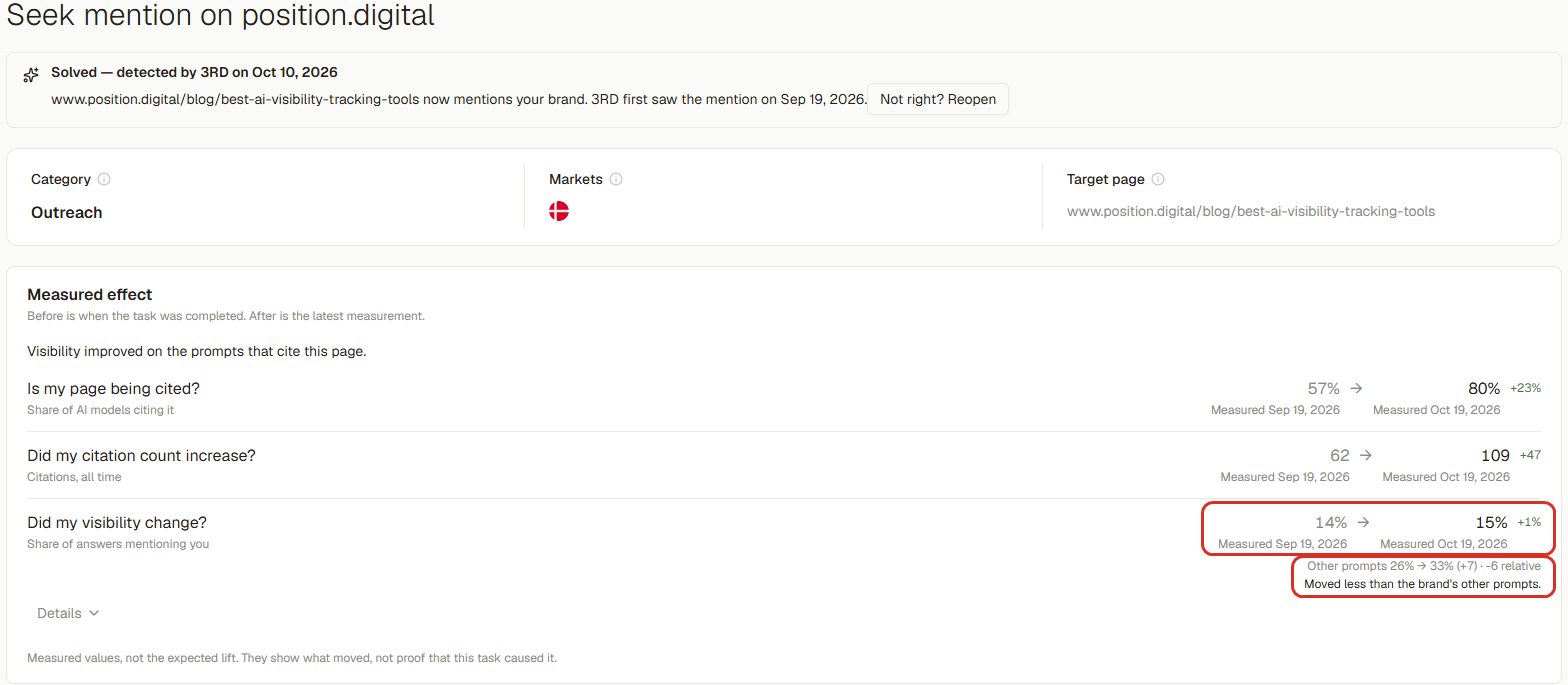
What we measured after one of our own outreach wins: more AI models cite the page, but visibility moved less than our other prompts. That's the honest reading, and it's the one your client should see.
Be careful with the before-and-after alone. Across 117 completed tasks we could read against a control, 29% moved up by more than 5 points relative to the control, 26% moved down and 44% stayed within 5 points. Tasks don't fail that often. Single readings are just that noisy. A report that only shows "before" and "after" will one day show a client a drop you didn't cause.
For deeper methods, see how to prove a GEO change moved AI visibility.
Delivering the work for many clients
This is the job that decides how far your team scales. For each client, someone has to turn "AI doesn't mention you" into briefs, pages, outreach and technical tickets.
Here's how that looks in 3RD, using our own brand as the example.
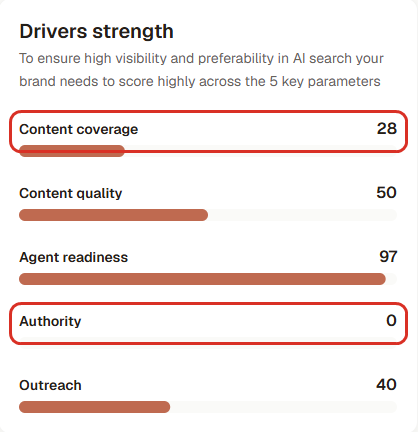
1. Diagnose why AI picks a competitor. Diagnostics explains the gap in plain language, per market.
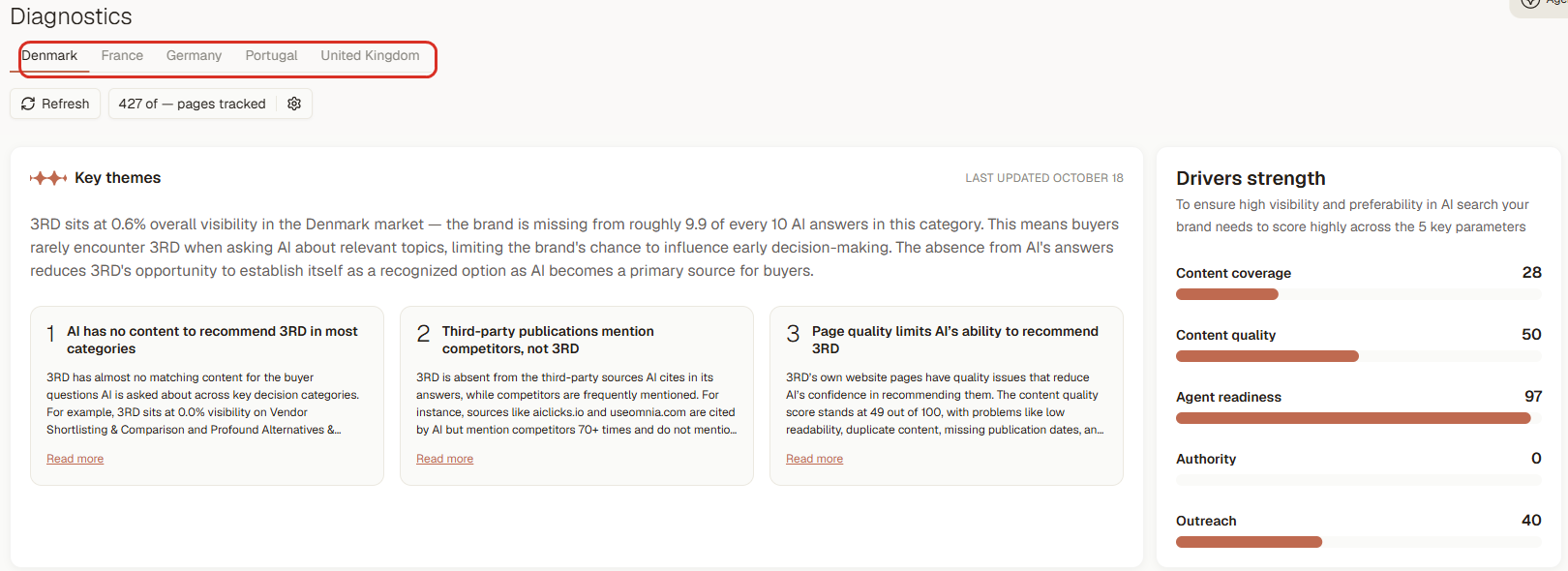
Our own Denmark diagnosis: no content for most buyer questions, and third-party pages name our competitors instead of us.
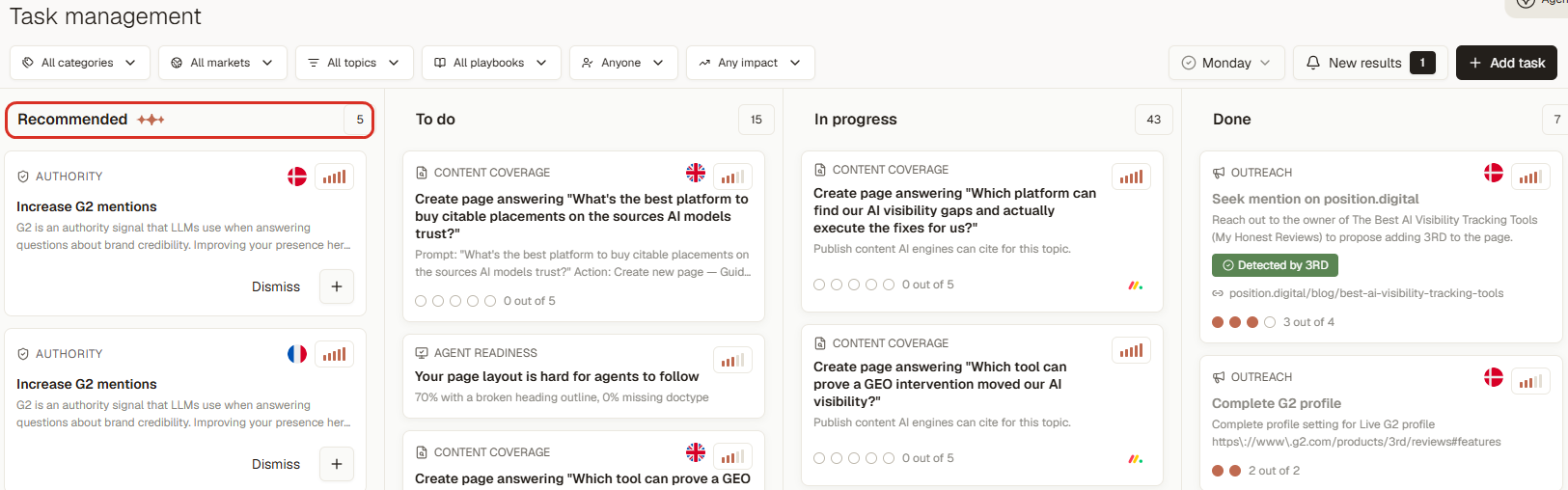
2. Turn it into a ranked board of tasks. Each card is tagged with the driver it moves.
The task board: recommended next, to do, in progress and done, each card tagged with the driver it moves.
3. Hand drafting to the agent, and keep the final call. Content tasks come with a checklist and a brief. "Create with agent" sends the draft to Content Agent; you edit, approve and publish, and the HubSpot connection sends it to the CMS.
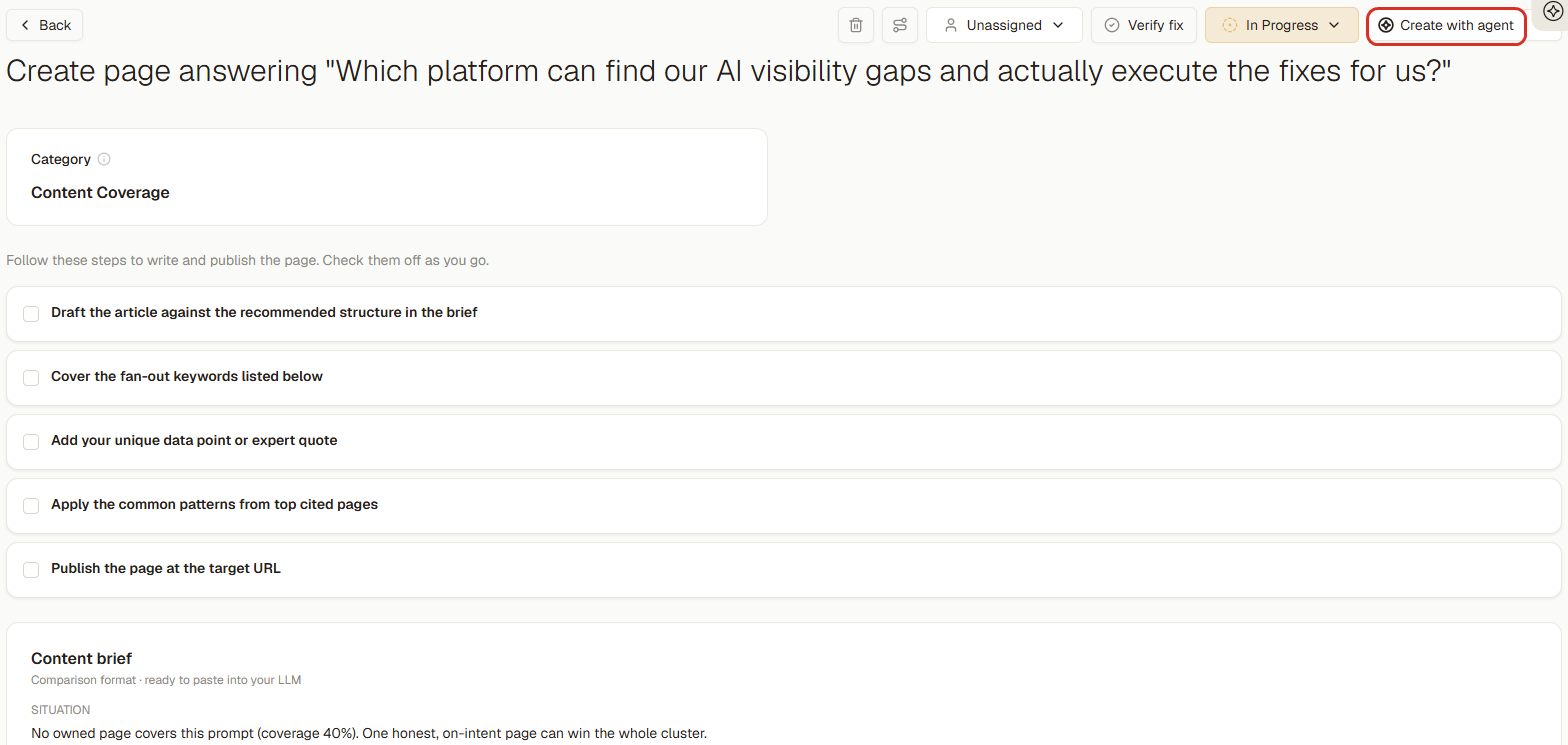
Every content task comes with a checklist, and "Create with agent" hands the draft to 3RD's Content Agent.
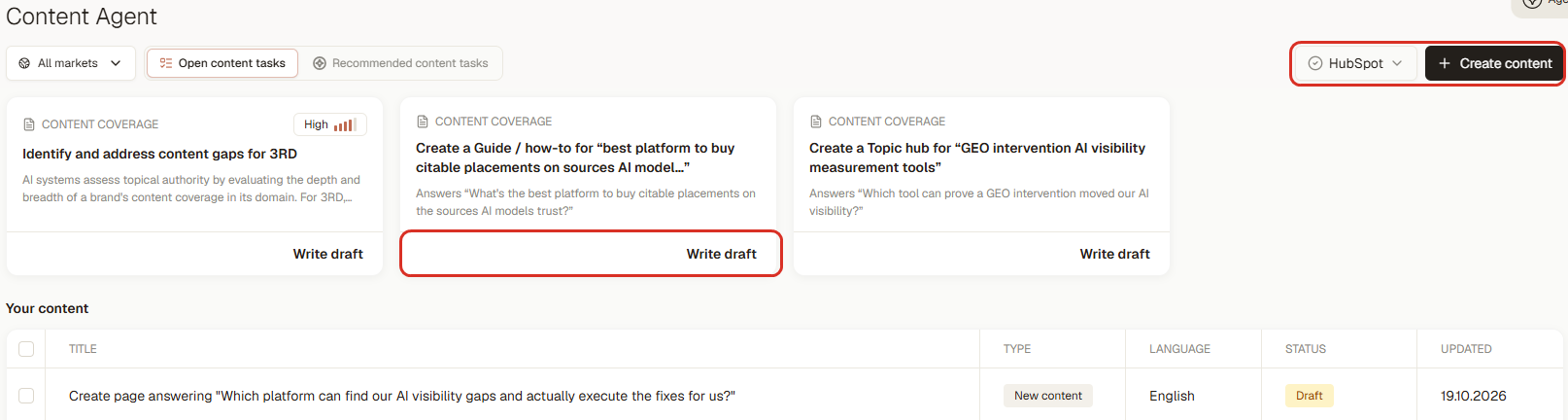
Content Agent drafts each page from its brief. Your team reviews it and publishes.
For an agency, that changes the unit of work. Your specialist reviews and decides instead of starting from a blank page. Publishing is still your team's call, which is what most clients want anyway.
Whatever platform you choose, test this part on a real client before you sign: can one person on your team ship the first five tasks for a client in a week?
When to choose which
|
Your agency |
Start with |
|---|---|
|
Sells AI visibility as its own service, content-led, clients with several markets or languages |
3RD |
|
Has AI visibility specialists who build their own workflows; enterprise clients that need SOC 2 |
Profound |
|
Analytics-first, runs the work itself, many small projects |
Peec AI |
|
Small agency, wants published pricing and a low entry point |
Otterly |
|
Wants agents to execute tasks and clients on live dashboards |
KIME |
|
Serves enterprise brands focused on how AI agents read the site |
Scrunch |
|
Wants vendor certification and referred leads |
AthenaHQ |
|
SEO shop that lives in Semrush and needs a first step |
Semrush AI Visibility Toolkit |
Whichever you shortlist, run the same pilot on two of them: one real client, the same 20 buyer questions, at least two models, two weeks. Then compare the hours it took your team to get from "here's your gap" to "here's what we shipped".
Where we are ourselves
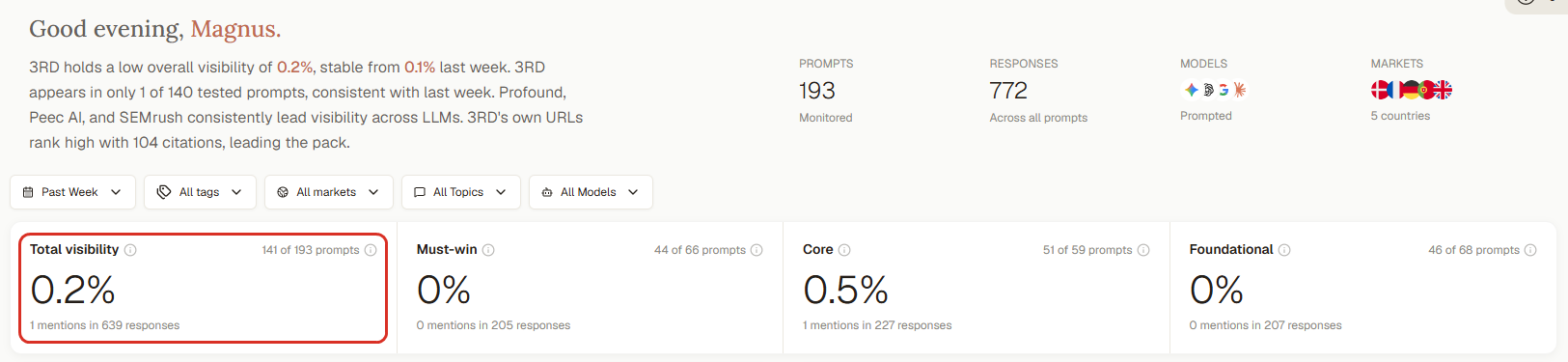
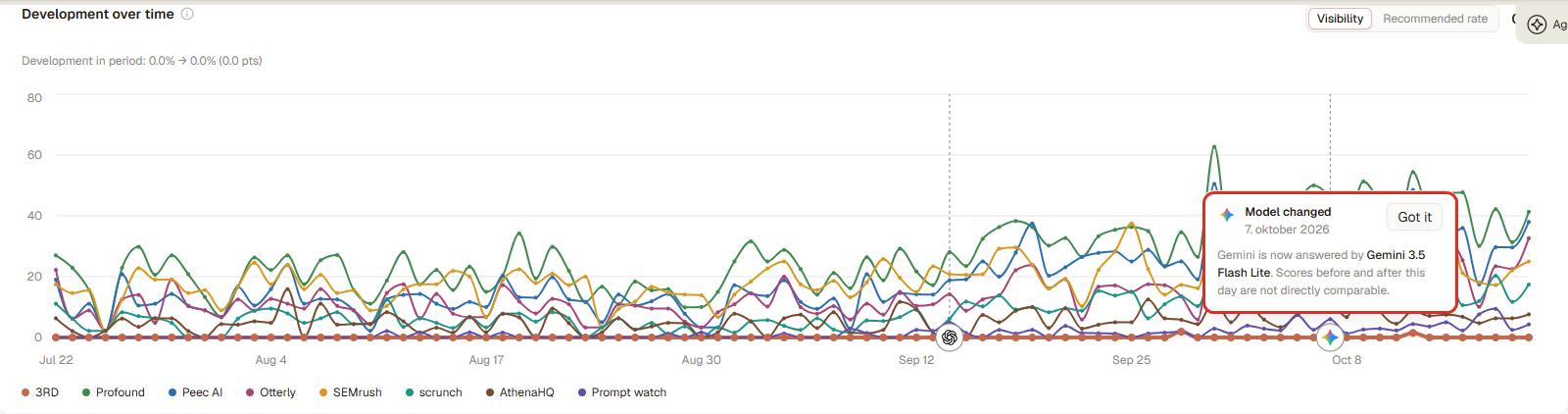
It would be odd to write this without saying where 3RD stands. In our own tracking of AI visibility platforms, we're ninth of fourteen. Profound, Peec AI and Otterly lead.
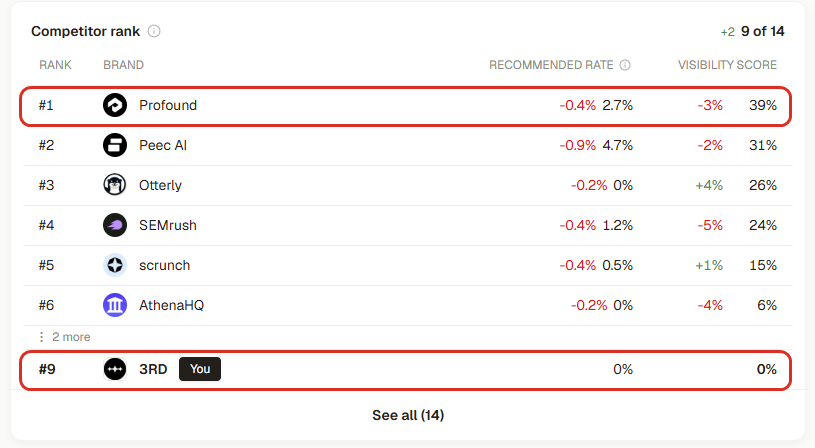
Where we stand against the tools buyers compare us with. Profound leads; we are ninth of fourteen.
We asked 3RD Agent what to fix first. Its answer: build the pages that answer the questions buyers ask. This guide is one of them.
About the data
The benchmarks in this guide come from brands tracked in 3RD between September 19 and October 18, 2026: 111 brands with a stable daily series (732,000 AI answers) for the variance figures, 60 brands for the model and recommendation figures, and 117 completed tasks with a control group. The sample comes from 51 customer organizations, including agencies, and leans toward the Nordics. All data is anonymized and aggregated; no brand is named.
FAQ
Which AI visibility platform is best for agencies managing many client brands? It depends on how you sell. 3RD fits agencies running AI visibility as its own service for complex clients. Profound fits specialist teams with enterprise clients. Peec AI and Otterly fit analytics-first agencies on a budget. All of them can run many client brands from one account.
Can I white-label an AI visibility platform? Mostly for reports, not the app. 3RD's Reports Studio and Otterly's Looker Studio reports carry your agency's branding, and KIME gives clients view-only dashboards. None of the vendors here publishes a fully white-labeled app.
How do agencies price AI visibility? As its own initiative with its own budget, not as a line on an SEO retainer. Model the platform cost per client brand, add delivery and reporting hours, and set your price on top. Ask each vendor for partner pricing per client.
How many prompts does a pitch need? More than most pitch workspaces give you. Small prompt sets swing about twice as much as large ones. Use a pitch to show a prospect's gap against competitors on at least two models, and save score promises for after a baseline.
Do I need a specialist to run AI visibility for clients? You need one owner who routes the work: content, outreach and technical tasks. In many agencies that's the content lead. A platform that drafts the work lets that owner carry more clients.
Want to see how a partnership works on one of your own clients? Talk to us about partnering, or start a 7-day trial on your own brand first.