
AI search
What is Generative Engine Optimization (GEO)? The complete guide
What GEO is, how AI assistants choose which brands to name, the five drivers you can work on, how to measure it, and a 30-day plan to start.

Contents
Generative engine optimization (GEO) is the work of getting your brand named, described correctly and cited when AI assistants such as ChatGPT, Gemini and Perplexity answer your buyers' questions.
A buyer asks ChatGPT which tool, supplier or brand to choose. The answer names three. If you're one of them, you're on the shortlist. If you're not, you never got the chance, and nothing in your analytics tells you it happened.
I'll start with our own number, because it's the honest way into this topic. As I write this, 3RD, a company that sells AI visibility software, is named in 0.2% of the AI answers to the 193 buyer questions we track. We're ninth of fourteen against the tools buyers compare us with.
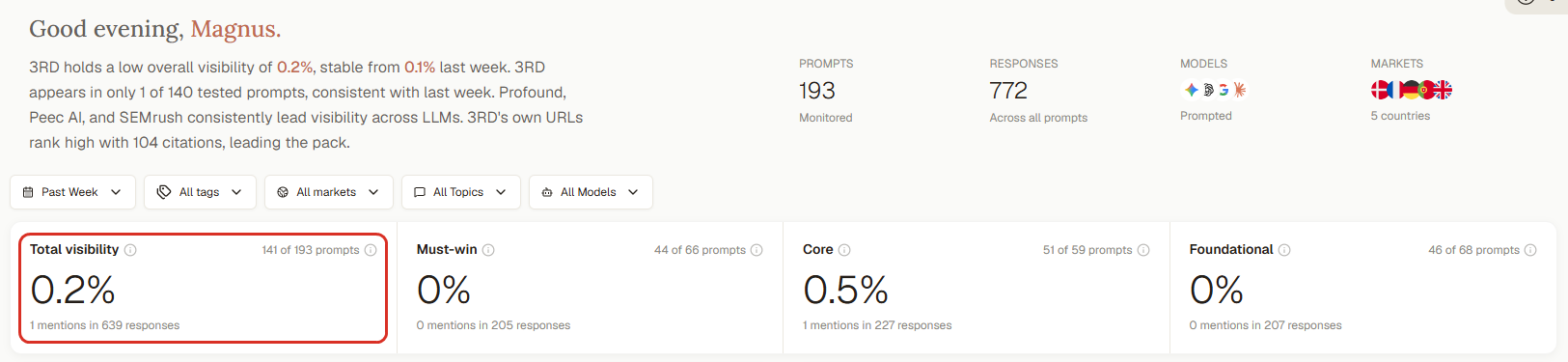
Our own starting point: 3RD at 0.2% visibility across 193 tracked buyer questions (week to October 19, 2026).
So this guide isn't written from a podium. It's the method we use on customer brands, and the one we're now running on ourselves. It explains what GEO is, how AI assistants decide which brands to name, what carries over from SEO and what doesn't, the five drivers you can work on, how to measure the result, and a 30-day plan to start. It also includes what we see across 111 brands tracked in 3RD. Each section links to a deeper guide when you want the full method.
Updated October 19, 2026.
The short answer
- What it is: GEO makes your brand part of the answer AI writes, not only a link on a results page. Some people call it AEO (answer engine optimization) or AI visibility. They mean the same goal.
- Why now: ChatGPT passed 900 million weekly users in February 2026 (OpenAI). Google reported more than 900 million monthly users for the Gemini app at I/O 2026, and AI Overviews reach more than 2 billion people a month. A growing share of shortlists now forms inside an answer.
- How AI picks: from what the model learned in training, plus the pages it searches and reads live when it answers. Your own pages, and third-party pages that mention you, both feed that.
- What you can work on: five drivers. Content coverage, content quality, agent readiness (formerly called crawlability), authority and outreach.
- How to measure it: run the questions your buyers ask across the AI assistants they use, every day, and track how often you're named (Visibility), how often your pages are cited (Citation Share) and how you're described (Sentiment).
What generative engine optimization means
Generative engine optimization (GEO) is the practice of making your brand easy for AI models to find, understand, trust and recommend, so they name you when they generate an answer.
The term comes from research. A 2023 paper from Princeton University and partners, presented at KDD 2024, defined GEO and tested which content changes made sources more visible in AI-generated answers. Adding citations, quotations and statistics improved visibility by up to 40% in their tests. The field has moved fast since then, but that finding still holds: specific, sourced, quotable content gets used.
You'll see three names for the same work:
|
Term |
Emphasis |
|---|---|
|
GEO (generative engine optimization) |
Being used and cited by generative AI |
|
AEO (answer engine optimization) |
Direct-answer surfaces such as AI Overviews and chat answers |
|
AI visibility |
The outcome you measure: how often AI names your brand |
The name matters less than the job. When a buyer asks an AI assistant about your category, you want to be in the answer, described the way you'd describe yourself, with your own pages as the source.
Why GEO matters now
Search isn't dead. Google still handles most queries. But the moment a buyer forms a shortlist has moved for a large share of people.
- The tools are mainstream. ChatGPT, Gemini, Google AI Overviews, Perplexity, Claude, Copilot and Grok are where many buyers now research, compare and decide.
- The answer replaces the list. A results page shows ten links and lets the buyer choose. An AI answer chooses for them and names a few brands.
- There's no ranking to check. You can't open a report and see position 4. Answers change from run to run and differ by model, market and language. Without measurement, you're guessing.
- The click often never comes. Many buyers act on the answer itself. They remember the names and type one into Google later, so your analytics credit "direct" or "branded search". We cover what you can and can't measure in how to connect AI recommendations and citations to revenue.
That last point is why GEO feels urgent once a team sees it. The buyer was influenced, and none of your existing reports show it.
GEO vs SEO: what carries over and what doesn't
GEO doesn't replace SEO. Most AI assistants run live web searches when they answer, so pages that rank and load well still feed AI answers. But the goal and the unit of success differ.
|
|
SEO |
GEO |
|---|---|---|
|
Goal |
Rank a page in a list of links |
Be named and cited inside one written answer |
|
Unit of success |
Position on the results page |
Presence, accuracy and prominence in the answer |
|
What the engine does |
Indexes and ranks pages |
Searches, reads, extracts and rewrites across sources |
|
Main metric |
Rankings, clicks |
Visibility, citation share, sentiment, position |
|
Who you compete with |
Pages for one keyword |
Every source the model reads for one question |
|
Stability |
Rankings move slowly |
Answers vary from run to run |
What carries over from SEO: crawlable pages, clear structure, fast load times, structured data, and a reputation built on other sites. If AI can't reach or read your page, nothing else matters.
What's different:
- Ranking first on Google doesn't guarantee a mention. AI combines many sources and names brands, not pages.
- Third-party pages carry more weight. Comparison lists, reviews, forums and press often decide who gets named. Much of the citation pool for a category sits on sites you don't own.
- Questions replace keywords. Buyers ask full questions ("which platform should a 50-person team in Denmark choose?"), and models break them into several searches behind the scenes.
- Language and market matter more. The same question in Danish and in English can get different answers, from different sources.
How AI assistants decide which brands to name
Understanding the mechanism tells you where to work.
Two sources of knowledge
- Training data. What the model learned before its cutoff date. This shapes what it "knows" about your brand and category: who you are, what you sell, who you compete with. It changes slowly, with each new model version.
- Live retrieval. When a question needs current information, the model searches the web, reads a set of pages and writes the answer from them. This is often called retrieval-augmented generation. It changes daily, and it's where most GEO work pays off fastest.
Fan-out queries
A model rarely searches for the buyer's exact question. It breaks it into several smaller searches, called fan-out queries. "Best CRM for a small agency" might become "CRM pricing small teams", "CRM agency features" and "CRM reviews 2026". The pages that answer those smaller searches are the ones the model reads. We explain this in more depth in the searches you never see.
Mentions vs citations
Two different things can happen in an answer:
- A mention: the model names your brand.
- A citation: the model links to a page as a source.
You can be mentioned without being cited, because another site's page said it. You can be cited without being recommended. Both matter, and they need different fixes. A mention gap on a question where your own page is missing is a content problem. A gap where a third-party list leaves you out is an outreach problem. AI cites pages, not websites: see why AI cites pages, not websites.
Here's what that looks like for us. These are the pages AI cites most for our category. Two of the lists that ChatGPT and Google's AI read again and again name our competitors and not us. One list, where we did outreach, now mentions us.
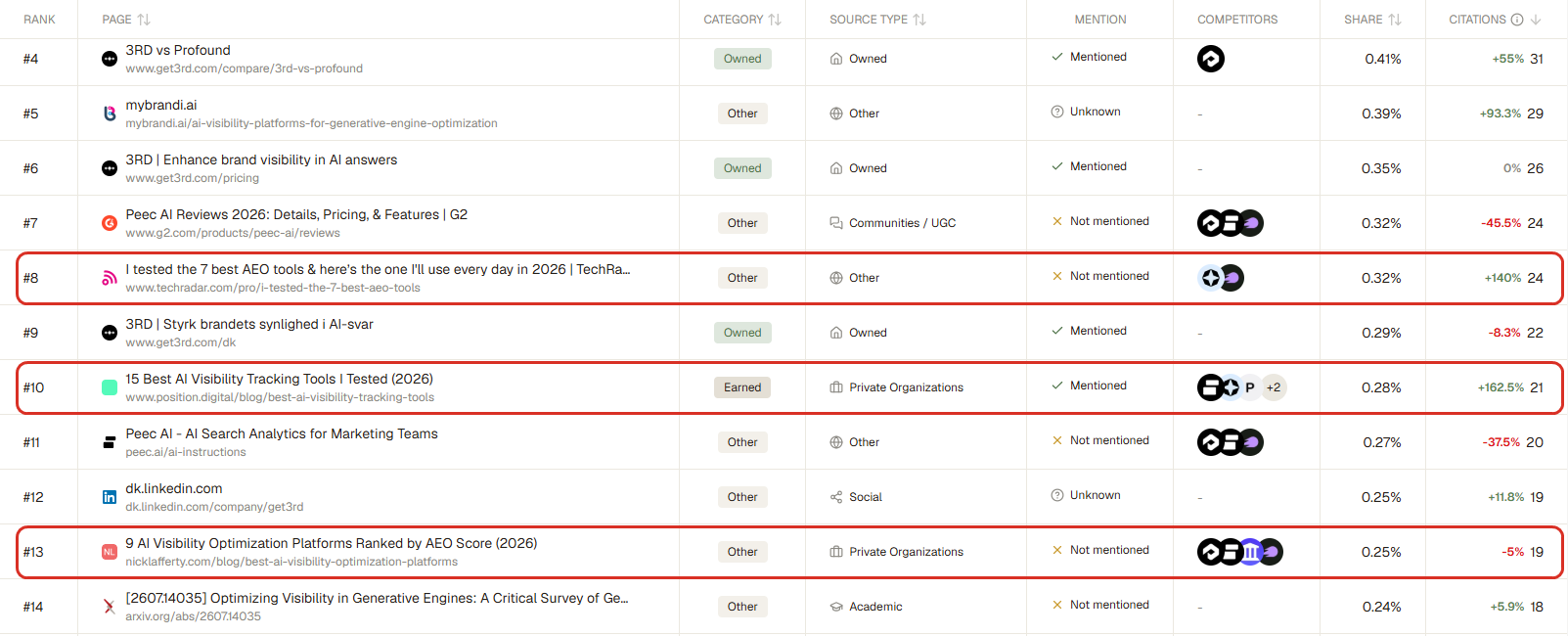
The pages AI cites for our category. The red boxes mark two lists that name our competitors but not us, and one where we earned a mention.
What makes a page worth citing
Pages that get used share a few traits:
|
Signal |
Why it helps |
|---|---|
|
Definitive statements |
Models prefer clear, quotable claims ("it costs €99 a month") over vague marketing copy |
|
Key information first |
Models weight what comes first; a buried answer gets missed |
|
Question-and-answer structure |
It maps directly onto how buyers ask |
|
Lists, tables and FAQs |
The easiest formats for a model to lift into an answer |
|
Sources, numbers and quotes |
The original GEO research found these raise visibility the most |
|
Freshness |
Current, dated information beats a page nobody has updated since 2024 |
In 3RD, these patterns become the brief for each page you need to write. This is the brief behind the page answering "Which platform can find our AI visibility gaps and actually execute the fixes for us?":
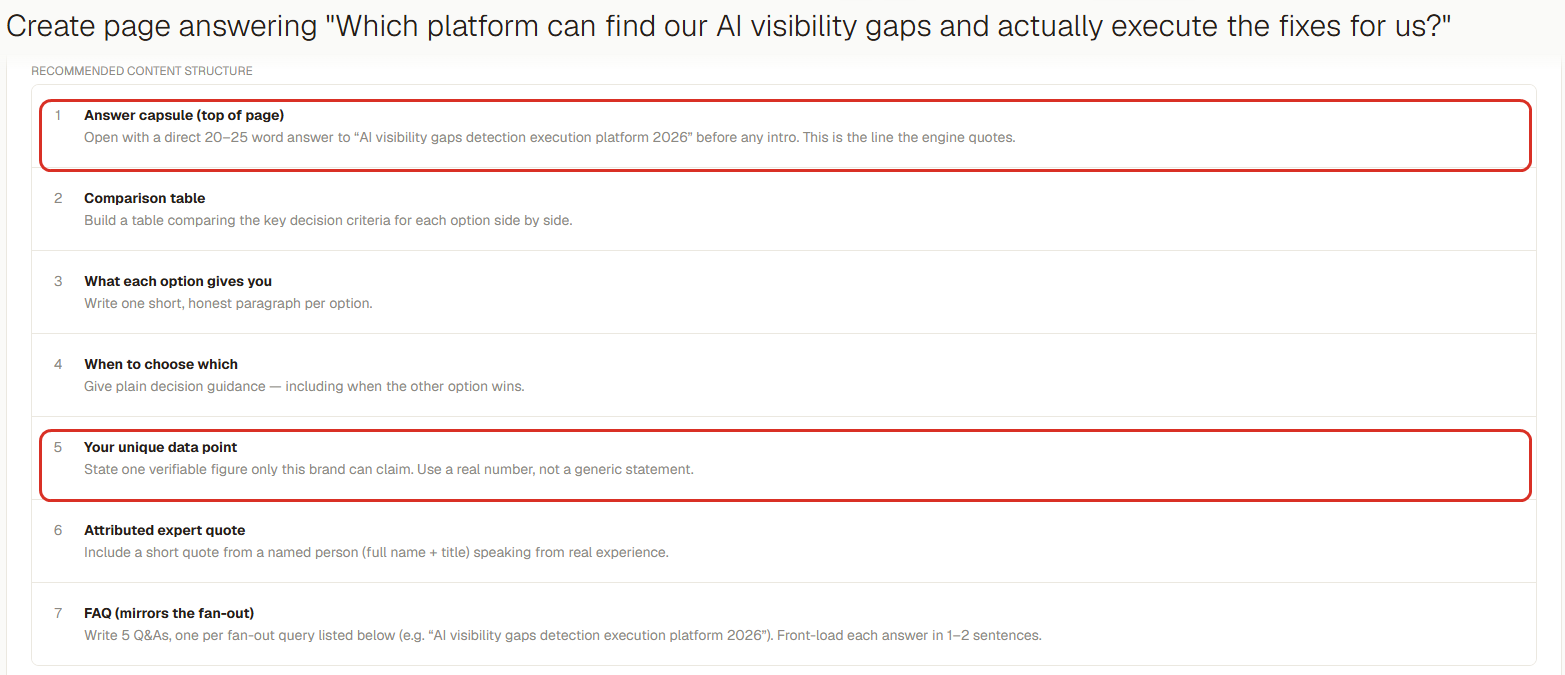
A content brief in 3RD: the structure the pages AI already cites have in common.
What we see across 111 brands
Most GEO advice is based on a handful of examples. Here's what the data looks like at scale. We analyzed 111 customer brands tracked in 3RD between September 19 and October 18, 2026: more than 18,000 prompts and 732,000 AI answers, plus 5.9 million source citations for 100 of those brands. The full method is at the end of this section, and the complete study is in The state of AI visibility, Q4 2026.
1. Your visibility number moves on its own. The median brand's daily visibility swung 12.5 points between its best and worst day in a single month, with no change to its prompts. For 7 in 10 brands, at least one day was more than 5 points away from the brand's 30-day average. A single check tells you very little.
2. Each AI assistant tells a different story. For 62% of brands (37 of 60), a different brand led on visibility depending on which assistant we looked at. Inside one brand, the best and worst assistant were a median 16 points apart.
3. AI rarely cites your own website. For the median brand, its own domains made up 6.8% of the sources AI cited in its category's answers (n = 100). The other 93% were third-party pages. Only 3 of 100 brands had more than 20% owned citations.
4. Competitors' sites can out-cite yours. For 41 of 100 brands, AI cited competitors' websites more often than the brand's own. Reddit was a cited source for 85 of 100 brands, but it took a median of just 1.1% of a brand's citations. Most citations go to a long tail of niche sites: trade bodies, associations, specialist blogs and directories.
5. Technical access is rarely what holds a brand back. The median crawlability score was 99 out of 100 (n = 57). Authority or content quality was the weakest driver for 42 of 54 brands. Crawlability was the weakest for none.
6. Being named isn't being recommended. The median brand was mentioned in 19.8% of AI answers but recommended over the alternatives in 0.2% (n = 60 brands, 494,000 answers). A quarter of brands (15 of 60) were never recommended in the month, even though AI mentioned them.
What this means in practice:
|
Finding |
What to do about it |
|---|---|
|
Visibility swings 12.5 points a month on its own |
Track daily and compare equal windows, never two single checks |
|
Assistants disagree for 62% of brands |
Track the assistants your buyers use, one by one |
|
93% of citations are third-party |
Plan outreach from day one, not only content |
|
Authority and content quality are the usual bottlenecks |
Check crawlability once, then spend your time on the other drivers |
|
Mentions outnumber recommendations by about 65 to 1 |
Say clearly who you're the best choice for, with proof |
About the data: 111 customer brands tracked in 3RD, 19 Sep – 18 Oct 2026, anonymized and aggregated, with no brand, domain or prompt named. Brands with a stable daily series and at least 1% mean visibility were included in the variance analysis. The deeper checks (models, recommendations, drivers) use 60 brands, at most three per customer organization. The sample leans toward the Nordics, and some brands are tracked by agencies. These are observational data, not controlled experiments. Each finding gives its own n.
The five drivers of AI visibility
3RD groups everything that moves AI visibility into five drivers. Each one has a different owner and a different fix.
|
Driver |
The question it answers |
Typical fix |
Usually owned by |
|---|---|---|---|
|
Content coverage |
Do you have a page that answers this question? |
Write the missing page |
Content team |
|
Content quality |
Can AI extract and quote the page you have? |
Restructure: answer first, Q&A, tables, specifics |
Content team |
|
Agent readiness (formerly crawlability) |
Can AI reach, recognise and read your site? |
Unblock crawlers, fix rendering, add structured data |
Web or dev team |
|
Authority |
Does the wider web talk about you in ways AI trusts? |
Reviews, press, profiles, consistent facts |
Brand, PR |
|
Outreach |
Are you on the third-party pages AI cites for your category? |
Get featured on the lists and reviews models already use |
PR, partnerships |
Two practical consequences:
- One earned page can move many answers. AI draws on a concentrated set of trusted sources per category. Getting onto one page that's cited across dozens of your most valuable questions influences every answer built from it.
- Don't aim for 100% of citations on your own site. Healthy AI visibility needs both your own pages and independent ones that back you up. If only your own site vouches for you, that's a warning sign.
Our own scores show the pattern from the data above. Agent readiness is fine. Authority is zero, and content coverage is low, because until this month we had almost no pages answering the questions buyers ask.
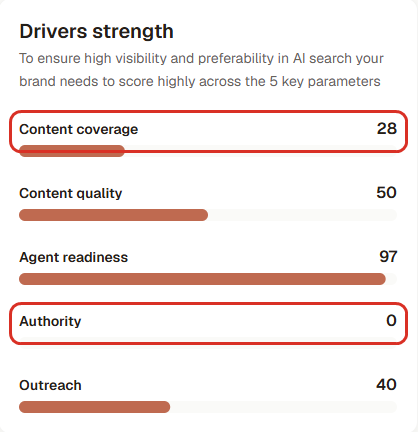
Our five drivers in Denmark. Agent readiness is fine. Authority (0) and content coverage (28) hold us back.
When AI does describe us, the negative phrases it uses are "limited public evidence" and "not established by the sources reviewed". That's an authority problem, not a product problem: few independent sources vouch for us yet.
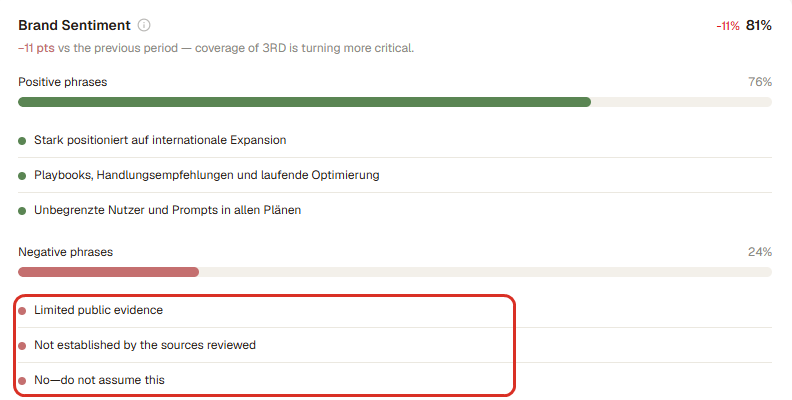
When AI describes us, the negatives are about missing evidence, not about the product.
A high agent-readiness score doesn't mean there's nothing to fix. Our own report flags a robots.txt on our trust center that tells automated visitors to stay away, and no Organization schema telling agents who we are. Both are on our list.
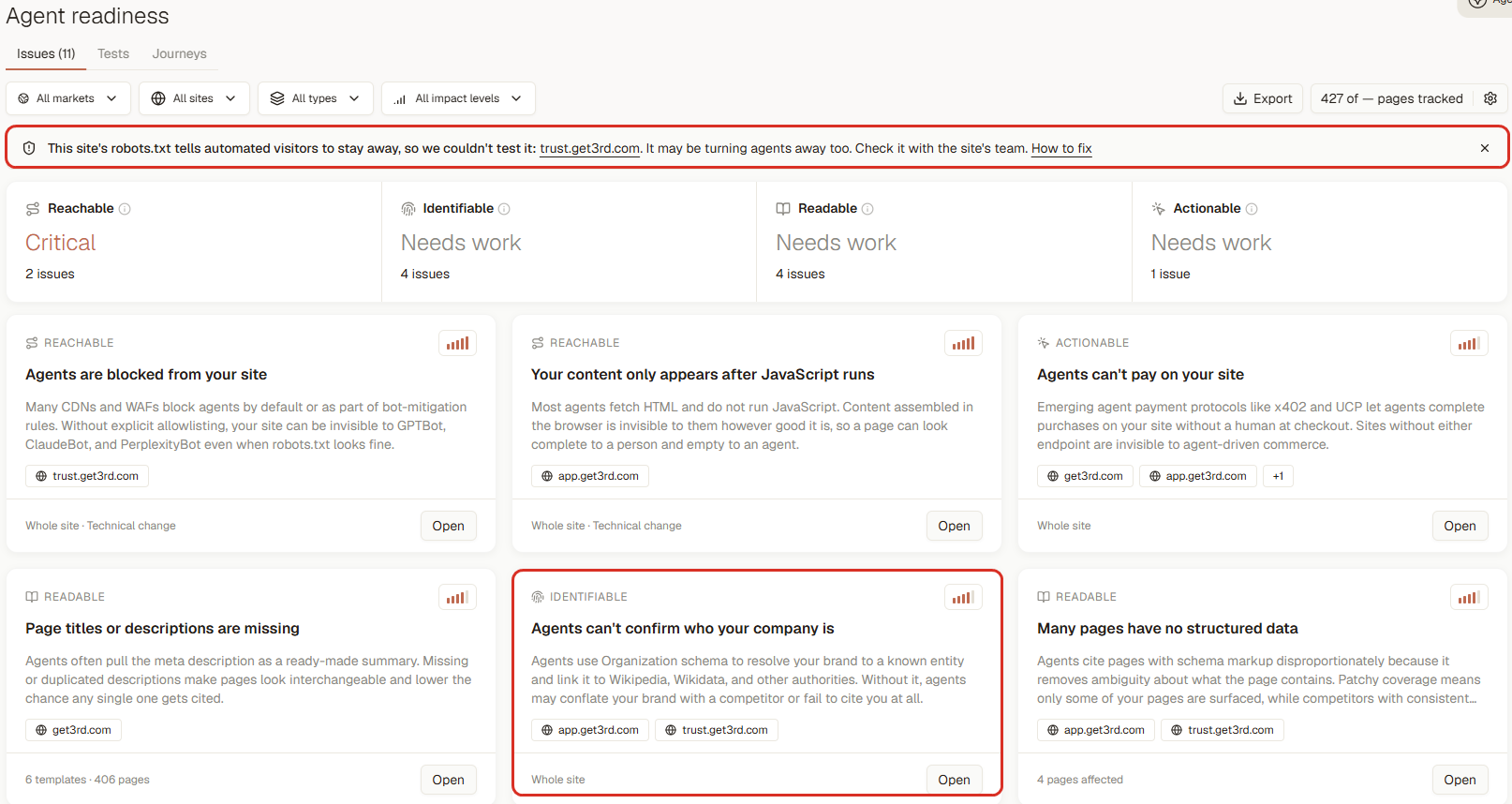
Our own agent-readiness report. Even an AI visibility company has fixes to make.
For the technical driver, start with crawlability and AI crawlers and JSON-LD schema explained.
How to measure GEO
You can't improve what you only check by hand now and then. A useful measurement setup has four parts.
1. The questions your buyers ask
Write the questions the way a buyer types them into an AI assistant. Group them into topics, and sort them by commercial value. 3RD uses three tiers:
|
Prompt type |
What it covers |
Recommended visibility target |
|---|---|---|
|
Must-Win |
Questions closest to a decision, where market share shifts ("which platform should we choose?") |
75% |
|
Core |
Questions that shape preferences and shortlists |
50% |
|
Foundational |
Broad research that builds AI's understanding of your category |
35% |
A strong overall score driven by Foundational questions while Must-Win lags is a warning, not a win.
2. The assistants, markets and languages that matter
Track the AI assistants your buyers use, in each country and language you sell in. Denmark in Danish and Denmark in English are two different markets, because AI answers each language differently.
3. Enough runs to see the pattern
AI models are probabilistic. The same question can get a different answer tomorrow. Run each question on a schedule, every day, and read the trend, not one answer.
This is 90 days of daily visibility for us and seven competitors. The competitors swing 10 to 20 points from day to day. On October 7, Google switched the model behind Gemini, and 3RD marks that day, because scores before and after it aren't directly comparable.
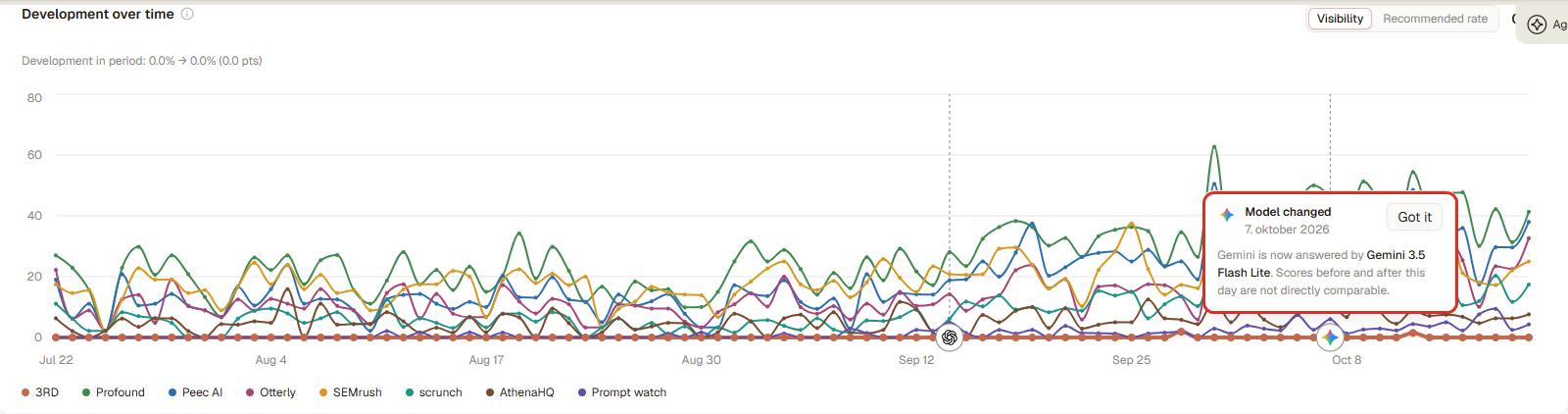
Ninety days of daily visibility. Competitor scores swing 10–20 points a day, and a model change on October 7 breaks the series.
Rule of thumb: the fewer questions you track, the noisier the reading. In our data, brands with under about 100 AI answers a day swung twice as much as brands with 230 or more (median standard deviation 4.5 vs 2.1 points).
4. The metrics
|
Metric |
The question it answers |
|---|---|
|
Visibility |
What share of AI answers name your brand? |
|
Citation Share |
How often do AI answers cite your own pages as sources? |
|
Sentiment |
Does AI describe you positively, neutrally or negatively? |
|
Position |
Where in the answer do you appear, compared with competitors? |
|
Rank |
Where do you stand against tracked competitors ("3 of 8")? |
For a step-by-step method you can run yourself, see how to measure your brand's visibility in ChatGPT, Perplexity and Google AI Overviews. For definitions of every term, see the GEO glossary and the 15 metrics behind your dashboard.
A 30-day plan to start
You don't need a specialist to begin. You need one goal and a weekly rhythm.
Week 1: set the baseline.
- Write 20–40 buyer questions for your most important market. Mark the 5–10 closest to a purchase as Must-Win.
- Name five competitors: the brands you lose deals to, not only the biggest.
- Run the questions across the AI assistants your buyers use for at least a week before you change anything.
Week 2: find the causes.
- For each Must-Win question where you're missing, write down who gets named instead and which pages the answer cites.
- Sort each gap by driver. No page? Coverage. A page that never gets cited? Quality. Blocked or slow site? Agent readiness. A third-party list that leaves you out? Outreach.
Week 3: ship the first fixes.
- Write or rewrite the one or two pages that answer your highest-value missing questions. Put the answer in the first two sentences.
- Check that AI crawlers can reach those pages.
- Contact the one third-party page cited most often for your Must-Win questions.
Week 4: measure and repeat.
- Compare the questions you worked on with the ones you didn't touch, over equal windows.
- Keep what moved, and pick the next three to five tasks.
The full method, with a scoring formula and task template, is in how to turn AI visibility data into a prioritized weekly task plan. To tell a real lift from noise, see how to prove a GEO change actually moved your AI visibility.
Common mistakes
- Checking ChatGPT by hand and calling it a baseline. One answer is a sample of one. It will be different tomorrow.
- Tracking only branded questions. "Is Acme good?" will name you. "Which tool should we choose?" decides the shortlist.
- Treating GEO as more content. Ten new blog posts won't help if the real gap is a third-party list or a blocked crawler.
- One market for a multi-market brand. Visibility in English says little about Danish or French answers.
- Writing for keywords instead of questions. Answer the full question, and the follow-ups a buyer asks next.
- Never updating. Pages you publish and forget lose ground to newer ones.
Which platforms help with GEO
You can start with a spreadsheet and manual checks. Most teams outgrow that within weeks, because the number of questions × assistants × markets × daily runs gets large fast.
The platforms on the market fall into three groups:
|
Type |
What it does |
Examples (as of October 2026) |
|---|---|---|
|
Monitoring |
Tracks mentions, citations and sentiment across AI assistants |
Peec AI, Otterly, Semrush AI Visibility Toolkit |
|
Monitoring plus recommendations |
Adds audits and suggested actions |
Scrunch, AthenaHQ |
|
Monitoring, diagnosis and execution |
Explains why AI picks a competitor and drafts or carries out the work |
Profound, KIME, 3RD |
The differences that matter: how answers are collected, which assistants and markets are covered, whether the platform explains why you lose, and who does the work after the diagnosis. We compare eight platforms on their public facts in how to choose an AI visibility platform, and look at which ones do the work in AI visibility platforms that do the work, not just monitor it. If you're evaluating Profound specifically, see Profound alternatives in 2026.
Where 3RD fits
Most AI visibility tools stop at a score. 3RD is built around three steps: Track → Diagnose → Act.
- Track. 3RD runs your buyer questions across the AI assistants you choose, every day, in each market. A market is one country in one language, so a brand selling in Denmark, France and Germany sees each one separately.
- Diagnose. Diagnostics explains why AI chooses a competitor, with evidence from real answers: a missing page, a weak one, a source that features your competitor and not you, or a technical block.
- Act. Playbooks turn the diagnosis into a prioritized plan toward a goal you set. You open 3RD Agent and ask what to focus on. It tells you what needs doing, and when you ask, it drafts the work: content briefs, pages in your brand voice, outreach. You check it and publish. 3RD doesn't publish anything on its own.
We asked 3RD Agent the question this guide is about: what should we fix first to get chosen when buyers ask AI which platform to use? Its first answer was to build the pages that answer buyer questions, because we had almost none. This guide, and the articles it links to, are that work.
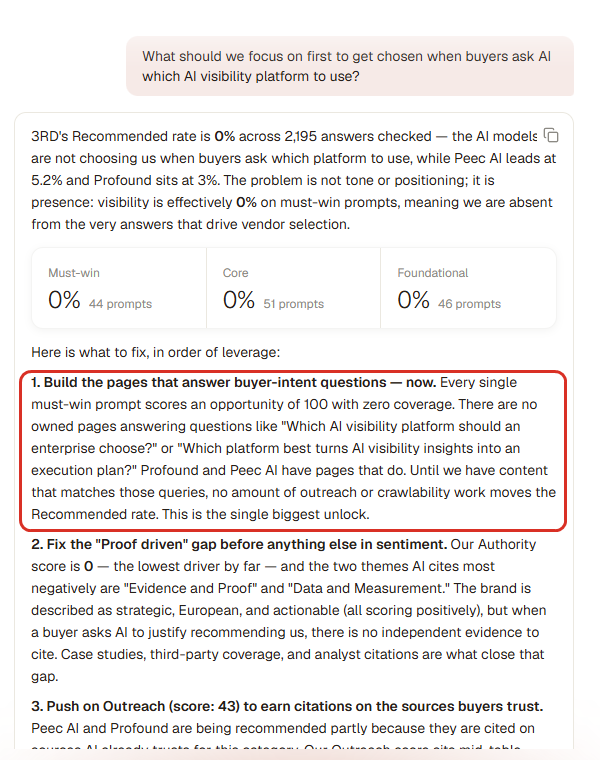
We asked 3RD Agent what to fix first. Its answer: build the pages that answer buyer questions.
3RD is built in Europe for brands that sell across European markets and languages. Data is hosted in the EU. The limits are worth knowing: there's no SOC 2 or ISO 27001 certification yet (controls follow both frameworks), and SAML single sign-on is set up for Enterprise customers by agreement.
The frameworks in this guide, the five drivers and the Must-Win, Core and Foundational tiers with their targets, are the ones 3RD uses in the product and documents openly at docs.get3rd.com.
What's next for GEO
Three shifts are already under way:
- Paid placements in AI answers. Ads have started appearing in AI assistants. They don't replace earned visibility, but they change the economics. See paid AI visibility in 2026: what you can buy in AI answers, and what you can't.
- AI agents that buy. Assistants are moving from recommending a product to completing the purchase. Clean product data and agent-readable sites become the new shelf. See AI assistants are starting to buy for your customers.
- More assistants, more markets. Every new model and every new language is another place the shortlist forms. Coverage across them matters more each quarter.
The brands that grow will be the ones AI names, trusts and recommends at the moment it writes the answer. The earlier you measure, the earlier you can change it.
FAQ
What is the difference between GEO and SEO? SEO aims to rank a page in a list of links. GEO aims to get your brand named and cited inside an AI-written answer. They overlap, because AI assistants search the web, but ranking first on Google doesn't guarantee a mention in ChatGPT.
Is GEO the same as AEO? Yes, in practice. AEO (answer engine optimization) emphasizes direct-answer surfaces such as Google AI Overviews. GEO covers all generative AI answers. Both describe the same goal: being the source and the brand the model chooses.
How long does GEO take to show results? Changes that AI finds through live search can show up within days to weeks. Changes to what models learned in training take longer, because they depend on new model versions. Measure on trends over equal windows, not single answers.
Can a small brand win in GEO? Yes. AI assistants weigh specific, useful, well-structured pages and trusted third-party mentions, not only domain size. A smaller brand with the clearest answer to a buyer's question can be named ahead of a bigger one. In our data, most citations go to a long tail of niche sites, not to a few giants.
Which tools can I use to increase my visibility across LLMs? You need two things: measurement across the assistants your buyers use, and a way to act on the gaps. Platforms such as Profound, Peec AI, Otterly, Semrush, Scrunch, AthenaHQ, KIME and 3RD cover these to different degrees. Our buyer's checklist compares them.
Next step
Write down the ten questions your buyers would ask an AI assistant before choosing you, and see who gets named today. Start a free 7-day trial of 3RD to run them across ChatGPT, Gemini, Perplexity and the other assistants in each of your markets, or see how 3RD works.